
Symbolic Play Activities: 15 Age-by-Age Ideas with Everyday Materials

The most effective symbolic play activities turn everyday objects into something else: a cardboard box becomes a kitchen, a scarf becomes a cape, a wooden spoon becomes a telephone. This article gathers 15 ideas sorted by age, plus the materials that work, the types that exist, what each round develops, and the mistake that most often holds play back. Start today with what you already have at home.
- In short
- What does symbolic play actually build?
- What is symbolic play, and what does it look like?
- What are the types of symbolic play?
- What does Piaget say about pretend play?
- What to play with: open-ended toys and materials for pretend play
- 15 symbolic play activities, sorted by age
- A common mistake, and how to fix it
- Frequently asked questions
In short
- Two or three everyday objects (a box, a scarf, a wooden spoon) give you 20-30 minutes of play from 18 months on.
- Pretend play trains language, executive function, theory of mind and emotional regulation, plus fine motor skills.
- Several types exist (object substitution, role play, imaginative story play, social play and dual-function play) and they change a lot between ages 2 and 6.
- The most common mistake is directing the play. It works better to narrate what the child is doing, add one detail, then step back.

What does symbolic play actually build?
Symbolic play builds language, executive function, theory of mind, emotional regulation and fine motor skills. The child holds a make-believe fiction (“this is dinner”), remembers invented rules, negotiates with others and rehearses characters who are different from themselves. All of that happens at once, without anyone giving instructions. Well-designed symbolic play activities multiply that effect because they add structure without taking control away from the child.
In practice, if your 4-year-old makes “soup” out of sand, leaves and stones, they are sorting, measuring, naming ingredients and telling a story. That is maths, vocabulary and narrative in a single session. What’s more, child development research collected by the American Academy of Pediatrics shows that free play with open-ended materials sustains attention and creativity better than adult-directed activities.

What is symbolic play, and what does it look like?
Symbolic (or pretend) play is when a child uses an object, an action or a situation to represent something it is not. A cardboard box becomes a car, a bucket becomes a hat, the sofa becomes a cave. Montessori materials work with reality; pretend play works with fiction. A healthy child needs both.
Simple examples: feeding a doll with a wooden spoon, hanging baby clothes on a pretend washing line, going to the supermarket with a cloth bag and empty tins, or serving an imaginary sandwich from a toy box. The rule is always the same: the child decides what each object represents, and you accept their version without correcting it.

What are the types of symbolic play?
There are five types of pretend play: object substitution, roles and characters, story-based imaginative play, social play (with other children), and dual-function play. They all overlap in a single afternoon and do not need to appear in any fixed order.
Object substitution comes first: a stick is a horse. Role play arrives around age 3, when the child takes on characters (“now I’m the doctor”). Story-based play involves a plot sustained for several minutes. Social play requires negotiating and taking turns. Dual-function play combines two uses at once, for example, a chair that is both a car and a bench.
Example: one afternoon with all five types
Imagine your 3-year-old grabs a cardboard box. First they drag it around like a car (substitution). Then they announce it is a bakery (role). Next they ask you to come along and buy bread (story). They invite their sister and hand out turns as the cashier (social). And finally they tuck their doll inside, who rides along while they “sell” (dual function). All from one single object.
What does Piaget say about pretend play?
According to Piaget, symbolic play is the play typical of the preoperational stage, between ages 2 and 6 or 7. The child uses signs to represent reality in its absence: an empty plate can be dinner. The Association Montessori Internationale described the same period from a different angle, but agrees that symbolic representation is the great cognitive achievement of these years.
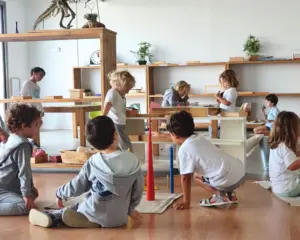
Maria Montessori also warned that a child needs real work before fantasy imposed from outside. That is why in the Casa de Niños classroom (ages 3-6), practical-life and sensorial materials sit alongside a corner of free pretend play: the child chooses, and the fiction grows out of them.
What to play with: open-ended toys and materials for pretend play
The best toys for symbolic play are open-ended materials, the kind that can be many things and don’t do the playing for the child. The golden rule is simple: if the toy talks, sings or moves by itself, the child is already being handed a script. If it is silent, they have to invent it.
These five groups cover almost everything:
- Textiles: scarves, small pieces of fabric, cloth bags, hats and old socks.
- Containers: cardboard boxes, clean tins, wooden bowls, bags and suitcases.
- Pretend table settings: wooden or metal play dishes, spoons, napkins, an apron.
- Nature: pinecones, shells, leaves, stones, sand, short twigs.
- Miniature real life: dolls, sturdy plastic animals, cloth nappies, play tools.
It’s also worth checking the Spanish Paediatric Association, which stresses buying simple, safe toys suited to the child’s age with no small dangerous parts. For families relocating to the Campo de Gibraltar or the Costa del Sol, this list fits in a single box and travels well.
15 symbolic play activities, sorted by age
Ages 18 months to 2 years
- Pretend kitchen: feed a teddy bear with a wooden spoon and a small plate.
- Play laundry line: peg scarves up with wooden clothespins.
- Shopping bag: put empty tins and cardboard boxes in and take them out.
- The imaginary telephone: talk into a small object and pass the turn to someone else.
Ages 3 to 5 years
- Cardboard bakery: bake imaginary bread and sell it with play coins.
- Doctor: put an imaginary bandage on an injured doll.
- Living-room camping: a blanket over two chairs becomes a tent.
- Hair salon: comb with a comb and imaginary water, taking turns.
- Village market: sort play fruit by colour and size.
Ages 6 to 9 years
- Shadow theatre: a bedsheet and a light project stories.
- Travel agency: suitcase, imaginary passport and a hand-drawn map.
- Restaurant with a menu: write the menu and split the waiter and customer roles.
Whole-family games
- Sofa cinema: turn the living room into a cinema with handmade tickets.
- Post office: write postcards and deliver them around the house.
- Explorers: invent an expedition with a toy compass and a field notebook.
A common mistake, and how to fix it
The most frequent mistake is directing the pretend play: “no, that isn’t a kitchen, it’s a car” or “now you have to say you’re the doctor.” The child then drops out, because the fiction stops being theirs. It usually happens when the adult wants the activity to produce a visible result (a photo, something “finished”).
The fix is simple. First, describe what you see (“you’ve made a huge kitchen”). Second, add one single element and hand it over (“would the baker like a bag for the bread?”). Third, go back to your own task and let them decide. That way the play lasts longer, and you’re not the director, you’re their playmate.
Frequently asked questions
What does symbolic play build?
Pretend play builds language, executive function, theory of mind, emotional regulation and fine motor skills. The child holds a make-believe fiction, remembers invented rules, negotiates with others and rehearses characters different from themselves, all within a single round. It also strengthens concentration and the ability to solve problems independently.
What is symbolic play, and what are some examples?
It is play in which a child uses an object, an action or a situation to represent something it is not, like turning a cardboard box into a car or the sofa into a cave. Examples: feeding a doll with a wooden spoon, hanging imaginary washing, or going to the supermarket with empty tins.
What are the types of symbolic play?
The main types are: object substitution (a stick is a horse), roles and characters, story-based play with a sustained plot, social play with several children, and dual-function play, where one object serves two purposes at once. They overlap and do not appear in a fixed order, but substitution usually comes first.
What does Piaget say about pretend play?
For Piaget, symbolic play is the play typical of the preoperational stage, between ages 2 and 6 or 7. The child uses signs to represent reality even when it is not present: an empty plate can be dinner. It is the great cognitive achievement of that stage and the foundation of later abstract thinking.
At what age does symbolic play begin?
The first substitutions appear around 18-24 months, when the child uses an object as if it were something else. Between ages 3 and 5 the play becomes more complex, with roles, storylines and play alongside other children. Ages are just a guide: every child has their own rhythm, and it’s worth observing without comparing.