
Pretend Play at 12 Months: How It Starts and How to Support It

Pretend play at 1 year is still just a sketch: at 12 months your baby isn’t yet carrying a scene with characters, but the first steps are already there, imitating gestures and using an everyday object as if it were something else (the spoon as a phone, the pillow as a car). This is what Piaget placed between the end of the action scheme and the start of symbolic function, around 18 - 24 months. This article shows you what to look for right now, which activities to try, and which toys actually make sense. Supporting this stage well doesn’t require buying anything.
- The Short Version
- When Does Pretend Play Start?
- The Key Difference Between a Toy and a Symbol
- What Play Activities Stimulate a 1-Year-Old?
- What Activities Can You Do for Pretend Play?
- The Most Common Mistake: Directing the Play
- What Are the Best Play Ideas for 1-Year-Olds?
- Toys for Pretend Play
- Pretend Play and Early Childhood Role Play
- Montessori Materials and Educational Play
- Frequently Asked Questions
The Short Version
- Pretend play begins with deferred imitation and one object standing in for another, around 12 - 18 months.
- At 12 months, gestures work best (talking on the phone, feeding a doll) rather than full stories.
- The best materials are real household objects and soft dolls, not single-function electronic toys.
- The most common mistake is directing or correcting the play. Unless there’s danger, let your baby lead.

When Does Pretend Play Start?
Pretend play appears between 12 and 18 months as deferred imitation, and settles in around age 2. This means a 12-month-old imitates what they’ve seen even when the model isn’t present: if they watched you talk on the phone yesterday, today they pick up the remote and hold it to their ear. The progression, as described by the Spanish Association of Pediatrics, depends heavily on language, and every child goes at their own pace.
The sequence of pretend play, age by age, is remarkably consistent. At 12 months the baby repeats actions with real objects. By 18 months they start substituting: the spoon stands in for a phone. At 2 years brief combinations appear (feeding the doll and then putting it to bed). With pretend play at 3 years, the scene lengthens with characters and dialogue, and by around 4 years it organises itself with roles and rules. These ranges are guidelines, not a test.

The Key Difference Between a Toy and a Symbol
The difference between imitating and symbolising lies in conscious substitution: the child knows the spoon isn’t a phone and still uses it as one. If your 14-month-old holds an empty cup to their mouth and says “mmm”, they may be imitating mealtimes without quite reaching symbolism yet. That step comes on its own. You can offer the bridge, never push them across it.

What Play Activities Stimulate a 1-Year-Old?
At 12 months, short imitation games with clear gestures and everyday objects stimulate far more than complex role-play. Babies learn by copying you, so your example is worth more than any toy.
Example: The Spoon Phone
Imagine your 13-month-old watches you talk on the phone twenty times a day. Hand them a wooden spoon and hold it to your own ear with a smile, chances are they’ll do the same on their own within two or three days. The game lasts fifteen seconds: that’s fine. Repeating that gesture ten times a day is worth more than one long afternoon session.
What Activities Can You Do for Pretend Play?
These activities use what you already have at home. They work with children from 12 to 24 months and take between two and five minutes.
- The doll’s snack time. Sit a cloth doll on the floor and feed it with a real spoon. Then offer the spoon to your baby so they can imitate the gesture. That’s two minutes, repeated three or four times.
- The shopping basket. Place three or four real objects (an orange, a cup, a brush) in a small basket. Take them out one at a time and name them. Then let your baby put them in and take them out: simply “putting away and taking out” is already early pretend play.
- Putting the stuffed animal to bed. Show how you tuck in a doll with a cloth and say “shhh, time to sleep.” If your 18-month-old repeats the action with their own stuffed animal, they’ve created a mini scene.
- The brush that grooms. Give them a soft brush and pretend to comb a doll. Then hand them the brush: transferring an action from one object to another is exactly the symbolic reasoning we’re looking for.
- Toy kitchen with real objects. An old pot, a wooden spoon, and three wooden fruit pieces are enough to cook pretend meals. You don’t need a full play kitchen.
The Association Montessori Internationale holds that children learn by repeating real actions from everyday life, and these activities follow exactly that line.
The Most Common Mistake: Directing the Play
Many families correct: “No, the spoon is for eating.” Or they guide without meaning to: “Feed the dog, now the cat, now the baby.” The child stops being the author and becomes just the executor. If your 20-month-old makes the wooden car fly, let them: imagination doesn’t accept sanctions. The fix is simple: watch quietly for twenty seconds before stepping in, and if you do join in, mirror their game rather than directing it.
What Are the Best Play Ideas for 1-Year-Olds?
The best options combine an everyday gesture, a simple object, and your calm presence. At 12 months, ten minutes of shared play is worth more than a whole afternoon of stimulation.
Play Ideas by Age Group
- 12 - 15 months: loose gestures with real objects (feeding, talking on the phone, covering a doll).
- 16 - 20 months: conscious substitution (the ball is an apple, the box is a house).
- 2 years: brief scenes with two chained actions (cooking, then eating). Pretend play at 2 years with concrete examples looks exactly like that: pot, spoon, mouth.
- 3 - 4 years: roles and characters (pretend play at 4 years already allows doctors, shops, families).
Toys for Pretend Play
Toys for pretend play should be simple, open-ended, and made of natural materials: the child creates the play, not the toy. A good rule is that they can be used for more than one thing, with no batteries and no screen.
A short, tried-and-tested list: a soft cloth doll, cotton scarves (they become blankets, capes, or rivers), a wooden spoon and pot, a small basket, a quiet wooden car, sturdy farm animals, fabric scraps, and cardboard boxes. Your corner shop and kitchen drawer already hold half this list. If you do buy, prioritise wood, cotton, and the right size to avoid choking hazards.
Pretend Play and Early Childhood Role Play
Pretend play and early childhood role play are actions in which the child represents a real-life situation using substitute materials: cooking, caring, travelling, sleeping. That’s why pretend play is so easy to spot at home: it reproduces what the child sees every day.
Example: The Bath-Time Scene
Imagine you’ve just bathed your 20-month-old and wrapped them in a towel. A while later, you see them feeding invisible water to a stuffed animal and drying it with a cloth. That two-step scene, without any prompting from you, shows they’ve internalised the sequence and are now re-enacting it. If it repeats over several days, the schema is in place.
Montessori Materials and Educational Play
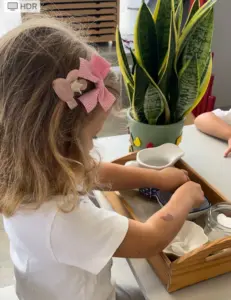
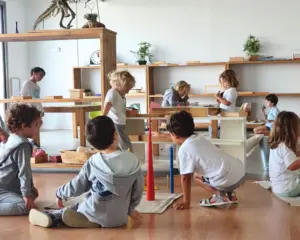
The educational materials that actually serve this stage are the ones that reinforce independence and concentration, two principles AMI identifies as pillars of the Montessori environment. in our Nido (0 - 3 years) classroom, practical-life materials (transferring, pouring, cleaning) support exactly this symbolic awakening.
Prepared Environment Checklist
Before buying anything, check these points in your home:
- A corner at your child’s height with a low shelf and two or three visible toys, no more.
- A clear floor space to crawl and play with no furniture in the way.
- Real household objects scaled to their size (small broom, basket, cloth).
- An adult who observes before stepping in and names the actions out loud.
- Unrushed time: pretend play needs repetition, and repetition needs calm.
Frequently Asked Questions
When Does Pretend Play Start?
Pretend play begins between 12 and 18 months with deferred imitation, when the child repeats a gesture they’ve seen without the model present. Around 2 years clear substitution appears (one object standing in for another), and by 3 - 4 years the scene with characters emerges. Every child has their own pace.
What Play Activities Stimulate a 1-Year-Old?
Short imitation games with everyday objects stimulate a 1-year-old: talking on the phone with a spoon, feeding a doll, covering a stuffed animal to put it to sleep. They last seconds and repeat many times. Your calm example and a voice naming the actions are worth more than any toy with sounds.
What Activities Can You Do for Pretend Play?
Activities like the doll’s snack time with a real spoon, the shopping basket with three household objects, putting a stuffed animal to bed with a cloth, grooming a doll, or cooking with a wooden pot all work. Each one takes two or five minutes and reinforces imitation, concentration, and independence.
What Play Is Best for 1-Year-Olds?
The best play for 1-year-olds combines an everyday gesture, a simple object, and a calm adult presence: feeding a doll, putting objects in and out of a basket, making a talking-on-the-phone gesture, or covering a stuffed animal. You don’t need electronics or small pieces, which are a hazard at this age.
If you’d like to see how we support pretend play in the classroom, book a personalised visit to the school and bring your questions.