
Montessori Elementary (6-12) Guide for Families | International School Near Sotogrande & Gibraltar
In short
When a child crosses the threshold of age 6, their mind takes a profound turn. They leave behind sensory exploration to embrace abstraction and imagination. In Montessori Elementary, that shift has a name: the awakening of reason. And at IMS Sotogrande we see it every day, in every question they ask.
When a child crosses the threshold of age 6, their mind takes a profound turn. They leave behind sensory exploration to embrace abstraction and imagination. In Montessori Elementary, that shift has a name: the awakening of reason. And at IMS Sotogrande we see it every day, in every question they ask. In this article we explore Montessori elementary school Sotogrande in depth with practical examples.
- What is Montessori Elementary?
- The child aged 6 to 12: an explorer of justice and logic
- The prepared environment in Montessori Elementary
- Differences with traditional elementary education
- True bilingualism at IMS Sotogrande
- The role of guides in Elementary
- Cosmic education: a holistic view of the universe
- Schedule, routines, and practical life in Workshop
- Frequently asked questions
- Key takeaways
What is Montessori Elementary?
Maria Montessori designed the second educational stage, ages 6 to 12, as a period of vast horizons. The child no longer absorbs the world through the senses, but with an investigative intelligence. At IMS, Montessori Elementary is organized into two cycles: Workshop 1 (6-9 years) and Workshop 2 (9-12 years). Here learning is not divided into isolated subjects, but woven together through cosmic education: a network of stories connecting the history of the universe with mathematics, biology, and language. The key word says it all: it’s not just an “elementary” stage. It’s a laboratory of critical thinking. When it comes to Montessori elementary school Sotogrande, it pays to listen to what families and lead guides actually report.
The child aged 6 to 12: an explorer of justice and logic
If you have a child of this age, you’ll recognize their chain of “whys.” The reasoning mind displays an insatiable thirst for understanding why things are the way they are. Additionally, a deep sense of justice and belonging to the group emerges. Montessori understood that this child needs big questions, not just closed answers. That’s why in our IMS guides we don’t lecture. We tell stories that spark curiosity and let personal investigation take the lead. Mistakes are tools, and collaboration replaces competition. Daily practice with Montessori elementary school Sotogrande reveals nuances no handbook fully captures.
The prepared environment in Montessori Elementary
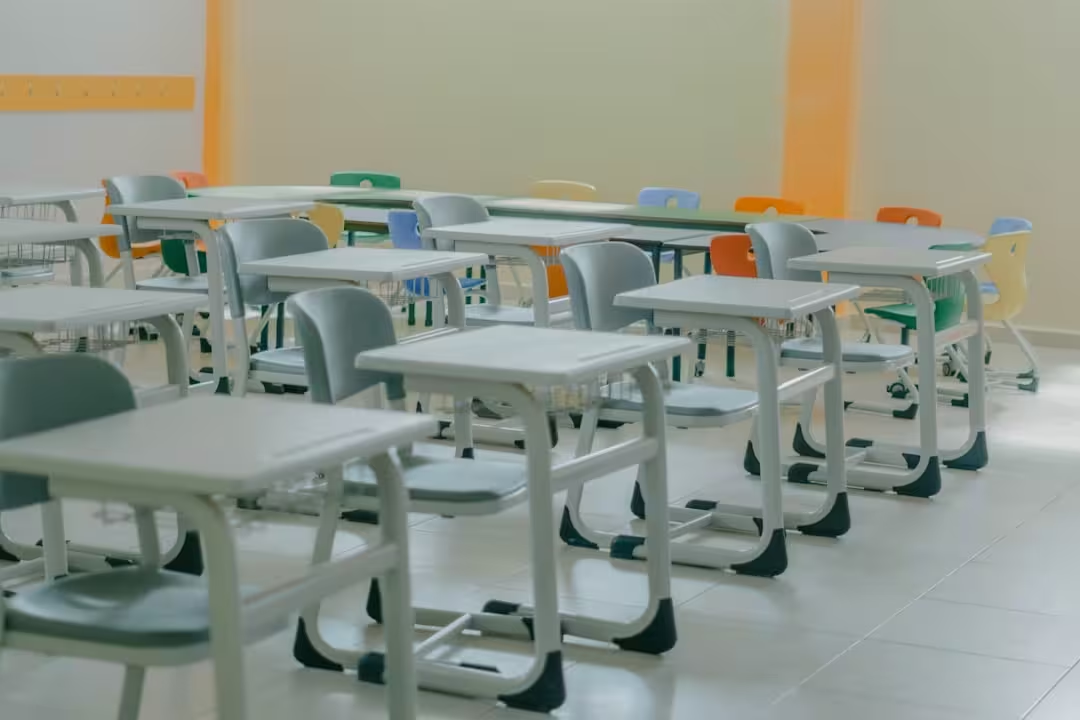
Walking into one of our workshops is to encounter a space that breathes order and possibility. The materials are no longer exclusively sensory: they now contain the keys to abstraction. Cubes of powers, fraction bars, timelines unfolding the evolution of life on Earth. Everything is arranged so that the child can manipulate, experiment, and then move to mental representation. Understanding Montessori elementary school Sotogrande from inside the classroom reshapes everyday decisions.
Tables are grouped for cooperative work and shelves have no doors: knowledge is accessible. And because learning doesn’t stop at the classroom wall, at IMS we hold monthly Learning Walks: outings to parks, museums, or the Sotogrande area, accompanied by parent volunteers. Because classifying leaves is best understood by touching native species from Campo de Gibraltar than by looking at a photo. Concrete data on Montessori elementary school Sotogrande is worth reviewing before acting on assumptions.
Differences with traditional elementary education
If you compare a day in a traditional school with a day in our Montessori Elementary, the distance is measured in bells and autonomy. Here there are no exams that memorize data only to forget it the next day. Assessment is continuous and based on teacher observation and the child’s self-assessment. The curriculum doesn’t set a single pace: each child advances at their own speed, delving into what fascinates them. Guides don’t explain the same thing on the board for everyone. They prepare individual or small-group lessons that respond to each child’s actual needs.
Another big difference is how mistakes are handled. In the traditional system, errors are often penalized. In Montessori, the material is designed so the child can detect their own errors and correct them without adult intervention. Thus motivation comes from within, not from a grade or external reward.
True bilingualism at IMS Sotogrande
One of the pillars making this Montessori Elementary unique is the dual immersion in Spanish and English throughout the whole day. We are the only school in the area offering a bilingual program co-funded by the EU (IMS Sotogrande). From Casa de Niños, French is incorporated as a third language, and in Workshop children integrate it naturally through songs, projects, and everyday conversations. The goal is not to give “English classes,” but to live in English while discovering photosynthesis or debating ancient civilizations.
If you are considering an international school near Gibraltar, the Montessori + bilingual combination makes IMS a top choice for many families from Algeciras, La Línea, or Estepona.
The role of guides in Elementary
At this stage, the Montessori guide is more like a senior researcher than a traditional teacher. Their main tool is scientific observation: recording what concepts the child has mastered, what they need next, and when they are ready for a new Great Lesson. Our Workshop team consists of professionals certified by AMI, including Javier Baena, Daniela Pereyra, Teresa García, Jennifer Lynam, Adriana Moreno, and Palma García Hormigo. Each brings their bilingual perspective and deep respect for individual processes.
Moreover, connection with families is ongoing. Through weekly reports, quarterly meetings, and personalized conferences, the child’s path is charted as a team. There are no end-of-year surprises: parents know exactly where their child is developmentally.
Cosmic education: a holistic view of the universe
If we had to choose one word to define Montessori Elementary, it would be “cosmos.” Cosmic education is based on five Great Lessons that ignite the imagination: the origin of the universe, the arrival of life, the coming of humans, the history of writing, and the history of numbers. From there, children choose their own research paths: from building a periodic table of elements to recreating a medieval market.
At IMS we have seen how a project on water led a Workshop 2 group to analyze the quality of the stream near Sotogrande, with bilingual graphs and a presentation to their peers. That is systemic thinking, not storing isolated data. And it’s exactly what educational neuroscience points to as deep, meaningful learning.
Schedule, routines, and practical life in Workshop
The day in our Montessori Elementary starts at 9:00 and runs until 16:00, with an optional extension until 17:00 to support work-life balance. There are no bells. Children manage their own time in blocks of uninterrupted work. They might spend 45 minutes on mathematical operations with hierarchy material and then move on to writing a medieval chronicle, while others prepare a biome presentation.
Outdoor breaks are an essential part of the day. Movement is not relegated to a separate physical education class. It is integrated into the routine. As for extracurriculars, families can choose aikido, dance, or music, all held in the afternoon on the same premises in Sotomarket, above Mercadona.
Frequently asked questions
Do children from a Montessori Elementary adapt well to secondary school?
Yes, and with an advantage. Having developed autonomy, critical thinking, and research skills, they face the transition with tools their peers may still be building. Additionally, at IMS we work on the transition with visits to secondary schools during the last year of Workshop.
How is progress evaluated instead of using tests?
Through continuous observation, skill rubrics, self-assessment, and work portfolios. Every Friday families receive a brief report via the Growappy platform, and a more detailed report quarterly. The focus is on personal growth, not a numerical grade.
Can I visit the Elementary classroom to see how my child works?
During the school year we hold at least three in-person conferences and several open days. Additionally, the monthly Learning Walks invite families to join us on educational outings. Communication is constant via ClickEdu and a private Facebook group.
How are literacy skills developed simultaneously in English and Spanish?
From Casa de Niños, children are naturally exposed to both languages. In Montessori Elementary, bilingual guides present lessons in the language corresponding to the area. No translation. Real contexts are created where English is a vehicle for communication. The result is functional bilingualism, which many children supplement with French started in preschool.
Are Montessori Elementary materials very different from those in Preschool?
They are an extension toward abstraction. A child who at age 4 handled sandpaper letters now uses symbolic grammar cards at age 7. One who counted golden beads now builds the trinomial cube with powers. All material is designed so that the transition from concrete to abstract happens naturally.
Key takeaways
Montessori Elementary is far more than an educational cycle: it’s a laboratory of humanity where the 6-to-12-year-old builds logical thinking, ethical sense, and a love for learning. At IMS Sotogrande, with AMI guides, NEASC accreditation, and a unique bilingual environment, that process comes to life every day. If you are looking for a school that respects developmental planes and prepares for life, not just for the next exam, it’s worth coming to experience it.
You can book a personalized visit with no obligation. We will show you how children work in their prepared environment and answer all your questions. Because choosing your child’s education is a decision made with information, but above all, with experience.









