
Montessori School Costa del Sol: Complete Guide for Expat Families Seeking Respectful Education (With Real Examples)
In short
Montessori School Costa del Sol: When you visit a Montessori classroom for the first time, what strikes you most is the active silence. Twenty-something children aged 3 to 6 each working on something different, focused and independent.
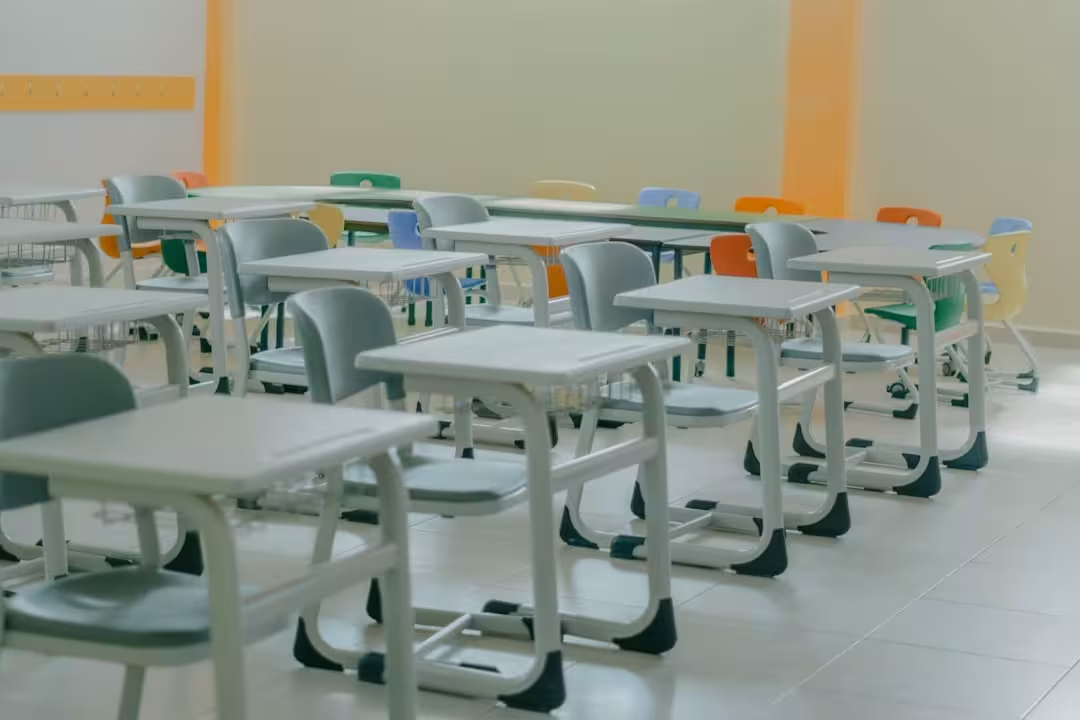
When you visit a Montessori classroom for the first time, what strikes you most is the active silence. Twenty-something children aged 3 to 6 each working on something different, focused and independent. There are no rows of desks, no bell ringing every 45 minutes, and the teacher is not at the front delivering a general lesson. That image, so different from what many of us experienced at school, defines the essence of a pedagogy that has been transforming education for over a hundred years. At IMS Sotogrande, located in the heart of the Costa del Sol near Gibraltar, we have been applying the Montessori Method faithfully to its original principles for two decades, and we have found that it works equally well in English, Spanish, or German. In this article we explore montessori school costa del sol in depth with practical examples.
But let’s take it step by step. The Montessori Method is not a set of educational tricks or an alternative fad. It is a way of understanding the child as the protagonist of their own learning, based on scientific observation of how the infant mind actually develops. Maria Montessori, an Italian physician and educator, developed it in the early 20th century, and today it is backed by neuroscience research confirming what she intuited: movement, autonomy, and freedom within limits are key to a healthy brain.
- What Is the Montessori Method and Why Is It Different?
- Principles of the Montessori Method That Transform Learning
- Montessori Environments by Age: From the Nest to the Workshop
- Montessori Method vs. Traditional Education: A Realistic Comparison
- Why the Montessori Method Works in a Fast-Changing World
- The Montessori Method at Home: What You Can (and Can't) Do
- Frequently Asked Questions
- Key Takeaways
What Is the Montessori Method and Why Is It Different?
Unlike the traditional model, where the adult transmits content uniformly to a same-age group, the Montessori Method is based on three inseparable elements: a prepared environment, an observing guide, and a child learning at their own pace.
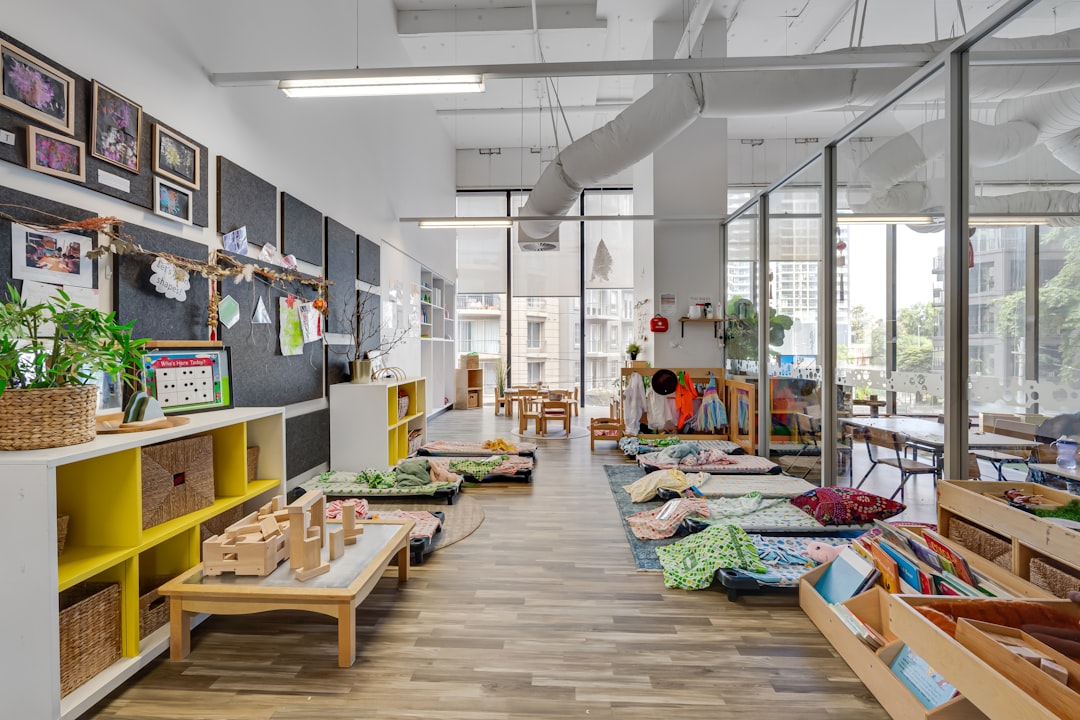
The Montessori environment is meticulously designed. Furniture is natural wood, sized for the child, and materials are placed on low shelves that children can access without help. Everything has a purpose: every tray, every jar, every sensory game invites a specific activity. No electronic toys or screens. At IMS Sotogrande, our Infant Community (1-3 years) and Children’s House (3-6 years) classrooms show exactly this: plants cared for by the children themselves, real glass cups (yes, they learn to use them without breaking), and a reading corner where they can curl up with a book.
The guide’s role also breaks molds. They don’t give lectures. Their job is to observe each child’s sensitive periods (phases of intense interest in something: language, order, movement) and present a material that helps them advance. Then they step back. The child tries, makes mistakes, repeats, and masters the skill themselves. This autonomy builds solid self-esteem, from which internal discipline arises without need for rewards or punishments.
Principles of the Montessori Method That Transform Learning
We can summarize the foundations of the Montessori Method into six key ideas that any family can also apply at home, though the specialized classroom is the ideal environment to enhance them:
- Absorbent Mind (0-6 years). The young child learns like a sponge, without conscious effort, through their senses and environment. That’s why in Montessori we care so much about aesthetics, order, and beauty: everything they see, touch, and hear is shaping them.
- Sensitive Periods. There are temporal windows when the child is especially receptive to acquiring a skill (language, writing, numbers, fine movement). If the environment responds to that interest, learning is explosive. If ignored, the opportunity fades.
- Autonomy and Free Choice. The child chooses their work within clear limits. This doesn’t mean they do whatever they want without control: the guide ensures the options are appropriate for their development.
- Movement and Cognition Integrated. Montessori demonstrated that movement is not a break from learning, but part of it. Carrying a water pitcher, sweeping, counting beads while moving: the body learns as much as the mind.
- Cosmic Education (6-12 years). From age 6, the child stops being a sensory explorer and becomes a rational explorer, eager to understand the universe and relationships among living things. The concept of “Cosmic Education” unites all subjects: math, history, biology, and art all stem from an interconnected whole.
- Evaluation Without Exams. Continuous observation by the guide replaces numerical grades. At IMS’s Taller (6-12 years), students keep a work journal and meet weekly with their tutor to review progress. They learn to self-evaluate, an essential life skill.
A recent study by the Association Montessori Internationale (AMI Research Outcomes) confirms that children who have attended a Montessori environment at least until age 6 show better academic performance, greater creativity, and more developed social skills than their peers in conventional schools.
Montessori Environments by Age: From the Nest to the Workshop
To truly understand the Montessori Method, it’s worth exploring its environments, because at each stage the child’s needs change radically. The division into planes of development is one of the great insights of this pedagogy.
From Birth to 3 Years: The Nest That Prepares for Life
In the first three years, the child builds their relationship with the world through movement and trust. At IMS Sotogrande, our Semillas (0-3 years) program is a welcoming space where babies crawl on natural mats and older ones practice practical life activities: dressing themselves, washing hands, pouring water from a small pitcher. No rush. Every achievement, no matter how tiny, is celebrated as a step forward in autonomy. Families from San Roque, Alcaidesa, and Sotogrande who entrust us with their little ones know that here we don’t just keep children. We accompany them as they grow.
Children’s House (3-6 Years): The Golden Age of Sensory Learning
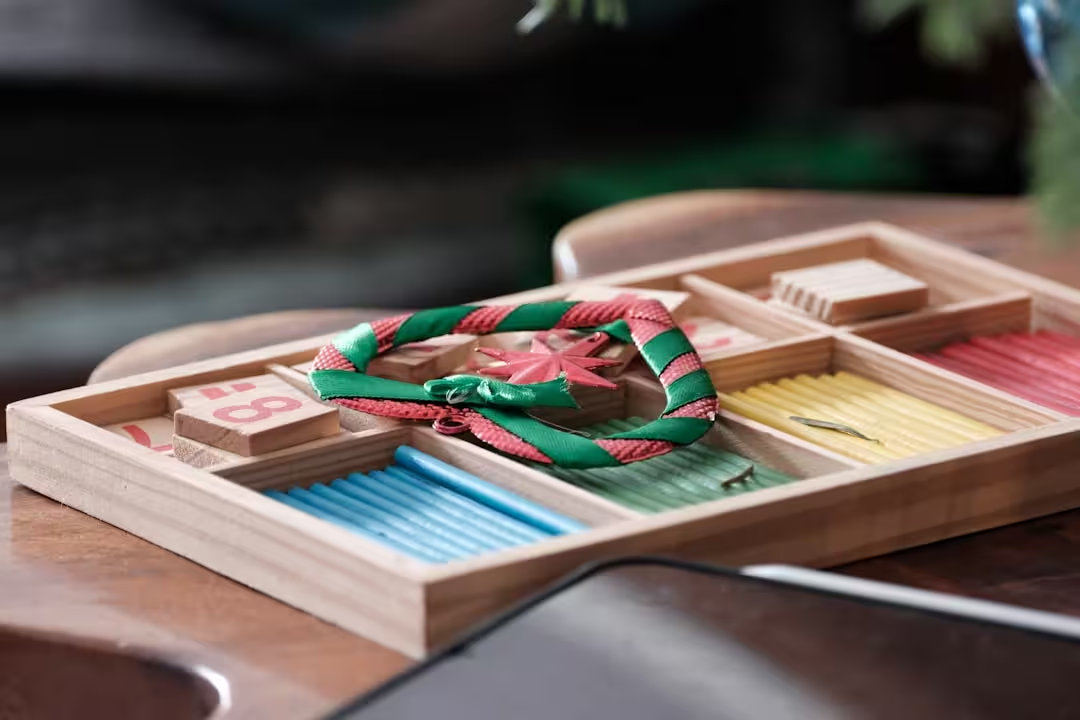
Between ages 3 and 6, the child refines their senses and language, and their absorbent mind continues at full capacity. In the Children’s House, manipulative materials are the stars: sandpaper letters to trace with fingers before writing, cylinders of different diameters for visual discrimination, chains of golden beads to count concretely up to a thousand. What’s fascinating is that the child doesn’t “play” with these materials: they work with them. At 4, they can spend twenty minutes concentrated on a pouring tray, developing attention without being forced. And at 5, they often start reading almost spontaneously because the environment has prepared them for it.
Book a personalized visit to our school and see firsthand how children work in the Children’s House: Book a personalized visit to our school.
Taller (6-12 Years): From Concrete to Abstract
By elementary school, the child asks “why” about everything. In Montessori, this stage is called Taller (Workshop), and here materials remain manipulative, but the mind moves toward abstraction. At IMS, students in Taller 1 (6-9 years) and Taller 2 (9-12 years) investigate together in small groups. No textbooks: they use encyclopedias, create their own workbooks, and present projects to the group. Math remains visual (with binomial and trinomial cube materials), while literature is read aloud and history is told as a grand narrative connecting the universe’s appearance with human diversity.
Many international families moving to the Costa del Sol choose us precisely for this approach. A child arriving at age 8 from an American or British school can integrate into our Taller because learning is individualized and English-Spanish bilingualism runs across all areas. French, introduced from age 3, adds a third language that stimulates brain plasticity.
Montessori Method vs. Traditional Education: A Realistic Comparison
This is not about demonizing other systems, but clearly laying out the differences so families can make informed decisions. The following list, though simplified, reflects each model’s priorities:
- Goal: Traditional aims to transmit curricular content, Montessori seeks to develop the child’s autonomy, curiosity, and critical thinking.
- Pace: Traditional sets a common pace for the whole class, Montessori respects individual pace.
- Adult Role: Traditional places the teacher as the source of knowledge, Montessori turns them into a guide who observes and connects the child with the environment.
- Grouping: Traditional groups by chronological age, Montessori mixes three ages in the same classroom, fostering peer mentoring.
- Motivation: Traditional relies on external rewards (grades, prizes, punishments), Montessori trusts intrinsic motivation from well-done work.
- Assessment: Traditional uses exams and grades, Montessori uses observation, portfolios, and self-assessment.
At IMS, this philosophy translates to a child moving to the next level not by age but because they are ready. Families coming from Algeciras or La Línea de la Concepción often tell us the relief they feel seeing their child happy going to school, without homework pressure or constant comparisons.
Why the Montessori Method Works in a Fast-Changing World
In a job market that rewards creativity, collaboration, and the ability to learn how to learn, the Montessori Method offers a head start. Children who have grown up choosing their work, managing their time, and resolving conflicts with peers of different ages naturally develop what we now call soft skills. In our IMS classrooms, we daily see a 5-year-old helping a 3-year-old tie shoelaces, or a group of 11-year-olds debating how to divide tasks for a science project without teacher intervention.
Moreover, neuroscience is confirming what Maria Montessori observed a century ago. The infant brain needs uninterrupted concentration periods to prune neural connections and consolidate learning. Every time a child immerses themselves in a material and no one interrupts, they are literally sculpting their brain. That’s why in Montessori we protect 2-3 hour work cycles without fragmenting the morning into subjects.
The Montessori Method at Home: What You Can (and Can’t) Do
Families often ask if they can apply Montessori at home without the classroom or guide training. The answer is yes, in part. We can incorporate these principles:
- Adapt the environment: low furniture, hooks at their height, a cozy reading nook.
- Offer realistic, simple materials: wooden blocks, animal puzzles, small watering cans for plant care.
- Let them dress themselves, even if it takes longer.
- Allow them to participate in household tasks: setting the table, washing vegetables, folding socks. It’s not help. It’s their work.
- Limit screens and instead offer conversation and outdoor walks.
But we must be honest: Montessori is not just a craft kit. The adult’s mindset is the hardest to replicate. A Montessori guide learns to observe without judgment, to resist the urge to correct or help too soon. At home, we can practice gradually, but the true prepared environment, with the full sequence of materials and a community of mixed-age children, is irreplaceable and found at school.
Frequently Asked Questions
At what age can a child start the Montessori Method?
From birth. Montessori environments adapt to each plane of development. At IMS Sotogrande, we welcome babies in the Semillas program (0-3 years) and continue until age 12 in Taller. The earlier a child is exposed to a prepared environment, the more natural their development of autonomy and concentration.
Is it true that Montessori children have no homework?
In the Children’s House stage (3-6 years), no homework is given. Learning happens in the classroom through materials and practical life. In Taller (6-12 years), students may bring home small research tasks or readings, but always connected to their interests and without daily deadline pressure. The serious work is done at school, respecting each child’s pace.
How does the Montessori Method handle discipline?
No rewards or punishments. Discipline comes from within when the child feels valued, competent, and part of a community. If conflicts arise, the guide uses them as learning opportunities: sitting with those involved, helping them express feelings and find solutions together. In the long term, Montessori children manage disagreements with more empathy and assertiveness.
Can a Montessori child adapt later to a traditional school?
Many do without problem, because they carry their concentration and independent work skills. However, the transition can be tough if the new environment expects all children to do the same thing at the same time. That’s why many families relocating near Sotogrande, whether from Gibraltar, Estepona, or Marbella, choose to maintain Montessori continuity at IMS until age 12 if possible.
Does the Montessori Method work for children with special needs?
Maria Montessori began precisely working with children considered “uneducable” in her time, and her results were astonishing. Individualized learning, multi-sensory materials, and respect for each child’s pace make the Montessori Method a very favorable environment for neurodiversity. At IMS, we have a Rainbow Room for diversity support, where specialized professionals accompany children who need it, always within the Montessori environment.
Key Takeaways
The Montessori Method is not a magic recipe, but it is a coherent path that respects childhood as it is: curious, active, capable. After more than twenty years seeing children who enter the nest crying and leave Taller at age 12 discussing astronomy or standing up to injustice, we can say it works. It works when applied with rigor, love, and the certainty that each child brings their own plan.
If you are looking for a school that does not extinguish your child’s natural spark but nurtures it, we invite you to come see us. No brochure can replace a personal visit. Seeing a Montessori classroom in action, with its unhurried rhythms and harmony, changes your perspective. Write to us at [email protected] or call +34 653 04 17 39 to schedule a no-obligation appointment. We are in Sotogrande, very close to Alcaidesa, San Roque, and the Campo de Gibraltar, and we welcome families from all over the Costa del Sol who have decided their children’s education is worth the trip.









