Gross Motor Skills and Balance in Kids: Age-by-Age Activities Guide

Gross motor skills with balance bring together the big movements of the body and the control that lets a child stay upright, move around, and react without falling. This starts when a baby lifts their head and keeps developing through adolescence. In this article I explain which skills it includes, how it connects to fine motor skills, and what activities you can set up at home based on your child’s age.
In a Nutshell
- Gross motor skills use the large muscles (legs, arms, core) for walking, jumping, running, and balancing.
- Balance is a motor skill you can train: crawling, walking along narrow surfaces, hopping on one foot, and spinning without getting dizzy.
- Each age brings its own challenge: 0 to 3 years builds stability, 3 to 6 years controls dynamic balance, and 6 to 12 years coordinates and refines it.
- The most common mistake is stopping your child from wobbling or falling. Without small moments of imbalance, there is no learning of balance.

What Are the Key Characteristics of Motor Development?
Motor development is the body’s ability to move on purpose. It has very clear characteristics: it is global, it develops from head to toe and from the center of the body outward to the limbs, it matures with age, and it improves with practice. It also connects movement, perception, and learning.
Development follows a predictable order. First the baby controls their head, then sits, crawls, and stands up. This head-to-toe pattern is the same in all children, though each has their own pace. The Spanish Association of Pediatrics reminds us that motor sequences are universal, but the exact ages vary greatly from child to child.
Another key characteristic is that motor development splits into two big blocks that support each other:
- Gross motor skills : broad movements of the torso, legs, and arms.
- Fine motor skills : precise movements of the hands, fingers, and wrists.

What Are Motor Skills and 5 Examples?
Motor skills are the movement abilities a child acquires and refines through practice. They are grouped into basic skills (running, jumping, throwing), manipulative skills (catching, throwing with accuracy), and stability skills, which include balance.
Here are five concrete examples you will see at any playground or schoolyard:
- Running while changing speed and direction without bumping into things.
- Jumping with two feet forward or off a low step.
- Throwing a ball with one hand toward a target.
- Walking in a straight line with one foot placed in front of the other.
- Standing on one foot for several seconds.
Each one combines strength, coordination, and postural control. That is why training one motor skill works several at the same time.

What Is Balance as a Motor Skill?
Balance as a motor skill is the ability to keep the body stable and controlled, whether still or in motion. It is the foundation of almost everything: holding up the head, sitting upright, walking, climbing stairs, or riding a bike.
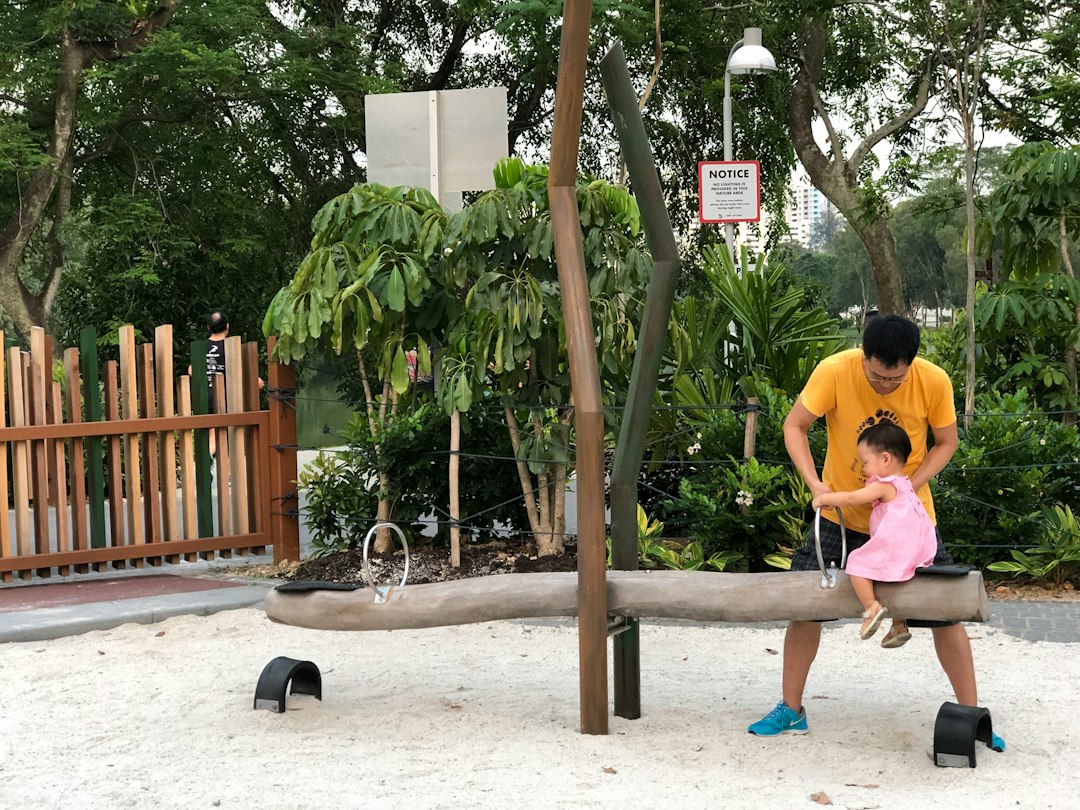
Balance comes in two forms. Static balance means staying still, standing or on one foot. Dynamic balance means keeping stability while moving, like walking along a log or hopping from stone to stone. Both depend on three systems working together: vision, the inner ear (which senses the head’s position), and proprioception (signals from muscles and joints). This is what the World Health Organization describes when explaining children’s physical activity.
When we talk about gross motor skills and balance, we are looking at the same thing from two angles. Balance is the ability, and gross motor skills are the ground where it shows up.
Example: Picture Your 3-Year-Old Walking Along the Curb
Imagine your 3-year-old climbs onto the sidewalk curb and starts walking along it with arms outstretched. They are practicing dynamic balance without anyone teaching them. If they wobble, they correct with their torso and arms. That little scare is not a failure: it is exactly where learning happens.
What Are Fine Motor Skills and 5 Examples?
Fine motor skills are the small, precise movements of the hands, fingers, and wrists. They make it possible to button a shirt, write, or cut with scissors. They rely on core stability: without solid gross motor skills, the hands do not have a good base to work from.
Here are five examples by age:
- Picking up small objects with thumb and forefinger (from 9 to 12 months).
- Fitting pieces of a shape sorter together (18 to 24 months).
- Kneading playdough or rolling small balls with the fingers (2 to 3 years).
- Cutting with scissors along a line (3 to 4 years).
- Writing letters and tying shoelaces (6 years and up).
Gross Motor Skills in Children: Activities for Every Age
Gross motor activities should match each child’s developmental moment. The goal is not to rush stages but to offer the right challenge. The Association Montessori Internationale theory of developmental planes describes four phases of childhood, and the first two (0 to 12 years) are exactly the ground where body control takes hold.
0 to 3 Years: Building Stability
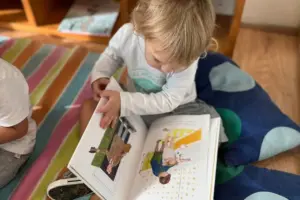
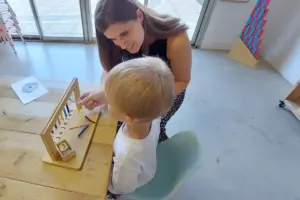
Babies and toddlers mostly work on static balance and core control. Simple activities do the job: lying on the tummy lifting the head, crawling across the floor, walking barefoot on soft textures, or carrying objects with both hands. In the Nido and Children’s House Community (0-3 years), open floor time and child-sized materials invite this constant movement.
3 to 6 Years: Mastering Dynamic Balance
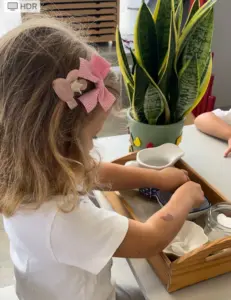
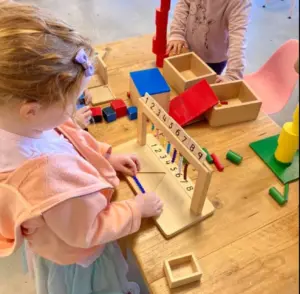
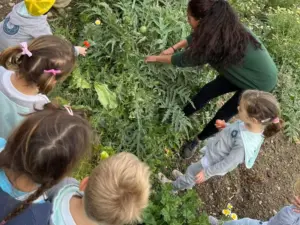
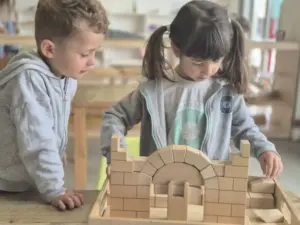
This is where jumping, obstacle courses, and moving along narrow surfaces come in. In the Children’s House (3-6 years), movement is built into the day: children carry trays, care for plants, and sit down and stand up without help. At home you can lay a strip of tape on the floor to walk along or line up couch cushions to jump from one to the next.
6 to 12 Years: Coordinating and Refining
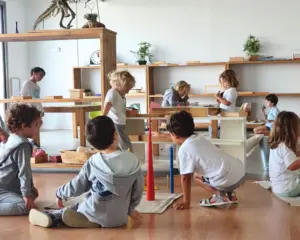
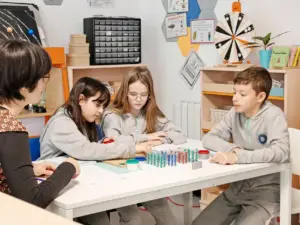
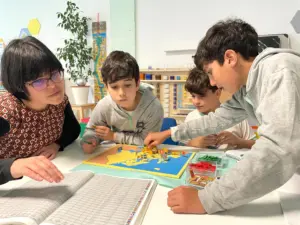
In the Elementary class (6-12 years), the body is fairly independent, so the challenge shifts to complex coordination: throwing and catching, balancing on one foot with eyes closed, and circuit courses combining crawling, jumping, and turning. Gross motor skills with balance remain present in every learning outing and every playground game.
Gross Motor Activities for Kids
These activities can be set up at home with what you already have. None of them require special equipment.
- Cushion circuit : line up 4 or 5 cushions and ask your child to jump from one to the next without touching the floor. Best from age 3.
- Homemade balance beam : a strip of tape on the floor to walk along, first forward and then backward.
- Object carrying : walking with a cup of water or a basket on the head trains static balance. Start with short distances.
- Red light, green light : run, stop on “red,” and hold a one-foot stand until “green.” Works inhibition and balance at once.
- Crawl under the table : an improvised tunnel with bed sheets builds core strength, the base of all stability.
The Typical Mistake: Avoiding Every Fall and Wobble
The most common mistake is correcting every small imbalance: holding a child by the elbow, steering them away from curbs, forbidding going up the slide backwards. We protect out of love, but we remove the very ground where balance is trained. The solution is not simply to let go, but to allow calculated risk: supervise from close by, let the body solve it on its own, and limit the environment rather than the movement. A playground with soft surfacing and you paying attention is safer and more educational than constant restriction.
Frequently Asked Questions
What Are the Key Characteristics of Motor Development?
Motor development moves from head to toe and from the center outward to the limbs, following a predictable order. It is global, matures with age, and improves with practice. It divides into gross motor skills (broad movements) and fine motor skills (precise hand and finger movements), and it connects movement with learning.
What Are Motor Skills and 5 Examples?
Motor skills are movement abilities a child develops through practice. Five examples: running while changing direction, jumping with two feet, throwing a ball at a target, walking in a straight line with one foot in front of the other, and standing on one foot for several seconds. They combine strength, coordination, and balance.
What Is Balance as a Motor Skill?
It is the ability to keep the body stable and controlled, still (static balance) or in motion (dynamic balance). It depends on vision, the inner ear, and muscular proprioception. It is the foundation for sitting upright, walking, climbing stairs, or riding a bike, and it is trained through daily play.
What Are Fine Motor Skills and 5 Examples?
Fine motor skills are the precise movements of hands, fingers, and wrists. Five examples: picking up small objects with thumb and forefinger, fitting shape pieces together, kneading playdough, cutting along a line with scissors, and writing letters or tying shoelaces. They require prior core stability.