Fine and Gross Motor Skills by Age: A Guide from 0 to 12 Years

Tracking fine and gross motor skills by age is the best way to know whether your child is progressing normally or whether one area needs extra support. Gross motor skills mobilise the arms, legs and trunk (sitting, jumping), while fine motor skills coordinate the fingers and wrist (drawing, buttoning). Both mature in a predictable order, but every child does it at their own pace.
- In short
- What is gross motor development and examples by age
- What is psychomotor education and why body comes first
- How to work on fine motor skills with older adults
- What skills should a 3 to 4 year old have
- Fine and gross motor skills by age: summary table
- Fine and gross motor activities for home
- FINE MOTOR SKILLS: finger movement step by step
- Frequently asked questions
In short
- Gross motor skills: sitting, crawling, walking, jumping and balance from birth to 6 years.
- Fine motor skills: pincer grasp, scissors, writing and self-care, from the palmar reflex to 12 years.
- The developmental sequence is fixed, but the individual timeline can vary by months between children.
- In short, the age-by-age table in this article is a quick reference, not a diagnosis.

What is gross motor development and examples by age
Gross motor development is the voluntary control of the large muscle groups that keeps the body balanced and moves it through space. It includes posture, walking, running and coordination between both sides of the body.
From 0 to 3 years
By around three months a baby can hold their head up. Between six and nine months they roll over and sit without support. Crawling appears at around eight or ten months, and first steps between twelve and fifteen months. By two years old they can climb stairs with support and run, albeit clumsily.
From 3 to 6 years
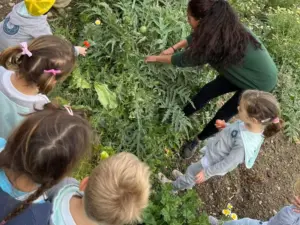
This is when jumping with both feet, walking backwards and balancing on one foot emerge. Imagine your 4-year-old crossing a hallway walking along an adhesive tape stuck to the floor without stepping off it. That game trains dynamic balance without feeling like an exercise.

What is psychomotor education and why body comes first
Psychomotor education is the discipline that works on the coordination between movement, perception and thinking. Its premise is simple: before writing, you need a body that can organise itself in space.

How to work on fine motor skills with older adults
Fine motor skills do not end in childhood: in older adults, manual work helps maintain dexterity, autonomy and self-esteem. It is best to start from each person’s actual level and adjust the challenge, without infantilising the activity.
Three lines of work
Guided by age, not by demands: sandpaper, threading large beads, modelling clay, sorting coins, screwing large pieces or folding napkins are respectful suggestions that also improve the grip needed for eating or dressing. The everyday practice of manual and cognitive activities combined with movement is a good ally for holistic development in childhood.
What skills should a 3 to 4 year old have
Between 3 and 4 years old, a child typically runs while changing direction, climbs stairs alternating feet, copies a circle, cuts along a straight line with scissors, fastens a large button and eats with a spoon unaided.
If at 4 years old your child cannot yet do any of these skills, or avoids hands-on tasks altogether, it is worth mentioning it to your paediatrician. Often more play with pincers, shape sorters and household chores is enough.
Fine and gross motor skills by age: summary table
This table gathers the expected milestones for each age range and is best reviewed as a general guide.
- 0 to 12 months: head control, sitting, palmar grasp and crawling.
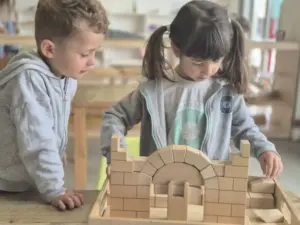
- 1 to 2 years: independent walking, first gestural words, stacking cubes and releasing objects voluntarily.
- 2 to 3 years: running, climbing stairs, circular scribbles, turning pages of a book.
- 3 to 4 years: jumping with both feet, copying a circle, cutting with scissors, fastening a large button.
- 4 to 5 years: balancing on one foot, copying a cross and a square, drawing a basic human figure.
- 5 to 6 years: writing some letters, dot-to-dot, simple shoelaces, growing pencil control.
- 6 to 9 years: fluent writing, using a ruler, team sports, precision in crafts.
Fine and gross motor activities for home
Example: if your 3-year-old avoids puzzles
Imagine placing three large pieces on the table and asking them to put one in the box. Reducing the challenge until they succeed is the trick. From there, increase the difficulty by one piece per week and you will see them re-engage.
Activities by age
- From 0 to 2 years: ramps for rolling balls, dragging with blankets, stacking large boxes.
- From 3 to 4 years: playdough, picking up dried chickpeas with clothes pegs, climbing at the playground.
- From 5 to 6 years: small-bead bracelets, cutting curves with scissors, balancing on one foot.
- From 6 to 12 years: origami, basic typing, cycling, racket sports.
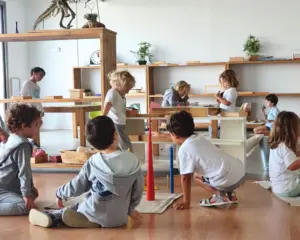
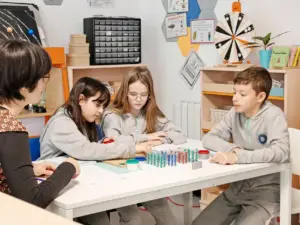
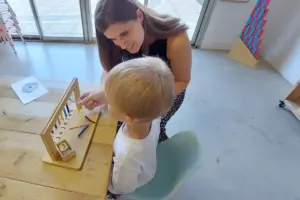
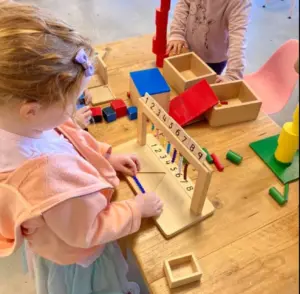
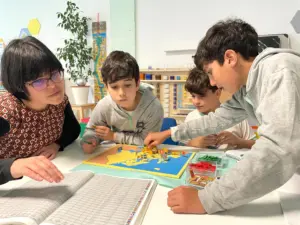
In our Montessori Children’s House (3-6 years) these activities are part of the daily work, with prepared materials that invite autonomous repetition.
FINE MOTOR SKILLS: finger movement step by step
Fine motor skills are the ability to coordinate fingers, hand and eye for precise actions. Development follows the sequence from a coarse to a refined pincer grasp, and it appears before legible writing.
Common mistakes and how to fix them
Frequent mistake: introducing pencils and scissors too early. If trunk strength is not yet consolidated, the child grips poorly and gets frustrated. The solution is simple: reinforce balance first with climbing, hanging from a bar or carrying heavy trays. Writing will come later, with less effort.
To look after postural hygiene and choose materials well, it helps to look for educational approaches that respect children’s physical development and adapt each activity to the age and developmental stage of each child. Whenever you have doubts about posture or specific needs, always consult a healthcare professional or the educational team at your centre.
Frequently asked questions
What is gross motor development and examples?
Gross motor development is the control of the large muscles of the body that allows us to stay balanced and move around. Examples: sitting without support, crawling, walking, running, jumping, climbing stairs and balancing on one foot. It develops mainly between 0 and 6 years of age, and is worked on through free play, the playground and household tasks.
What is psychomotor education?
Psychomotor education is the intentional work on the coordination between movement, perception and thinking. Its goal is for the child to orient themselves in space, control their body and gain autonomy before writing. It is worked on through play, music, manipulative materials and daily life activities from early childhood.
How to work on fine motor skills in older adults?
The most effective way is to adapt meaningful manual tasks to each person’s level, avoiding infantilising the proposal. Activities such as modelling clay, screwing large pieces, sorting coins or folding napkins improve grip and confidence. Short, frequent sessions are best, and it is worth consulting a healthcare professional if there is pain or stiffness.
What skills should a 3 to 4 year old have?
Between 3 and 4 years old, a child typically runs while changing direction, jumps with both feet, copies a circle, cuts along a straight line with scissors, fastens a large button and eats with a spoon unaided. Every child progresses at their own pace, so the table in this article is a general guide, never a diagnosis.