
Fine Motor Skills vs Gross Motor Skills: Examples and Activities by Age

The difference between fine and gross motor skills comes down to this: gross motor skills use the large muscles of the body (legs, arms, core) for actions like running or jumping, while fine motor skills coordinate the hands, fingers and wrist for precise tasks like buttoning a shirt or drawing. Maria Montessori called the hand the instrument of the mind, and both types work together from birth. If you want a clear comparison with examples and ages, this article gives you the full picture.
- In Summary
- Gross Motor vs Fine Motor Skills: Definitions and Characteristics
- What Are Gross Motor Skills? Five Examples
- What Are Fine Motor Skills? Five Examples
- At What Age Should You Encourage Fine Motor Skills?
- Ten Fine and Gross Motor Activities to Play at Home
- A Common Mistake When Encouraging Motor Skills
- Frequently Asked Questions
In Summary
- Gross motor skills control big movements (running, jumping) using the large muscles.
- Fine motor skills coordinate hands and fingers for precise actions (picking up tweezers, getting dressed).
- Gross motor skills mature first, then fine motor skills: from the shoulder down to the fingertips.
- Fine and gross motor milestones by age provide key checkpoints from 0 to 6 years.

Gross Motor vs Fine Motor Skills: Definitions and Characteristics
Gross motor skills are the ability to perform large movements with the major muscle groups. They include actions such as sitting up, crawling, running or keeping balance. This is the foundation everything else builds on.
Fine motor skills, on the other hand, control the small, precise movements of the hands, fingers, wrists and even the eyes. They make it possible to fit pieces together, cut with scissors, write or tie shoelaces. They require eye-hand coordination and good control of pressure.

What Are Gross Motor Skills? Five Examples
Gross motor skills are the ability to move the body using the large muscles, controlling balance, coordination and the strength of the trunk and limbs. They develop before fine motor skills and set the pace for the rest of motor development.
Five Examples of Gross Motor Skills
- Running and stopping without falling, controlling momentum.
- Going up and down stairs alternating feet.
- Jumping with both feet on the spot and forward.
- Keeping balance on one foot for a few seconds.
- Throwing and catching a large ball with both hands.
If your 3-year-old still can’t jump with both feet, there’s no need to worry. Every child has their own pace. However, if at age 4 they can’t balance even for a moment or constantly trip and stumble, talk to your pediatrician or a pediatric physiotherapist.

What Are Fine Motor Skills? Five Examples
Fine motor skills are the ability to perform small, precise movements with the hands, fingers and wrist, coordinating sight with touch. They come into play when dressing, eating, drawing and, later, writing.
Five Examples of Fine Motor Skills
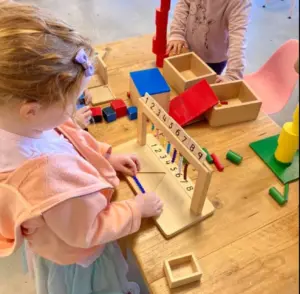
- Fitting small pieces together (like the knobs on a shape-sorting board).
- Picking up objects with a pincer grip between thumb and forefinger.
- Buttoning and unbuttoning buttons or zippers.
- Cutting with scissors along a straight line.
- Threading beads or lacing cords through holes.
These skills really take hold between ages 3 and 6. In the Children’s House (3-6) stage, practical life activities (pouring, buttoning, transferring) prepare the hand for writing without forcing the child.
At What Age Should You Encourage Fine Motor Skills?
Age-by-Age Guidelines
- 0-12 months: objects with different textures and sizes that invite grasping, without forcing the pincer grip.
- 12-24 months: putting pieces in and taking them out, stacking, starting to use a spoon.
- 2-3 years: kneading, tearing paper, fitting things together, trying to dress themselves.
- 3-6 years: cutting out, threading, fastening, controlled drawing.
- 6-12 years: handwriting practice, precision tools, detailed craft work.
Example: if your 2-year-old is trying to eat with a spoon and making a mess, don’t take the spoon away. They’re training wrist control, pressure and eye-hand coordination. Put on a bib, protect the floor and give them ten calm minutes of daily practice.
Ten Fine and Gross Motor Activities to Play at Home
Looking for ten examples of fine and gross motor activities? Here’s a combined list to alternate through on afternoons at home, five gross motor and five fine motor.
- Cushion hopscotch circuit for jumping and balancing (gross).
- Dancing and freezing when the music stops (gross).
- Improvised sack race with pillowcases (gross).
- Walking like a crab backwards down the hallway (gross).
- Playing statues standing on one foot (gross).
- Pushing plastic pushpins into a corkboard (fine).
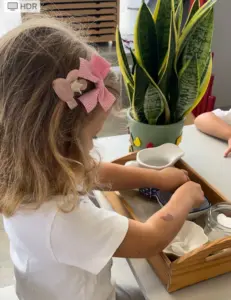
- Pouring water between two cups with a sponge (fine).
- Finger painting prints with paint (fine).
- Unscrewing and screwing on kitchen jars (fine).
- Rolling paper balls with one hand (fine).
Example: imagine setting up a play afternoon with your 4-year-old. Start with the cushion circuit (ten minutes of gross motor activity) and finish at the water-pouring table (fifteen minutes of fine motor practice). Combining both keeps their attention and works the whole body.
A Common Mistake When Encouraging Motor Skills
The most frequent mistake is jumping straight into letters and written homework, assuming this is how you build fine motor skills. When the hand doesn’t yet have the strength or stability, the writing comes out shaky and the child gets frustrated.
The solution is simple: before writing, strengthen the core and wrist with gross motor movement and grip games (kneading, crumpling, hanging clothes with pegs). Writing comes naturally when the hand is ready. This is the principle behind Montessori pedagogy, and it’s backed by organizations like the American Academy of Pediatrics, which recommends active play as the foundation of learning.
Frequently Asked Questions
What Are Gross Motor Skills? Five Examples
Gross motor skills are the ability to move the body with the large muscles, controlling balance and coordination. Five examples: running and stopping, going up stairs, jumping with both feet, balancing on one foot and throwing or catching a large ball.
What Are Fine Motor Skills? Five Examples
Fine motor skills are the ability to make precise movements with the hands, fingers and wrist, coordinating sight and touch. Five examples: fitting pieces together, picking up objects with a pincer grip, buttoning buttons, cutting with scissors and threading beads.
At What Age Should You Encourage Fine Motor Skills?
From birth, with activities adapted to each stage: grasping objects at one year, fitting and kneading at two, buttoning and cutting between three and six years. The goal isn’t to write early, but to prepare the hand through play.
Can You Give Me Ten Examples of Fine and Gross Motor Activities?
For gross motor: cushion hopscotch, dancing and freezing, sack race, walking backwards and playing statues. For fine motor: pushing plastic pushpins, pouring water, finger painting, screwing jars and rolling paper balls.
If you’ve made it this far, you can now tell the two types of motor skills apart and know which game suits which moment. Start today with one activity of each type and watch how your child responds. And if you’re looking for an environment where movement and learning go hand in hand, book a personalized school visit and we’ll explore it together.