
Fine and Gross Motor Skills Development in Early Childhood: Age-by-Age Guide

Fine and gross motor skills development in early childhood follows a predictable order: first children master the big movements of the trunk and legs, and then the precise gestures of the hands and fingers. Understanding that journey, from ages 0 to 6, helps you support your child without comparisons or rushing, and to pick activities that match where they actually are. Fine and gross motor skills are two branches of the same tree: gross motor moves the whole body (crawling, jumping, balancing), while fine motor coordinates the hands, fingers and eyes (pinching, threading, drawing).
- In Summary
- How Gross and Fine Motor Skills Develop in Children
- How Psychomotor Development Unfolds in Early Childhood
- How Motor Skills Develop at Ages 4 and 5
- Activities for Building Fine and Gross Motor Skills by Age
- Which Comes First: Gross Motor or Fine Motor Skills?
- The Common Mistake That Holds Back Motor Development (and How to Fix It)
- Frequently Asked Questions
In Summary
- Gross motor skills come first: a child controls their trunk, head and legs before their fingers.
- Between ages 3 and 6 the three-finger (tripod) grip matures, bringing scissors, buttons, detailed drawing and early writing.
- Crawling a lot and using both hands in everyday life prepares children for writing better than any worksheet.
- Compare your child to their own progress, not the child next door: developmental rhythms vary, a lot.

How Gross and Fine Motor Skills Develop in Children
Gross and fine motor skills develop in parallel, but gross motor lays the groundwork. Before a child can hold a pencil with precision, they need balance, muscle tone and awareness of where their body is in space. Gross motor skills cover the big movements involving the arms, legs and trunk: sitting, crawling, walking, running, jumping and balancing. Fine motor skills, on the other hand, refer to the small, precise movements of the hands, fingers, wrist and eyes: grasping, releasing, stacking, opening, drawing or buttoning up.
The two connect through visuomotor coordination, the ability to guide movement with what you see. When a 4-year-old fits puzzle pieces together, they’re using balance, arm control and finger precision all at once. That’s why balanced motor development is built through whole-body movement, not just finger exercises. The Spanish Association of Pediatrics insists that free, active play is the best engine for this learning in the early years.

How Psychomotor Development Unfolds in Early Childhood
In early childhood (ages 0 to 6) psychomotor development advances through ordered stages, and each new skill builds on the one before it. It’s not a list of scattered achievements but a construction from the bottom up: holding up the head, turning over, sitting, crawling, walking and, much later, using tools with precision. The environment matters as much as the age: a child who climbs, drags boxes and plays outdoors strengthens the vestibular and proprioceptive systems that later support writing.
Motor Milestones from 0 to 3 Years
In the first year, a baby goes from controlling their head to sitting up alone and starting to crawl. Between 12 and 18 months, most children walk and already use a thumb-and-index pincer grip to pick up small pieces of food. By around age 2, fine motor skills take off: they unscrew lids, stack two or three blocks, scribble with thick strokes and throw a ball with both hands. At 3, they jump with both feet together and copy a circle.
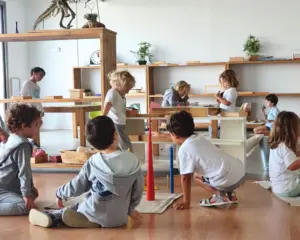
These milestones have wide ranges. A child might walk at 10 months or at 15 months and still follow a typical path. In our Nido and Infant Community (0-3), we prioritise freedom of movement above all: clear floors, low shelves within reach and daily time outdoors. That’s what lets development follow its own rhythm.
Motor Milestones from 3 to 6 Years
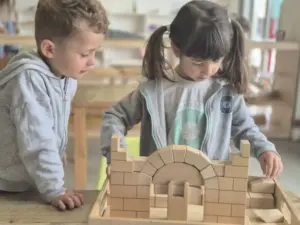
Between 3 and 6, the body becomes more agile and the hands much more skilful. At 4, a child handles their fingers well enough to thread beads, cut along a straight line with scissors and fasten large buttons. At 5, they copy a cross and their name (if they’ve been taught it), hop on one foot for a few steps and use a mature tripod grip (thumb, index and middle finger) to hold a pencil. Fine motor skills at 5 are already quite precise.

How Motor Skills Develop at Ages 4 and 5
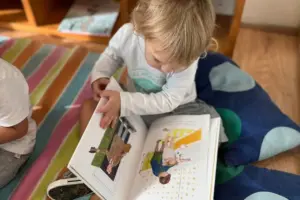
Between 4 and 5, the hand-eye coordination needed for writing consolidates. A child this age can already cut along a curved line, roll playdough into balls and sausages, zip up a jacket and drink from a cup without spilling. They begin copying simple geometric shapes and colouring within the lines. The writing grip takes hold even before there’s any actual letter formation.
Example: Picture an Afternoon Between 4 and 5
Imagine a 4-and-a-half-year-old wants to help you prepare a snack. You ask them to spoon chickpeas from a jar into a bowl, twist the lid off a small pot, and cut a banana with a serrated knife. It takes them much longer than it would you. Even so, those fifteen minutes move more motor development than twenty minutes of worksheets: hand strength, bilateral coordination, sustained attention and the desire to do it independently.
If your 5-year-old is moving from scribbles to drawings with detail (a person with fingers, a house with a chimney), their fine motor skills are progressing well. If not, adding more hands-on play each day usually does the trick: playdough, threading, screws and bolts, water play. Writing comes more easily when the hands are already strong and skilful, not the other way around.
Activities for Building Fine and Gross Motor Skills by Age
The best activities don’t require expensive materials or printable worksheets. Everyday life is a complete motor gym. What changes with age is the level of difficulty, not the type of play. The idea is to offer enough challenge that the child wants to try, without frustrating them.
Activities for the Smallest Ones (0-3 Years)
- Placing objects of different sizes in and out of boxes, jars and bags.
- Crawling through tunnels made of sheets or navigating cushions scattered on the floor.
- Eating safe pieces of fruit with their fingers to practise the pincer grip.
- Pulling apart and pressing together Velcro, opening and closing zippered bags.
Activities for Children’s House and Primary (3-6 Years)
- Pouring water or dried beans between containers, using funnels and spoons.
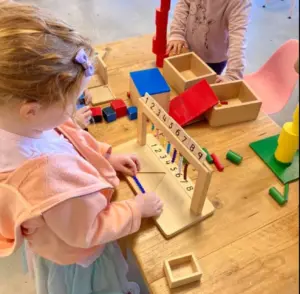
- Threading large beads, shoelaces or small coloured beads.
- Cutting strips of paper and then simple shapes with blunt-tipped scissors.
- Hopping from one imaginary stone to another, walking in balance along a line on the floor.
- Kneading bread dough or playdough: pure hand and wrist strength.
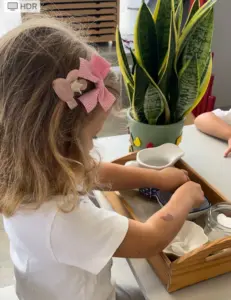
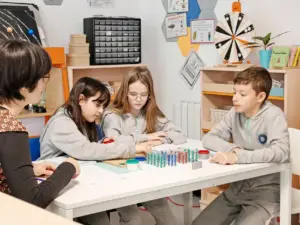
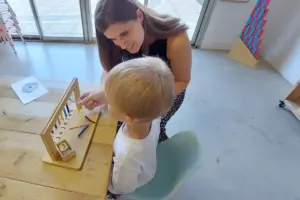
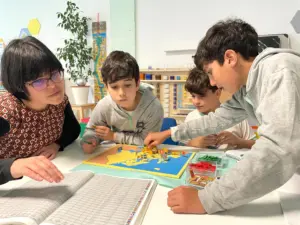
In the Children’s House (3-6) classroom, these actions are part of daily practical life. Children pour water, sweep, polish wood and use real tools adapted to their size. It’s movement with a purpose, and that purpose is what hooks them.
Which Comes First: Gross Motor or Fine Motor Skills?
Gross motor skills develop first, and fine motor skills build on top of them. The order is always proximal-to-distal and head-to-toe: a child gains control of the head and trunk before the limbs, and the shoulders before the fingers. A child who can’t sit up steadily won’t have fine finger control, and forcing it only creates tension. Once the postural base is solid, the hands learn quickly.
Example: Picture a Staircase of Learning
Imagine you want a 3-year-old to cut with scissors. If they haven’t climbed, hung from a bar or dragged heavy objects, their wrist is weak and cutting resists them. But if they’ve spent months carrying trays, hanging from the playground bar and kneading dough first, the open-and-close motion of the scissors comes naturally. Gross motor work precedes and enables fine motor work. This hypothetical example shows why the order matters.
The Common Mistake That Holds Back Motor Development (and How to Fix It)
The most frequent mistake is jumping straight to pencil and paper before it’s time. Many families buy handwriting worksheets for a 3-year-old who still needs to climb, run and use their hands in practical life tasks. The result is frustration, rejection of paper and zero motor gain. A 3-year-old’s hands simply aren’t ready to hold a pencil with fine control.
The solution is simple: swap worksheets for movement and manipulation. Ten minutes a day of playdough, threading, pouring and cutting prepares the hand far better than any template. Once the child has mastered the tripod grip and trunk control, writing arrives almost on its own, and gladly. In primary, at Taller (6-12), the pencil is just one tool among many.
Frequently Asked Questions
How do gross and fine motor skills develop in children?
Gross motor skills develop first and lay the foundation for fine motor skills: a child controls the head, trunk and legs before the fingers. Fine motor skills progress afterward, with the maturation of the hands and hand-eye coordination. Both advance together through free play, daily movement and manipulating objects, respecting each child’s individual pace.
How does psychomotor development unfold in early childhood?
In early childhood, psychomotor development unfolds in ordered stages from ages 0 to 6, from controlling the head all the way to writing. Active play and practical life tasks (pouring, fastening, kneading) strengthen muscle tone and coordination. An environment that allows movement and independence accelerates progress.
How do fine and gross motor skills develop between ages 4 and 5?
Between 4 and 5, a child strengthens balance and coordination in gross motor skills (jumping, climbing, running) and refines the tripod grip in fine motor skills (cutting, threading, buttoning, detailed drawing). Scissors, playdough, outdoor play and adapted household tasks are great ways to work on these. Writing isn’t necessary yet.
Which comes first: fine motor or gross motor skills?
Gross motor skills come first. Development follows a head-to-toe and proximal-to-distal order: trunk before hands, fingers before writing. Good postural control and plenty of big-body movement prepare fine precision. Forcing the pencil before it’s time only creates frustration and tense postures.
If you’d like to see how this kind of motor development is supported in a real Montessori environment, we invite you to visit our project in Sotogrande, just minutes from La Línea de la Concepción, Algeciras and San Roque. Book a personalised school visit and see whether it’s the right fit for your family.