Toys Without Gender Stereotypes: A Montessori Guide for Inclusive Gifts in Spain

Why does the pink-blue division in toys still persist?
Last month, in a toy store in Barcelona, I saw a four-year-old girl ask for a fire truck. The saleswoman told her: “Sweetie, that’s for boys, why don’t you look at the dolls?” The girl insisted. Her mother, visibly uncomfortable, took her to the pink aisle. Scenes like this repeat daily in Spain. According to a UOC study (2023), 72% of toy advertisements in our country still explicitly segment by gender. It’s not a matter of fashion: it’s a limitation on child development. In this article we explore toys without gender stereotypes in depth with practical examples.
The pink-blue division is neither natural nor historical. Until the early 20th century, pink was associated with boys (derived from red, a strong color) and blue with girls (for the Virgin Mary). The marketing industry reversed the association in the 1940s to double consumption. Today, that segmentation still conditions play and, with it, the skills children develop.

How gender stereotypes limit development according to Montessori
Maria Montessori observed that children learn through free play and manipulation of concrete materials. A toy has no gender; we adults assign gender to it. When we label a play kitchen as “for girls” or a construction set as “for boys,” we are telling the child: “this is not for you.” We are denying them the opportunity to explore entire areas of knowledge.
Construction games develop spatial vision and mathematical skills. Play kitchens and dolls foster empathy, language, and care. If we segregate by gender, we are creating artificial cognitive gaps. In Spain, the INJUVE warned in 2022 that girls show lower self-confidence in math from age 6, precisely when construction games are no longer offered to them.
The specific case of the play kitchen and the truck
A boy who plays at cooking is practicing sequences, measurements, and cooperation. A girl who plays with trucks is learning about cause and effect, basic physics, and narrative. Denying either of these experiences impoverishes their development. Auditing schools in Madrid, I have seen how children who freely play with all kinds of toys have a richer vocabulary and solve social problems better.

Inclusive gifts: Montessori criteria for choosing well
The Montessori philosophy does not prescribe a list of toys, but principles. The ideal toy should be open-ended, realistic, and allow for error. Here are three practical criteria to get it right this year:
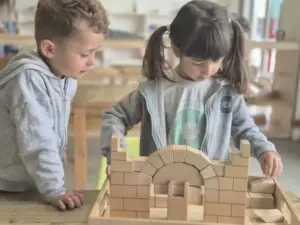
- Open-ended : that allows multiple uses. A set of wooden blocks can be used for building, stacking, sorting, or making sounds. A battery-operated toy with a single function does not foster creativity.
- Realistic : that represents the real world without exaggerated fantasies. A play kitchen with real utensils (wood, metal) teaches more than a plastic one with lights. The same applies to carpentry tools or art materials.
- Neutral in shape and color : avoid saturated colors and stereotypical shapes. Montessori materials usually use pastel tones or natural wood because they do not distract or pigeonhole. Neutrality invites the child to project their own imagination.
Toys for all ages without labels
Ages 0-3: visual mobiles, wooden rattles, stacking rings, fabric balls. Ages 3-6: sorting games, wooden puzzles, real kitchen utensils (safe), building blocks, realistic animals. Ages 6-9: science kits, puzzle maps, cooperative board games, musical instruments. At each stage, the key is to offer variety without imposing.

Data supporting gender-neutral play in Spain
In 2024, the Spanish Association of Toy Manufacturers (AEFJ) published a guide to eliminate gender bias in catalogs. Although 60% of companies signed the commitment, the reality in stores remains unequal. A report from the University of Valencia (2023) showed that children who receive non-stereotyped toys show greater frustration tolerance and more advanced social skills. It’s not ideology, it’s evidence.
Furthermore, the new Child Protection Law (LOPIVI) promotes equality education from early ages. Families who choose inclusive toys not only favor individual development but contribute to a more equal society.

Frequently asked questions
Can boys play with dolls without affecting their gender identity?
Yes. Playing with dolls develops empathy, language, and care skills. Numerous studies, including those from the University of Cambridge, confirm that the type of play does not determine sexual orientation or gender identity. What does determine it is the rigidity with which adults label games.
Where to buy stereotype-free toys in Spain?
There are more and more specialized stores: Akros Interdidak, Minikidz, or the Montessori section of some department stores. You can also look in educational materials stores and sustainable toy fairs. The AEFJ catalog includes equality seals on some products.
What if my child only wants toys of their assigned gender?
Don’t force it. Offer variety and play with them. If a boy only wants trucks, sit beside him and build a city. If a girl only wants princesses, invent stories where princesses also build castles. Gradual exposure and modeling are more effective than prohibition.
Key takeaways
Choosing toys without gender stereotypes is not a fad or a whim: it is an act of coherence with respectful education. Every time we give a toy, we are telling the child: “Your interests matter more than what society expects of you.” The Montessori philosophy reminds us that play is the child’s work, and limiting it by gender is stealing half the world from them.
This year, before buying, ask yourself: does this toy enrich their development or does it just fit into a commercial binary? Opt for open-ended, neutral, realistic. Your children will thank you with a freer and more complete childhood.