Pretend Play at 18 Months: How to Support It at Home

In a nutshell
- Pretend play is acting out actions with objects: it appears in its simplest form around 18 months (feeding a doll, talking on the phone).
- You don’t need to buy anything: wooden spoons, bowls, scarves, and boxes invite far more play than a toy with lights.
- Between ages 2 and 3, children move from imitating isolated actions to short make-believe scenes with a storyline.
- The most common mistake is directing the play. It’s better to observe, model one gesture, and give space for them to repeat it.

When does pretend play start?
Pretend play typically emerges between 18 and 24 months, with very simple gestures. Before that, children engage in functional play: they use objects according to their real purpose (brushing a doll’s hair, dialing a toy phone). By around age 2, actions start to link together, and by ages 3 - 4, pretend play develops into role play with a storyline.
Every child develops at their own pace. If your 18-month-old is still mainly exploring how objects work, there’s no cause for concern. The Spanish Association of Pediatrics reminds us that development is assessed as a whole (language, motor skills, social interaction), not on the basis of one type of play. If you have any concerns, talk to your pediatrician.

What activities can I do with an 18-month-old?
Short, concrete activities with real objects work best at 18 months: preparing a pretend “meal” with wooden bowls, bathing a doll with a damp cloth, hanging small laundry on a low line, or making a phone call with two toy phones. Ten minutes is plenty: attention spans are short at this age, and it’s best to stop before they get tired.
A concrete example to get started
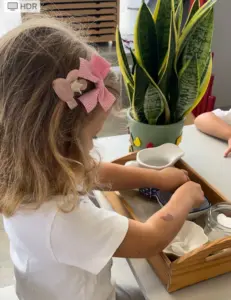
Imagine taking out two small bowls, two wooden spoons, and a simple doll. Hand one spoon to your child, take the other, and mime feeding the doll without talking too much. They will copy the gesture and, most likely, offer it to you or feed themselves. That already counts as pretend play, and no special toy was needed.

What is pretend play with examples?
Pretend play is the ability to treat an object or action as if it were something else: to make believe. A classic example is a stick that becomes a horse, a box that becomes a kitchen, or a doll fed with an empty spoon. It appears around 18 months, solidifies at age 2, and flourishes between ages 3 and 6.
Examples of pretend play in young children fall into three types. First, object substitution: a spoon becomes a telephone. Second, attributing life: the doll is hungry or sleepy. Third, a scene with a storyline: “we’re going to the doctor and the doll is sick.” This last type typically appears from age 3, when children begin to take on roles.
What does Vygotsky say about pretend play?
For Vygotsky, pretend play is the main activity of young children because it creates a “zone of proximal development”: in play, children practice what they cannot yet master in real life. That’s why an 18-month-old imitates actions they have observed: cooking, talking on the phone, caring for a baby. Imitation is the engine of learning, not an empty behavior.
Montessori arrives at a similar conclusion by a different path: children need to handle real objects and recreate the everyday life of the adults around them. Both perspectives agree that play is not “just play”, it is how young children make sense of their world. You can explore the principles of Montessori pedagogy further at the Association Montessori Internationale.
Toys for pretend play
The best toys for pretend play are simple, open-ended objects that can be used in many ways. For an 18-month-old, these are enough: a simple poseable doll, a bib or scarf, two wooden bowls, a spoon, a small basket, a piece of fabric, and a toy phone with no screens. Everything fits in one box.
Avoid toys with a single function and lots of sound effects, because they do the playing for your child and leave no room for imagination. A cardboard box with a hole becomes a kitchen, an oven, or a mailbox, and changes function every day. If you’re looking for other Montessori-inspired activities for 18- to 24-month-olds, prioritize real materials at child scale.
| Age | What happens | What to offer |
|---|---|---|
| 12-18 months | Functional play: uses objects for their real purpose | Small real utensils, simple doll |
| 18-24 months | First isolated pretend actions | Bowls, spoons, fabric, toy phone |
| 2-3 years | Links actions into scenes | A pretend-play corner with a basket of objects |
| 3-4 years | Role play with a storyline | Simple dress-up clothes, animals, small scenes |
Pretend play resources
Quick checklist for setting up the basket
- Two wooden bowls and two wooden spoons.
- A simple poseable doll and a scarf or bib.
- A large piece of fabric (blanket, scarf).
- A small cardboard box.
- An old phone or remote that’s no longer used.
A common mistake (and how to fix it)
Mistake: constantly directing the play. If your child is pretending to feed the doll and you say “no, not like that, feed them this way,” the play breaks off and they stop exploring. Solution: observe first, model a gesture only once, and wait. If your child changes the rules of the game (the doll eats sand, for example), they’re experimenting, let them.
Pretend play for toddlers: 8 scenarios
These eight scenarios grow with your child from 18 months to age 4. The table above will help you know what to expect at each stage.
- Kitchen: bowls, spoons, and a box as a stovetop.
- Baby care: feeding, tucking in, and putting a doll to sleep.
- Doctor: “listening” with an object and applying a fabric bandage.
- Shop: exchanging objects and “paying” with cardboard pieces.
- Laundry: hanging small scarves on a line at your child’s height.
- Building: a large box that becomes a house, car, or boat.
- Travel: a blanket as a boat, with objects that “climb aboard.”
- Characters: talking to a doll, a stuffed animal, or a shadow.
Choose two or three scenarios and rotate them week by week. Novelty sustains interest better than putting everything out at once. If your child is 2, you’ll see them start to mix scenarios: the doctor cooks, the mother builds. That’s a sign of creativity, not confusion.
Frequently asked questions
When does pretend play start?
Pretend play becomes clearly visible between 18 and 24 months, with simple pretending actions like feeding a doll or talking into a TV remote. Before that, children engage in functional play. By ages 3 - 4, it develops into role play with a storyline.
What activities can I do with an 18-month-old?
Short activities with real objects work well at 18 months: preparing food in wooden bowls, bathing a doll, hanging small laundry, or making a call with a toy phone. Ten minutes is plenty, and it’s best to stop before they get tired. No screens.
What is pretend play with examples?
Pretend play is acting as if an object or action is something else: a stick that’s a horse, a box that’s a kitchen, a doll fed with an empty spoon. It appears around 18 months, solidifies at age 2, and flourishes between ages 3 and 6.
What does Vygotsky say about pretend play?
For Vygotsky, pretend play creates a “zone of proximal development”: in play, children practice what they cannot yet master in real life. That’s why they imitate the adults around them. Imitation is learning, not empty behavior, and it supports language development and socialization.
If you’d like to see how we support this kind of play in our classrooms, book a personalized visit to the school. Bring your little one: watching them in our prepared environment will tell you more than any article.