Pre-Symbolic Play: 12 Examples by Age and the Mistake That Slows Development

If you’re searching for pre-symbolic play examples, here’s the quick answer: they’re the actions a baby or toddler repeats with objects to discover what they do, long before they can pretend with them. Sucking a rattle, shaking it, banging it on the floor, dropping it, or putting it in a box. These are the seeds of all the play that follows, and here you’ll find concrete examples by age, the main types of play, and one typical mistake worth avoiding.
In short
- Pre-symbolic play is functional and exploratory: the child repeats actions with objects between 0 and 2 years old, without pretending yet.
- Examples by age: mouth and hands (3-8 months), repeated actions like throwing (9-15 months), and combinations like putting in and taking out (15-24 months).
- It’s different from symbolic play, which appears around 18-24 months when the child uses an object as if it were something else.
- The most common mistake is jumping ahead with scripted toys, which replace free exploration with instructions.

What is pre-symbolic play?
It’s called pre-symbolic because it comes before the symbol. The child doesn’t pretend the spoon is a phone. They simply pick it up, bang it, put it in their mouth, and repeat. In developmental terms, it’s also known as functional play or practice play.
How to recognise it at home
Three clear signs. First, repetition: they throw the toy twenty times in a row. Second, variation: they change one detail of the action, for example throwing from higher up. Third, the absence of a character: nobody is playing a role. If you see all three, you’re watching pre-symbolic play.

What are the 4 types of play?
The classification most widely used in child development distinguishes four types based on what the child brings to the activity: functional or exercise play, constructive play, symbolic or pretend play, and games with rules. Maria Montessori also spoke of children’s work to name that serious, concentrated activity, something the Spanish Paediatric Association echoes when insisting that play is the engine of development.
- Functional or exercise play: repeating actions for the pleasure of mastering them. Running, throwing, stacking. This is the territory of pre-symbolic play.
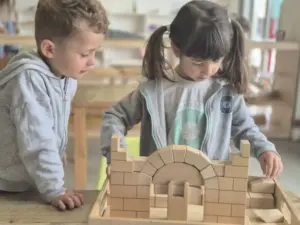
- Constructive play: creating something with materials. Block towers, puzzles, drawing. Appears around 18 months.
- Symbolic play: pretending. A stick becomes a sword. Dominates from ages 2 to 6.
- Games with rules: accepting shared rules. Lotteries, sports, board games. From ages 4-5.

What are 10 types of play?
Broadening the map, children’s play unfolds in ten overlapping forms. None replaces the previous one. They all coexist, and the child needs a prepared environment that offers all ten.
- Sensory play: exploring textures, water, sand.
- Gross motor play: running, jumping, climbing.
- Fine motor play: fitting, threading, using tongs.
- Functional play: repeating actions with objects. The pre-symbolic kind.
- Cause and effect play: pressing a button to make a sound.
- Construction play: towers, bridges, collages.
- Symbolic play: pretending roles and scenes.
- Social play: playing with others, taking turns.
- Language play: rhymes, songs, made-up words.
- Games with rules: competing under agreed rules.
A hypothetical example that ties them together
Example: play that evolves. Imagine your 18-month-old pushes a wooden car across the floor, over and over (functional). Then they lift the car onto the sofa and drop it (cause and effect). Next they line it up with three others (construction). Later they make it drive past a fabric clown (pretend). The same object supports four types of play in a single afternoon.
What are some types of symbolic play?
- Substitution: the spoon is a phone. A classic example of symbolic play in two-year-olds.
- Object assignment: a box becomes a cot for the teddy bear.
- Role play: the child pretends to be a doctor, a cook, or a mum.
- Script play: sequences with a beginning and an end, like preparing a meal and serving it.
- Sociodrama: several children sustain a story with characters and rules.
With symbolic play, examples for 2-year-olds abound: holding an unplugged phone to the ear, rocking a doll even when it’s not there, or feeding a teddy bear with an empty spoon. By around three, these scripts grow longer and playmates join in.
Pre-symbolic play in practice, with examples by age
From 3 to 8 months: exploring with the mouth and hands
In this phase, grasping and oral play dominate, as described by paediatrician Emmi Pikler. You can offer lightweight wooden objects, a textured ring, or a silk scarf. Hold the object close to their chest and wait: you’ll see them bring it to their mouth, pass it from one hand to the other, and let it go.
Example: the rattle. If your 6-month-old has a wooden rattle, the pre-symbolic behaviour is shaking it to hear the sound, banging it on the tray, and repeating the sequence. Offering four identical rattles only adds noise. One is enough.
From 9 to 15 months: repeating and varying an action
The child discovers that their action changes the world, and wants to repeat it hundreds of times. Throwing, emptying, banging, dragging. Here it helps to have a low, stable basket with three or four varied objects: a small ball, a scarf, a ring, and something that makes a noise. In the Nido, the 0-3 Community, the floor is the best ally: firm cushions and a clear space.
Example: emptying time. Imagine your 12-month-old has a box with five caps. They take them all out one by one, look at them, bang them together, and then try to put them back in. They don’t need you to teach them how. They need you not to do it for them.
From 15 to 24 months: combining two actions
Combinations appear: in and out, open and close, matching, fitting. This stretch is the bridge to symbolic play, because the child begins using one object to act on another. You can prepare a box with a lid and holes, or a bag with objects that fit exactly through the slot.
In the Children’s House, the 3 to 6 stage, those materials are still present, but now with fictional scripts layered on top. The transition isn’t a jump: it’s an expansion.
A typical mistake and how to fix it
The most frequent mistake is jumping ahead with toys. Many families buy play kitchens, work benches, or dolls for a child who is still in the pre-symbolic phase, and then prompt them: “come on, cook, feed the baby.” The child tries to follow the adult script, loses interest quickly, and free exploration disappears.
The solution is simple. Offer open-ended materials: boxes, fabrics, wooden spoons, tubes, everyday objects. Place them on trays at their height, in a fixed spot, and put everything else away. Repetition comes on its own. The American Academy of Pediatrics safe play recommendations point in the same direction: fewer toys, more free play.
Checklist for setting up a pre-symbolic play corner
- Clear floor space, with a blanket or firm cushion where they can move.
- Between five and eight open-ended objects made of wood, fabric, or metal.
- A low basket or tray, always in the same place.
- No batteries, no lights, no automatic music.
- At least twenty minutes a day without intervening or correcting.
Frequently asked questions
What is pre-symbolic play?
It’s repetitive exploratory actions the child performs with objects and with their own body before they can pretend with them. They appear between 0 and 2 years old: the baby sucks, shakes, bangs, throws, or puts objects in and takes them out. There’s no character and no fiction; the child is practising and discovering the physical properties of the world.
What are the 4 types of play?
The four types are functional or exercise play, constructive play, symbolic or pretend play, and games with rules. Functional play repeats actions, constructive play creates things, symbolic play pretends characters, and games with rules accept shared rules. Each appears at a different developmental moment, and all of them coexist throughout childhood.
What are 10 types of play?
They are: sensory, gross motor, fine motor, functional, cause and effect, construction, symbolic, social, language, and games with rules. Each develops different abilities, from balance to language or cooperation. None is better than another: the child needs spaces to practise them all.
What are some types of symbolic play?
Substitution (a stick is a sword), object assignment (a box is a cot), role play (pretending to be a doctor), script play with narrative sequences, and sociodrama among several children. It appears around 18-24 months and takes hold between ages 3 and 6.