
Montessori Outdoor Classroom Design & Materials | IMS Sotogrande
Designing a Montessori outdoor environment is about more than just taking toys into the garden. It’s about creating a space where your child can explore freely, develop autonomy, and connect with nature, all following their own rhythm. Whether at home or at school, the outdoors becomes a living classroom when we know how to organize it. In this article we explore Montessori outdoor classroom in depth with practical examples.
Key Takeaways
- The Montessori outdoor environment respects the child’s developmental stages, offering materials and areas adapted for each age.
- Nature is the best Montessori material: soil, water, plants, and stones stimulate all the senses.
- A good outdoor design includes distinct zones for movement, sensory work, plant care, and rest.
- At IMS Sotogrande, we integrate outdoor corners as a natural extension of our AMI-accredited classrooms.
What is a Montessori Outdoor Classroom and Why It Matters
A Montessori outdoor classroom is an open-air space designed with pedagogical intent. It’s not a generic yard with swings, but an environment where each element invites the child to explore, work, and care for their surroundings independently. Maria Montessori herself noted that contact with nature is essential for the child’s holistic development.
Dr. Angeline Lillard, a researcher at the University of Virginia, has demonstrated in her studies that children in Montessori environments show greater concentration, creativity, and social skills. When that environment includes the outdoors, the benefits multiply: free movement reduces anxiety, contact with soil strengthens the immune system, and observing nature develops scientific thinking. When it comes to Montessori outdoor classroom, it pays to listen to what families and lead guides actually report.
How to Create a Montessori Garden at Home
Creating a Montessori outdoor environment at home doesn’t require a large garden. A balcony, terrace, or corner of a patio can be transformed with a few changes. The key is to offer the child direct access to nature and materials sized for them. Daily practice with Montessori outdoor classroom reveals nuances no handbook fully captures.
Essential Zones for Your Outdoor Space
Divide the space into functional areas. A movement zone with uneven surfaces (grass, soil, smooth stones) for climbing and balancing. A vegetable patch or planters with aromatic plants the child can water and harvest. A low table with sensory materials like water, sand, or clay. And a quiet corner with cushions or a hammock for cloud-watching or reading.
Materials should be within the child’s reach, on low shelves or in wicker baskets. Avoid over-stimulation: less is more. A wooden rake, a small watering can, a bucket with water and natural shells offer hours of focused work.
Montessori Materials for the Outdoors
Outdoor materials in Montessori are mostly natural and multisensory. Stones of different textures, logs for stacking, containers with water for pouring, seeds for sorting. From age 3, a child can use real tools adapted to their size: shovels, rakes, pruning shears with supervision.
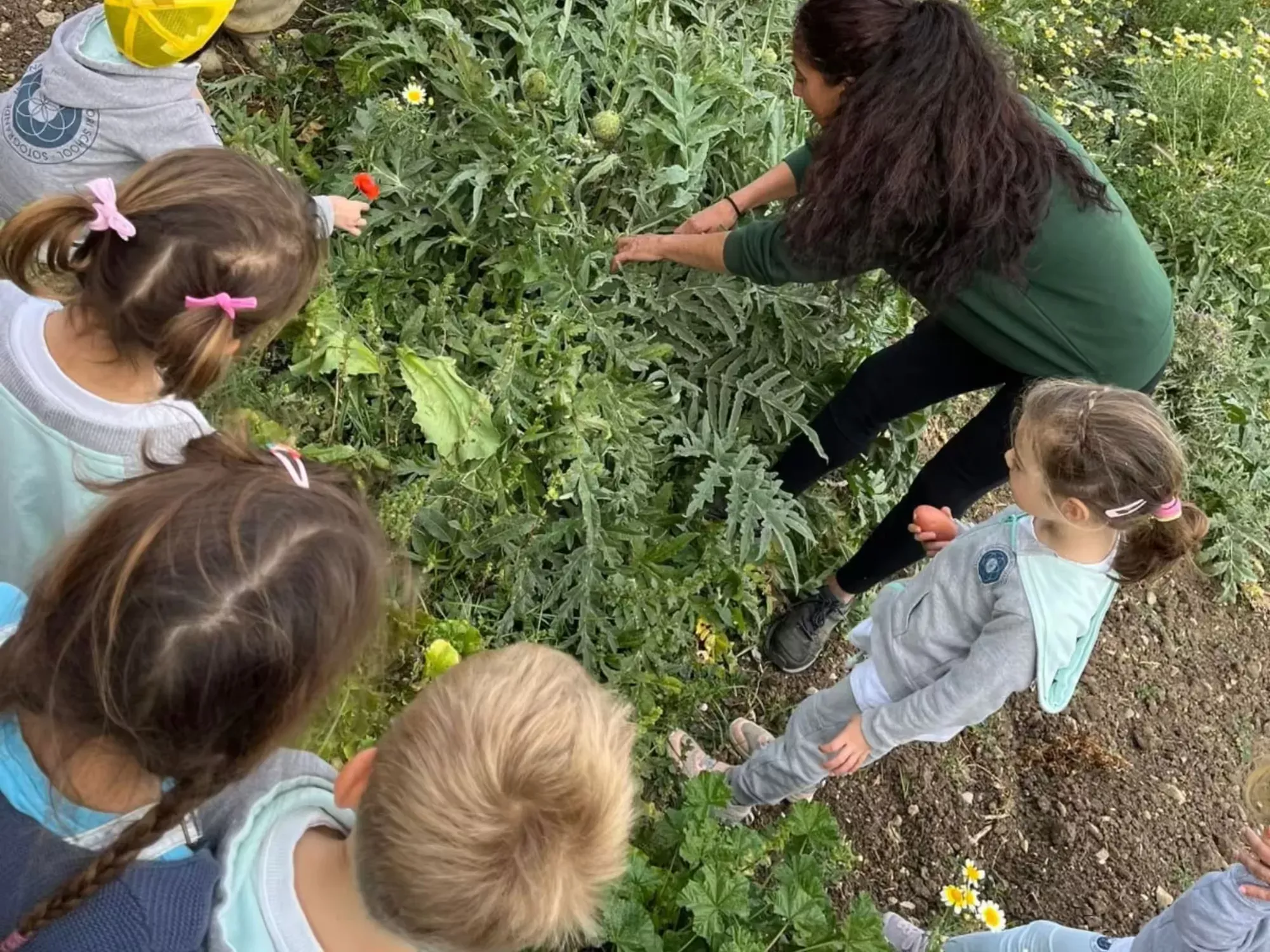
In the Children’s House (ages 3-6), plant care is a fundamental practical life activity. The child learns sequences (watering, removing dead leaves, repotting), develops fine motor skills, and assumes responsibility for a living being. In Elementary (ages 6-12), the garden becomes a science lab: pH measurements, insect observation, field journals.
For families looking for an international school in the Campo de Gibraltar area with classrooms that open to the outdoors, book a personalized school visit and discover our outdoor corners in Sotogrande.
The Outdoor Environment in the Montessori Classroom
In an AMI-accredited Montessori school, the outdoor environment is an extension of the indoor classroom, not a separate space. Sensory, practical life, and language materials can be moved outdoors when the child needs them. Dr. Montessori spoke of the ‘cosmic child’ who relates to their entire environment, and the outdoors is an essential part of that vision.
At IMS Sotogrande, our classrooms feature outdoor corners where children work with Montessori materials under natural light. The Spanish-English bilingual immersion also extends outdoors: the guides converse with the children in both languages while they tend the garden or explore natural textures. It’s an experience that families in Sotogrande, La Línea, Algeciras, and the whole area particularly value.
Common Mistakes When Creating a Montessori Outdoor Space
The most frequent mistake is treating the outdoors as an energy-burning zone rather than a work space. Swings and slides have their place, but in a Montessori environment the child also needs opportunities for concentrated work outdoors. Another mistake is overloading the space with plastic toys: nature offers much richer materials.
It’s also important to respect the child’s rhythm. If a 2-year-old wants to spend 20 minutes watching ants, don’t interrupt them to ‘do an activity.’ That silent observation is deep concentration, one of the pillars of Montessori pedagogy. The same goes for controlled risk: climbing a low log or hopping stones develops confidence and coordination safely.
Frequently Asked Questions
At what age can I start creating a Montessori outdoor environment?
You can start from birth. A few-months-old baby benefits from being outdoors on a blanket, watching leaves move and feeling the wind. From 12-18 months, when they start walking, introduce varied surfaces, containers with water, and natural elements to manipulate. The Montessori outdoor environment adapts to each plane of development.
Is it necessary to have a garden to apply Montessori outdoors?
No. A balcony with potted plants, a terrace with a low table and natural materials, or even a nearby park can become your Montessori outdoor environment. What’s important is that the child has regular access to nature and materials sized for them. Many families in La Línea, Algeciras, or San Roque use local parks as an extension of their Montessori space at home.
What Montessori materials can I use outdoors?
Smooth stones, logs, shells, seeds, soil, water, aromatic plants, child-sized gardening tools, containers for pouring and sorting, and natural art materials like plant dyes. The essentials are that they are real (not toys), multisensory, and accessible to the child without adult help.
How is the outdoors integrated into an accredited Montessori school?
In a school with AMI accreditation, the outdoor environment is part of the complete pedagogical design. Sensory and practical life materials are moved outdoors according to the child’s need. The guides observe and prepare the space just as they would indoors. At IMS Sotogrande, for example, our outdoor corners complement the indoor classrooms with authentic Montessori materials.
Key Conclusions
The Montessori outdoor environment transforms any open-air space into an authentic learning setting. You don’t need extensive resources: with natural materials, functional zones, and respect for the child’s rhythm, your garden or terrace can become a living classroom that fosters autonomy, concentration, and a love for nature.
If you’d like to see how we apply these principles at our school in Sotogrande, book a personalized visit. We’ll show you our outdoor corners and how every child, from Infant Community to Elementary, connects with nature as part of their daily Montessori experience.









