
Montessori Materials Guide: Practical Tips for Families in Sotogrande, Gibraltar & Costa del Sol
In short
Montessori Materials Guide: The first time I walked into a Montessori classroom, the silence struck me. No desks, no blackboard, no rows. But what caught my eye were the low shelves full of trays, wooden blocks, bowls, and tiny pitchers. Those were the Montessori materials the invisible skeleton of this pedagogy.

- What Montessori Materials Are (and What They Are Not)
- The Five Characteristics Every Montessori Material Must Have
- Montessori Materials by Stage: From Nest to Workshop
- Common Mistakes When Choosing Montessori Materials at Home
- How to Improvise Montessori Materials Without Breaking the Bank
- Montessori Materials vs. Conventional Toys: Why the Difference Is Noticeable
- The Most Controversial Montessori Material: Fragile Objects
- Frequently Asked Questions
- Key Takeaways
What Montessori Materials Are (and What They Are Not)
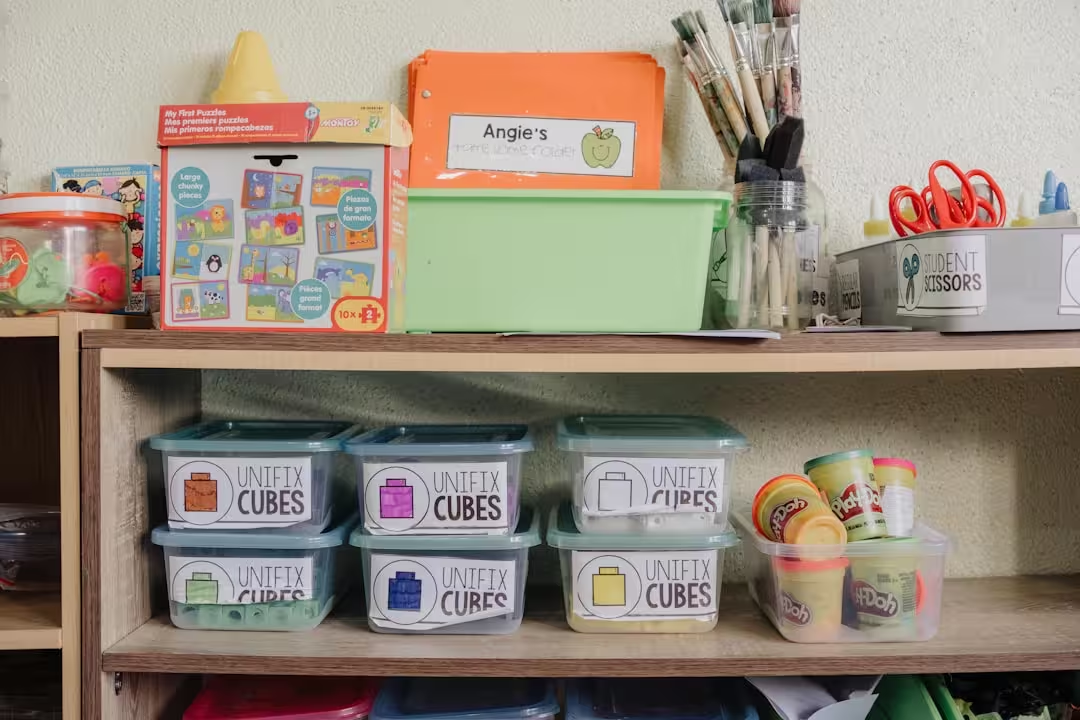
The first time I walked into a Montessori classroom, the silence struck me. No desks, no blackboard, no rows. But what caught my eye were the low shelves full of trays, wooden blocks, bowls, and tiny pitchers. Those were the Montessori materialsthe invisible skeleton of this pedagogy. They are not toys, though some may look like it. They are not decoration or an aesthetic whim for Instagram. Each piece has a scientific purpose: to isolate a difficulty, refine a movement, or awaken an abstract concept through concrete manipulation. Without them, the prepared environment is just good intentions. In this article we explore Montessori materials guide in depth with practical examples.
Here in Sotogrande, at IMS, each material is designed for a specific developmental stage. Guides present them one by one, at the right moment, and then the child repeats until mastery. No rewards, no punishment: the material itself provides error correction. If the pink tower collapses, the child sees what happened and corrects it. That is real autonomous learning, not an empty phrase in a brochure.
Book a personalized visit to the school and come see how children work with materials in our classrooms.
The Five Characteristics Every Montessori Material Must Have
Not everything sold with the “Montessori” label deserves the name. Maria Montessori designed her materials after years of scientific observation with almost obsessive rigor. Here are the five traits that should never be missing:
- Isolate a single quality: The material focuses on one concept, weight, color, length, sound, so the child is not distracted. For example, the red rods vary only in length. All have the same color and thickness.
- Built-in error control: The object itself tells the child if they are correct. The cylinders only fit into their exact hole. If one is left over, something is wrong. No need for an adult to correct.
- Aesthetic and appealing: Natural wood, vivid but not garish colors, harmonious proportions. Beauty invites activity. Cheap plastic or busy designs often scatter attention.
- Size and weight adapted to the child’s hand: Trays they can carry unassisted, pieces they can handle without fatigue. This fosters independence from 18 months.
- Purposeful activity: The material is not for free play alone. Each has a presentation and a specific goal. Then the child can repeat, explore variations, but the focus is clear.
If a material does not meet at least three of these characteristics, it is probably a nice toy, but not a pedagogical tool. And that is fine, but do not call it Montessori.
Montessori Materials by Stage: From Nest to Workshop
0 to 3 Years: The Conquest of Movement and Practical Life
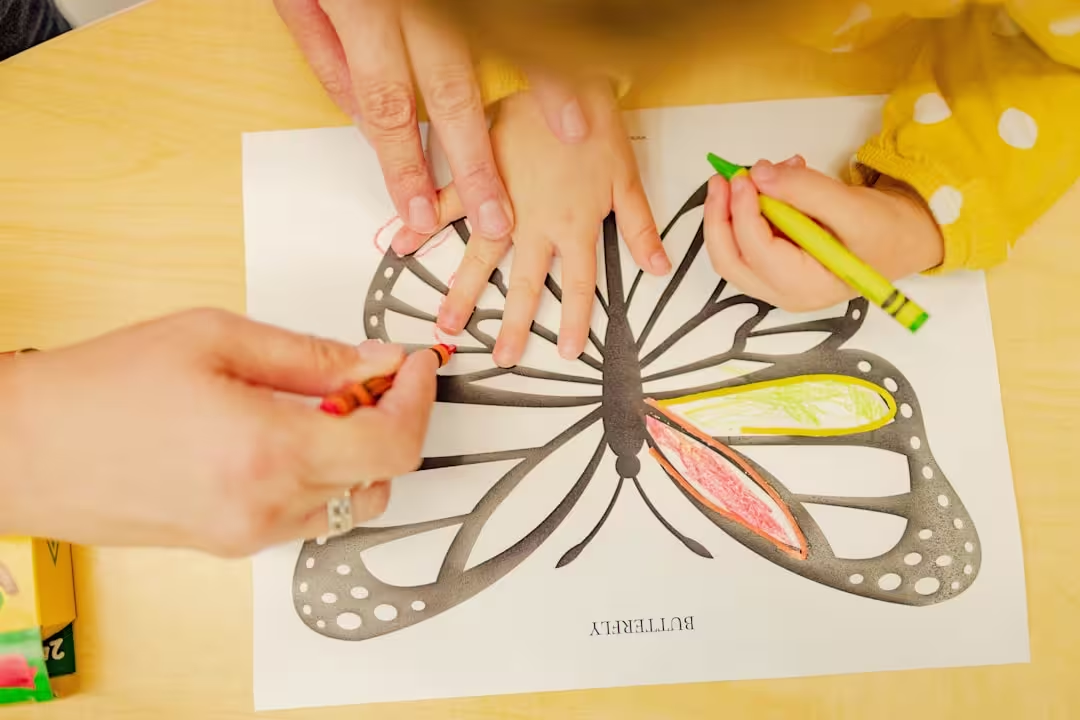
The first plane of development is marked by the absorbent mind and the need to refine gross and fine motor skills. Here, Montessori materials are real objects, not miniatures: glass pitchers, sponges, large beads, grasping puzzles, and drawers with locks. In our Nest at IMS, toddlers transfer chickpeas, clean tables with a spray bottle, and open and close screw-top jars. This is not yet symbolic play, it is real exercise with purpose. Repetition of these movements lays the foundation for hand-eye coordination and self-confidence.
The most iconic material of this stage is the tower of cubes, but also the object permanence box or the vertical discs. You do not need to spend a fortune. A basket with corks and a clothespin, a coffee can with a slot for popsicle sticks, an unbreakable mirror at their height, that is Montessori for 0 to 3.
3 to 6 Years: Sensory Awakening and First Symbols
In the Children’s House, the senses are fine-tuned like an instrument. Here come the pink tower, brown stair, color boxes, sound cylinders, thermic tablets, and bells. The child assimilates concepts like heavy-light, rough-smooth, long-short through repeated manipulation, before naming them. Only later do guides introduce nomenclature: “this is rough, and this is smooth.”
Meanwhile, practical life materials gain complexity: sewing with a blunted needle, cutting fruit with a butter knife, washing real dishes in a basin. And without rush, sandpaper letters and the movable alphabet emerge. Language explodes when the child is ready, not when the calendar dictates. At IMS Sotogrande, we see children who at age 4 could barely babble in English, at 5 writing bilingual shopping lists because the need to communicate came from within.
6 to 12 Years: The Reasoning Mind and Research
In Workshop 1 and 2, Montessori materials transform into research tools. No longer limited to isolating qualities, they now tell stories, connect disciplines, and spark questions. The timeline, economic geography maps, chains of mathematical operations (addition, subtraction, multiplication, division with concrete materials before abstract algorithms), and scientific nomenclature boxes. The child moves from “what is it” to “why” and “how did we discover it.”
A real example: last week a 9-year-old student set up an experiment with the density material because he had read about the Dead Sea. He found the graduated cylinders and metal balls in the cupboard and spent an hour measuring, recording, and formulating hypotheses. The material sparked the research. The guide just brought him a glass of salt water.
Common Mistakes When Choosing Montessori Materials at Home
Many families, with the best intentions, fall into traps that end up frustrating everyone. Here are the four mistakes I see most often:
- Buying too much and presenting everything at once: The Montessori environment should be orderly and predictable. If the child sees 20 new trays on the first day, they become overwhelmed. Better to rotate 3 or 4 activities each week.
- Forcing use: If your child shows no interest in the red rods at age 3, put them away. Maria Montessori spoke of “sensitive periods”, the window opens and closes naturally. Forcing creates a negative association with the material.
- Substituting real materials with plastic: Glass that breaks teaches cause and effect. Plastic does not. Obviously, with supervision and common sense, we wouldn’t give a glass pitcher to a 10-month-old without an adult nearby. But from age 2, fragility is a powerful teacher.
- Forgetting practical life: It is tempting to fill the house with puzzles and numbers, but children first need to master self-care and environment activities. Dressing themselves, setting the table, watering plants. Without that foundation, intellectual materials lose meaning.
How to Improvise Montessori Materials Without Breaking the Bank
You don’t need to buy the official brand. Montessori pedagogy doesn’t depend on a logo, but on a principle. With well-chosen everyday objects you can create real magic:
For transferring: two ceramic bowls and chickpeas. For classifying: an ice cube tray with colored pom-poms. For fine-tuning hearing: opaque bottles with rice, lentils, and sand. For graphomotor skills: a tray with fine sand to trace letters with a finger. Even math: with buttons and numbered cards you can replicate the Seguin board.
The key is the presentation: show the material with slow, precise movements, without speaking, then invite the child to try. On our IMS YouTube channel (yes, the one Daniela records in the workshop), we often post tutorials on how to set up a low-cost Montessori environment.
Montessori Materials vs. Conventional Toys: Why the Difference Is Noticeable
A child raised with Montessori materials develops a concentration ability that astonishes any grandparent. In a traditional classroom, every 20 minutes the bell changes activity. In Montessori, the child may spend 45 continuous minutes fitting cylinders without interruption. That flow time builds deep neural connections. Toys with lights, music, and multiple buttons, on the other hand, foster fragmented attention and dependence on external stimulus. They are not “bad”, they just train a different type of brain.
A longitudinal study from the University of Virginia (2020) compared children from Montessori preschools with those from traditional ones and found that the former showed better emotional regulation and greater cognitive flexibility at age 6. The key variable was not the philosophy, but the type of material they manipulated daily. At IMS we see it every day: children entering at 3 not knowing how to hold a clothespin, and within a month they are pouring water without spilling. That is real empowerment.
The Most Controversial Montessori Material: Fragile Objects
I confess that when I started as a guide, I got nervous every time a 2-year-old picked up a glass pitcher. But Olimpia Tardá said something I’ve never forgotten: “Tamara, glass teaches care. Plastic teaches indifference.” She is absolutely right. When a glass breaks, the child feels the immediate consequence of their abrupt movement. They clean up the pieces (with help, of course) and next time handle the object with a tenderness that moves you. That is not something a shatterproof sippy cup can teach.
Of course, common sense applies. We don’t put a wine glass in the hands of a child who still wobbles. In the Nest, we start with wood, then thick glass, and gradually refine. Progression is part of the secret.
Frequently Asked Questions
How many Montessori materials does my child need at home?
Fewer than you imagine. With 5 or 6 well-chosen trays, rotated each week, you have enough for the first 6 years. The important thing is not quantity, but that they respond to their current interest. If they are obsessed with opening and closing lids, that becomes your priority.
Can normal toys be mixed with Montessori materials?
Of course. Home is not a classroom and doesn’t have to be. You can have a shelf with Montessori materials in the living room and a box of stuffed animals in their room. The key is that the child distinguishes when they are in “focused work mode” and when in free play. It helps a lot to define spaces: the low table for trays, the rug for building.
At what age can math materials be introduced?
The first math concepts (more-less, big-small, full-empty) arise naturally around age 2 with sensory and practical life materials. The number rods and spindles are usually introduced in the Children’s House around age 4, but only when the child shows interest. Forcing before that only causes rejection.
Are Montessori materials necessary to apply the pedagogy at home?
No. The essential thing is the adult’s attitude: observe, respect the child’s pace, allow mistakes, and encourage autonomy. Materials are wonderful tools, but if you don’t have them one day, you can always involve your child in cooking, gardening, or cleaning. Daily life is the best Montessori material of all.
Key Takeaways
Montessori materials are not an end in themselves, but a means for the child to discover the world and themselves. Choosing them wisely, presenting them with respect, and allowing mistakes without intervening are the three legs that support their effectiveness. If in doubt, start simple: a transferring activity, a tower of cubes, and lots of observation. The rest will follow.
At IMS Sotogrande, in the heart of Campo de Gibraltar, we accompany families from their first contact with this pedagogy. If you want to see how we work with materials in a real environment, with AMI-certified guides, we invite you to schedule a no-obligation visit. Your child will show the way. We just provide the tools.









