Montessori light table: what it is for and how to use one at home

In summary
- A light table builds observation, sorting and hand-eye coordination from 18 months to 6 years, and can be reused later for sensory math work.
- Short 15 to 20 minute sessions, with only a few materials at a time and an adult always nearby, work far better than leaving it switched on all afternoon.
- The most common mistake is offering too many pieces: with three or four types of material a child concentrates, with thirty they scatter.
- Before buying, check for adjustable height, cool-to-the-touch LED light and a wipe-clean surface. You do not need the largest model to get started.

The Montessori light table in the early years
In the early years, a light table works as a sensory material: the child does not play “because it glows”, but because the light makes visible properties that go unnoticed in normal daylight. Color becomes translucent, shadows take center stage, and differences between pieces become clearly visible.
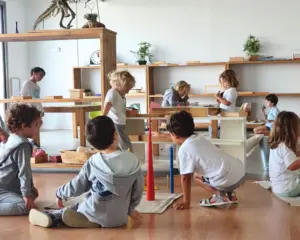
Montessori described the absorbent mind: between the ages of 3 and 6 a child takes in the environment with tremendous intensity. That is why material should be presented in an orderly way, in trays and with a clear purpose. This is how it works in a prepared environment, just as it does in Casa de Niños (3-6 years).
The Montessori light table serves as an experimentation bench, not a decorative toy. Its educational value appears when the child compares, orders and repeats. Without that intention, the table is just a pretty spotlight.
What skills it trains, by area
The table summarizes what to watch for by age. These are not rigid stages, but useful cues for adjusting the challenge.
- 18-24 months: fitting, dragging and stacking large translucent pieces. Works on grasp and cause and effect.
- 2-3 years: sorting by color and size, pouring small contents. Works on order and vocabulary.
- 3-4 years: simple mosaic patterns and gradient sequences. Works on visual discrimination.
- 4-6 years: transferring with tweezers, tracing with stencils and exploring shadows. Works on precision and pencil control.
- 6-12 years: fractions with translucent circles, prisms and light and shadow experiments. Works on logical thinking.
The Spanish Association of Pediatrics reminds us that free, hands-on play is the main route to learning in the early years. The light table fits that idea as long as it respects the child’s own pace.

The magic of playing with light and color, step by step
Imagine your 3-year-old has four translucent bowls and a tray of colored beads in front of them. You ask them to separate the red ones from the blue ones on the lit panel. Each illuminated bead looks like a drop of color. The activity lasts 12 minutes and ends when they decide to put the trays away. You have worked on visual discrimination, precision grasp and ordering without saying almost anything.
The Montessori light table also helps children explore the physical world. With a side flashlight and opaque objects, a child discovers that a shadow changes size depending on the distance. It is pure science, using kitchen materials.
Practical example with household materials
Example: colored circles and gradients. If your child is 4 and loves colors, cut tissue paper circles in five shades of the same color (for example, blue from lightest to darkest). Ask them to order them on the lit table, from the lightest to the most intense. The light surface makes the differences obvious that would blur on an ordinary table. Repeat the exercise with another color a week later.
These ideas draw on the principles of the Association Montessori Internationale, which holds that direct manipulation of material is the foundation of children’s learning.

How to choose a good light table for home
The criterion is not size, but fit for the child. A table that is too high forces posture, and one that is too large invites materials to be scattered without purpose. Prioritize three things: adjustable height or a cushion to correct position, low-temperature LED light, and a surface that wipes clean with a damp cloth.
The Montessori light table is a long-term investment when chosen well. A small model used thoughtfully delivers more than a large one that takes up half the room and gets used twice.
Common mistakes and how to fix them
Mistake 1: leaving the table on all afternoon. The novelty wears off and the light becomes visual noise. Fix: switch it on only during the activity and switch it off when tidying up.
Mistake 2: putting out all the materials at once. The child chooses out of overwhelm, not interest. Fix: present one activity at a time, in closed trays.
Mistake 3: using tiny pieces with children under 3. Beyond the choking risk, the precision grasp is not yet developed. Fix: large pieces and constant supervision. If you have any safety concerns, check with your pediatrician.
Checklist before buying or setting up the light table
- Does the height let the child rest their elbows without hunching?
- Does the light stay cool to the touch after ten minutes?
- Do I have three activities ready before first use?
- Do I store the materials out of reach when it is not in use?
- Can the surface take a damp cloth without risk?
If you answered yes to all five, the table is ready to work. If any answer is no, fix it before investing more in materials.
Frequently asked questions
What age can a child start using a light table?
From 18 months, with large pieces and constant supervision. From age 3 onwards the play becomes more intentional: sorting, ordering and composing. Adjust the activity to your child’s real interests and do not force it if they are not in the mood to explore that day.
How long a day is a good amount of time?
Between 15 and 20 minutes is enough for younger children, and up to half an hour if an older child is deeply focused. What matters is not the duration but the quality of attention. If they scatter, put the material away and come back another day.
What materials work well on a light table?
Translucent pieces, tissue paper, colored beads, droppers with tinted water, and natural objects such as leaves or shells. Avoid small materials with children under 3 because of the choking risk. Start with three or four types of material and expand once they have mastered the activity.
Do you need a professional-grade light table?
No. A household light panel or an adapted illuminated surface works fine as long as the height is comfortable and the light stays cool to the touch. What matters is how the material is presented, not the brand of the equipment. Prioritize lightweight models that are easy to store if space is tight.