
Montessori Hands-On Learning: Why Concrete Materials Are Key | IMS Sotogrande
In short
Montessori Hands-On Learning: Watching a four-year-old line up a row of beads and discover for themselves that ten units make a ‘ten’ is priceless. That moment is only possible when we offer hands-on work with concrete materials, one of the most powerful foundations of Montessori pedagogy and the starting point for all authentic learning.

Watching a four-year-old line up a row of beads and discover for themselves that ten units make a ‘ten’ is priceless. That moment is only possible when we offer hands-on work with concrete materials, one of the most powerful foundations of Montessori pedagogy and the starting point for all authentic learning. In this article we explore Montessori hands-on learning in depth with practical examples.
Key Points When it comes to Montessori hands-on learning, it pays to listen to what families and lead guides actually report.
- Hands-on work with concrete materials allows the child to build abstract concepts through the senses and movement.
- Maria Montessori designed materials that contain their own built-in control of error, eliminating constant adult dependence.
- At IMS Sotogrande, every classroom offers real AMI materials adapted to the three planes of development (0-3, 3-6, 6-12).
- A child’s voluntary repetition with a material reveals sensitive periods and consolidates concentration.
What Hands-On Learning Really Means in Montessori
Hands-on learning with concrete materials is the process by which a child manipulates physical objects designed to represent abstract ideas like quantity, grammar, or geometry. It’s not about ‘playing with things’. Each piece has a precise pedagogical purpose: the red cylinder fits only in its correct hole, the bead bar instantly shows the difference between 3 and 8, and the sandpaper letters combine touch and sight to fix the shape of each grapheme. Daily practice with Montessori hands-on learning reveals nuances no handbook fully captures.
Maria Montessori observed that young children need to touch, hold, and move in order to think. Premature abstraction, sitting a five-year-old in front of a worksheet, produces empty memorization. In contrast, when that same child stacks golden bead towers, the concept of ‘carrying’ becomes something they can see and feel between their fingers. Understanding Montessori hands-on learning from inside the classroom reshapes everyday decisions.

Why Hands-On Learning Works: The Neurological Basis
Educational neuroscience confirms what Montessori discovered over a century ago. The somatosensory cortex, the brain area that processes what the hands touch, is directly connected to the logic and language centers. A study published in Child Development (2015) showed that children who solved math problems by manipulating objects showed greater activation in the parietal cortex than those who only received verbal instruction. In simple terms: hands ignite the brain.
Furthermore, movement associated with learning generates dopamine, the motivation neurotransmitter. That’s why children in the IMS Children’s House repeat an activity up to fifteen times without being asked. It’s not obsession. It’s neuronal consolidation in action.

Montessori Materials Are Not Toys
It’s easy to confuse a Montessori material with any educational toy. The difference is structural. Each AMI material meets three conditions:
- Isolation of a single difficulty. The pink tower works only on size. If you added varied colors, the child would be distracted by color and lose focus on the dimension.
- Built-in control of error. The child knows alone if they did it right or wrong without an adult needing to intervene. This protects their autonomy and self-esteem.
- From concrete to abstract in gradual steps. The decimal system beads move from loose material (units) to cards with symbols and finally to the pure operation on paper. Each step is a bridge, not a leap.
In the IMS Sotogrande classrooms, from Nido (0-3 years) to Taller (6-12 years), the materials are organized on open shelves. The child chooses, works, repeats, and returns. That complete cycle develops responsibility, concentration, and respect for shared space.
Book a personalized school visit and see for yourself how your children interact with the materials in a prepared environment.

How Hands-On Learning is Applied at Each Development Stage
Nido and Community Initiation (0-3 years)
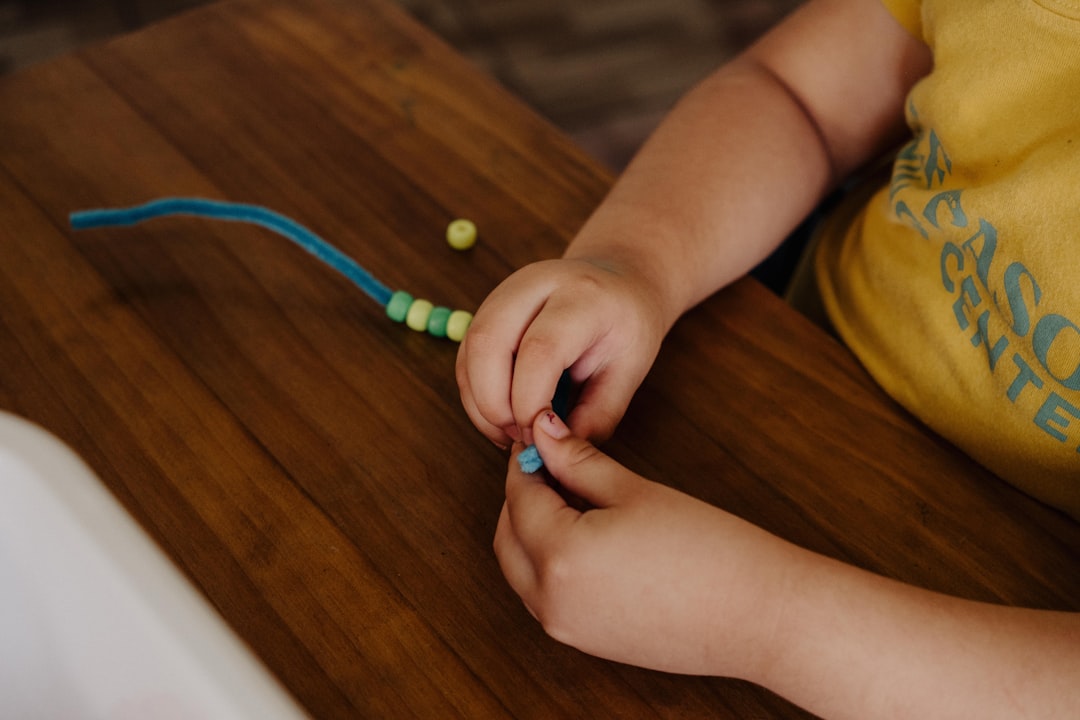
At this stage, hands-on work with concrete materials focuses on motor autonomy and sensory exploration. Pouring trays, large buttons for stringing, objects of different textures. The adult doesn’t teach. They present and observe. The baby pouring water from one jug to another is training hand-eye coordination, concentration, and the idea that they can cause an effect on the world.
Children’s House (3-6 years)
Here, hands-on learning with concrete materials reaches its full expression. The bead frame, the sandpaper numbers, the grammar box with colored symbols: each material opens a door to an abstract concept. The four-year-old who sets up the addition material on the table and discovers that 7+5=12 is not memorizing. They are understanding. At IMS, we also include Spanish-English bilingual immersion, which multiplies vocabulary opportunities while the child manipulates.
Taller (6-12 years)
In Taller, the concrete material doesn’t disappear. It transforms. The golden beads become fraction material. The blank maps are studied with hands before being drawn. The difference is that a child of this age can now, in addition, imagine the material in their head. They have internalized the concrete and can operate mentally. That’s why group research is introduced in Taller: the hands-on work has sown the foundation for abstract and collaborative thinking.
How to Reinforce This Approach at Home
You don’t need to buy professional Montessori materials to support hands-on learning at home. Some practical ideas:
- Cooking. Measuring ingredients with spoons and cups is real arithmetic. A five-year-old pouring 200 ml of milk is working with fractions and proportions.
- Sorting. Ordering buttons by color, size, or shape reinforces logic and observation.
- Nature. Counting stones, comparing leaves, measuring branches with a tape measure. Nature is the ultimate free sensory laboratory.
- Order. Offering a defined space where the child works, finishes, and stores. That routine replicates the Montessori classroom cycle and reinforces concentration.
The essential thing is to trust the process: give time, don’t correct every step, and observe more than we talk. The child who repeats an activity is building deep understanding, not wasting time.
Frequently Asked Questions
At what age does hands-on learning with concrete materials start in Montessori?
From birth. In the Montessori Nido (0-3 years) the baby works with real objects adapted to their motor skills: pouring trays, treasure baskets, sensory textures. From age 3, in the Children’s House, more structured materials are introduced, like the pink tower or the bead frame. The key is to offer the right material for the child’s developmental moment, without rushing.
Can my child use Montessori materials at home without a Montessori guide?
Yes, with nuances. Many materials are safe and beneficial at home. However, their true potential is unlocked when an AMI-trained guide presents the material with the correct order and precision. If you want a balance, incorporate everyday objects at home that promote sorting, ordering, measuring, and pouring. These are concrete activities that develop the same capacities.
Is hands-on learning with concrete materials only for math?
No. Although math is the most visible example, hands-on learning covers all areas: language (sandpaper letters, moveable alphabet), geography (relief maps), science (leaf sorting, simple experiments), and practical life (pouring, care of the environment). The principle is universal: the hand teaches the brain in any discipline.
What’s the difference between a Montessori material and an educational toy?
The difference lies in intentional design. A Montessori material isolates a single difficulty, includes its own control of error, and follows a sequence from concrete to abstract. An educational toy can be entertaining and valuable, but it rarely meets those three conditions. At IMS, we use exclusively AMI-certified materials, guaranteeing that each piece serves a precise pedagogical objective.
Key Takeaways
Hands-on learning with concrete materials is not a phase to be outgrown. It is the foundation upon which abstract thinking is built. The hands, the senses, and movement are the true engines of learning in the early years of life.
If you want to see how your children work with real materials in an accredited AMI environment, we invite you to book a visit at IMS Sotogrande. Seeing it is understanding it.









