
Fine and Gross Motor Skills Activities for Toddlers and Preschoolers (18 Months to 6 Years)

The fine and gross motor skills activities are simple games and tasks that train, on one hand, the big movements of legs, arms and trunk, and on the other, the precise movements of fingers, hands and wrists. With 10 or 15 minutes a day using household materials, from 18 months to 6 years old, a child improves balance, future handwriting, and independence for dressing or feeding themselves. This guide gathers 10 finger-focused ideas, 5 whole-body ones, and a summary table to choose by age.
- In short
- What are fine and gross motor skills activities?
- What are 10 fine motor skills activities for kids?
- What are 5 gross motor skills activities for kids?
- What games combine fine and gross motor skills?
- Fine motor coordination with household materials
- Games and activities that build fine motor skills
- How to combine these exercises with the Montessori method
- Frequently asked questions
In short
- Gross motor skills: jumping, climbing, rolling, throwing and balancing on a line, 15 minutes daily from 1 to 3 years old.
- Fine motor skills: pincer grasp, pouring, lacing, moulding and transferring, with kitchen objects between 2 and 4 years old.
- Recommended order: move the whole body first, then the hands. A child whose arms are tired won’t paint comfortably.
- Track 3 observable milestones in 3 months: climbs onto the sofa alone, turns pages one at a time, and fastens a large button.

What are fine and gross motor skills activities?
Fine and gross motor skills activities fall into two groups. Gross motor skills use large muscles: crawling, jumping, rolling or keeping balance. Fine motor skills coordinate fingers and hands: picking up with a pincer grasp, cutting with scissors or buttoning.
They progress from big to small. First the child controls the trunk and balance. Then they refine the hand. That order underpins later handwriting. The American Academy of Pediatrics recommends daily active play because it feeds both types of muscular control.
In practice, these are trained with household materials. A chickpea works the hand’s pincer grasp. A rolled blanket works balance. At ages 3-5, psychomotor skills are combined with pretend play. From age 6 onwards, the same exercises serve to polish handwriting. They also adapt to adults: reviewing psychomotor exercises for adults helps anyone recovering mobility or seeking manual precision.

What are 10 fine motor skills activities for kids?
These 10 fine motor skills activities use everyday materials and progress from easy to challenging.
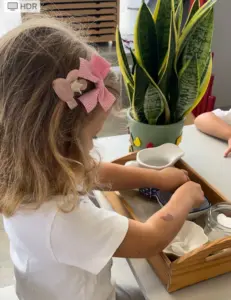
- Chickpea pincer grasp : move chickpeas from one bowl to another using thumb and index finger. Five minutes, from 18 months.
- Pouring water : transfer liquid between two small jugs. At age 2, without filling to the brim.
- Tearing paper : rip small pieces into strips. Works the wrist and finger strength.
- Lacing : thick cords through large wooden beads, from age 3.
- Kneading : flour and water dough to stretch, flatten and cut with cookie cutters.
- Modelling clay : make snakes, balls and holes with the thumb.
- Buttoning : a large-button board or their own clothes, calmly, from age 3.
- Cutting with blunt-tip scissors : first straight strips, then curves and shapes.
- Pinching and hanging : clothes pegs clipped onto the edge of a cardboard box.
- Finger painting : strokes, dots and lines on a large sheet of paper.

What are 5 gross motor skills activities for kids?
These 5 gross motor skills activities use legs, arms and trunk. They need about one square metre of clear floor.
- Cushion hopscotch : jump from cushion to cushion without touching the floor. Strengthens legs and coordination.
- The turtle : walk on all fours with a cushion on the back, without letting it fall. Builds trunk control.
- Snowball : roll downhill or along a blanket. Stimulates vestibular balance.
- Target throwing : toss balls into a basket from one metre away. Aim-and-arm game.
- Walking the line : a ribbon on the floor as a balance line, on tiptoes with arms open.
What games combine fine and gross motor skills?
The games that blend fine and gross motor skills are the most engaging, because they alternate whole-body and hands. None need a screen or bought materials.
Hide-and-seek forces crouching, squeezing into a corner and controlling the body. Action songs weave fingers and movement together. A circuit with a manual finish works brilliantly: jump over cushions, crawl under the table and, on arrival, drop plastic coins into a money box. Salt dough to knead after a running game works too.
Example: a 5-minute circuit at home
Imagine your 3-year-old can’t sit still at dinner time. Set up a short circuit before sitting down: two jumps on the cushion, crawl under the table, and at the end, spoon five chickpeas into a glass. That’s five minutes. The body gets tired and the hands focus. Then dinner arrives with a different mood.
Fine motor coordination with household materials
| Activity | Typical age | What it works | Materials |
|---|---|---|---|
| Chickpea pincer grasp | 18-24 months | Thumb-index pincer grip | Bowl and chickpeas |
| Pouring water | 2-3 years | Wrist and control | Two small jugs |
| Lacing beads | 3-4 years | Two-handed coordination | Cord and large beads |
| Fastening buttons | 3-5 years | Fingers and independence | Shirt or button board |
| Cutting with scissors | 4-6 years | Strength and precision | Blunt-tip scissors |
Games and activities that build fine motor skills
Common mistakes and how to fix them
Mistake 1: demanding correct posture too early. If your 4-year-old writes hunched over, don’t correct their back every two minutes. First strengthen the trunk with the turtle activity and balancing on the ribbon. With a stable trunk, the hand frees up. Mistake 2: changing activities every day. The same game for two weeks produces more progress than five new games. Pick one fine motor skills idea and one gross motor skills idea per week and write down what you observe.
How to combine these exercises with the Montessori method
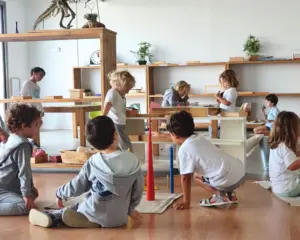
Montessori turns these fine and gross motor skills activities into practical life: pouring, buttoning, cutting and sweeping are the child’s real work, not entertainment. The prepared environment places materials at their height and on individual trays, so they can pick them up and put them away unaided. The adult observes before intervening and offers the just-right challenge: neither so easy it bores nor so hard it frustrates. The same principles carry over to school and home.
Frequently asked questions
What are the fine and gross motor skills activities?
Fine motor activities coordinate fingers, hands and wrists: chickpea pincer grasp, pouring, lacing, kneading, buttoning or cutting with scissors. Gross motor activities use large muscles: jumping, crawling, rolling, throwing, climbing and balancing. They’re practised daily with household materials, from 18 months to 6 years old.
What are 10 fine motor skills activities?
Chickpea pincer grasp, pouring water, tearing paper, lacing beads, kneading dough, modelling clay, buttoning, cutting with scissors, pegging clothes and finger painting. They’re ordered from easiest to hardest. With 5-10 minutes a day on one or two, the hand gains strength and precision.
What are 5 gross motor skills activities?
Jumping cushion to cushion, walking on all fours with a cushion on the back, rolling on the floor, throwing balls into a basket and walking on a ribbon on the floor like a tightrope. All use legs, arms and trunk and need less than one square metre of clear space.
What games combine fine and gross motor skills?
The best are mixed circuits: jump cushions, crawl under the table and finish by spooning chickpeas. Also hide-and-seek, action songs, clay, and building and taking apart. Alternating whole-body with finger work keeps attention longer.
At what age should motor skills activities start?
From the moment a child can sit up, around 6 months, with large materials and supervision. From 18 months the finger pincer grasp and pouring become accessible. Between 3 and 6, fine and gross motor skills ideas can be combined in the same afternoon.