Children’s Golf Academy in Marbella: A Montessori Guide
In short
Marbella enjoys a privileged environment for golf, with top-level courses and a growing offer of children's golf academies. Finding a children's golf academy in Marbella that truly respects your child's pace and personality is not just a matter of facilities. The Montessori perspective gives us very valuable clues to choose that space where sports technique and emotional development are balanced.
Marbella enjoys a privileged environment for golf, with top-level courses and a growing offer of children’s golf academies. Finding a children’s golf academy in Marbella that truly respects your child’s pace and personality is not just a matter of facilities. The Montessori perspective gives us very valuable clues to choose that space where sports technique and emotional development are balanced.
Over the last three years, several parents from Alcaidesa and San Roque have asked me how to choose the ideal children’s golf academy for their child.
- What the Montessori perspective can bring to choosing a golf academy
- Keys to evaluating a children's golf academy with a respectful approach
- Benefits of a Montessori approach in children's golf
- Real examples of golf academies in Marbella that apply related principles
- Frequently asked questions about children's golf academies in Marbella
- Key conclusions
What the Montessori perspective can bring to choosing a golf academy
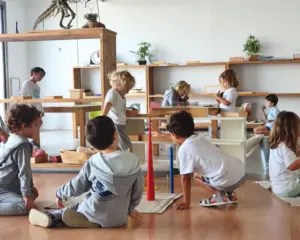
Montessori pedagogy is not limited to the classroom. Preparing the environment, observing without judgment, and allowing free choice are principles that fit perfectly in sports teaching. A golf academy that incorporates these concepts does not focus solely on swing technique. First, it considers the child as the protagonist of their learning.
Instead of directed sessions where the instructor imposes exercises, the Montessori approach invites designing a prepared space: differentiated areas for putting, short game, and long game, with equipment adapted to the child’s size and strength. The child explores and the adult observes to intervene only when necessary. This fosters concentration and autonomy, two pillars of the method.
Prepared environment on the driving range
A children’s golf course cannot be a miniature replica of the adults’. It must have sensory obstacles that invite movement, colors that define distances, and lightweight tools. Last summer we visited an academy in Guadalmina that had placed colored hoops to work on approach precision. The children went from one hoop to another without anyone telling them what to do. Simply, the environment guided them.
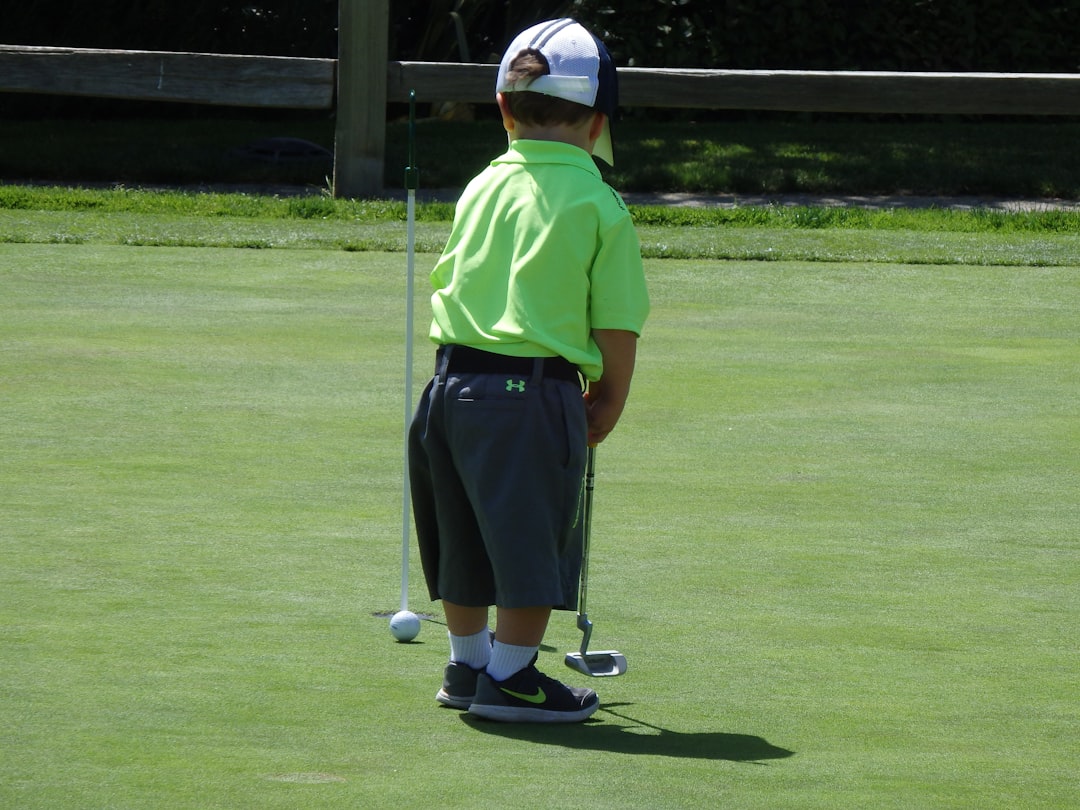
At home we can also apply this principle: a corner with a portable putting green and clubs of different lengths that the child can choose from as they wish. It’s not about training, but about playing with a purpose.
The guide who observes and accompanies
In the AMI (Association Montessori Internationale) training, observation is emphasized as the main tool for the adult. A good children’s golf instructor is not a military coach who corrects every posture. They are a guide who waits, detects the moment of frustration or interest, and then offers a brief suggestion. Constant correction interrupts flow and creates dependence. Instead, if the child discovers for themselves how to improve their putt after several attempts, the lesson sticks.
Keys to evaluating a children’s golf academy with a respectful approach
Before enrolling, we recommend spending at least two sessions observing without the child knowing. Pay attention to these five points:
- Instructor-student ratio: in early ages (3-6 years), the group should not exceed 4 children per adult. This guarantees that individualized observation that allows the guide to intervene only when the child needs it.
- Use of sensory materials: colored balls, cones, flags, textures on the greens. The richer the environment, the greater the intrinsic motivation.
- Flexibility in the session: is a child allowed to spend more time in the bunker if that interests them? Or must they rotate rigidly every 15 minutes? The second option breaks the concentration cycle.
- Instructor’s language: listen if they say “grab the 7-iron and stand like this” or if they ask “which club would you like to try today?”. The tone reveals the academy’s philosophy.
- Error management: in Montessori, the control of error lies with the material, not the adult. If the putt doesn’t go in, the child sees the result and can repeat. The instructor should not point out the failure, but rather ask: “how could you adjust the direction?”.
Observe the session before enrolling
Ask to attend a class without prior notice. If they make excuses, be suspicious. During the visit, focus on the children’s faces: look for expression of concentration, not boredom or stress. A very clear indicator is if the children voluntarily approach the teacher to show an achievement. That denotes a bond of trust, not fear.
Key questions for the technical director
It never hurts to interview the person in charge. Some questions I usually raise in my consultations with families:
- What training in child development does the team have?
- Do they adapt the exercises to each child’s developmental stage or follow a fixed program?
- How do they handle a child who prefers to be alone on the putting mat while the rest are doing swings?
- Do they have equipment of different weights and sizes to respect each arm’s strength?
The answers will tell you much more than the promotional brochure.
Benefits of a Montessori approach in children’s golf
Beyond learning to play golf, children who begin in a prepared environment develop skills that transcend the course. A University of Virginia study (2022) on self-regulation in children aged 4 to 7 found that those who practice sports with a high degree of autonomy improve their concentration capacity by 30% in school tasks. Golf, with its leisurely pace, is ideal for cultivating patience and precision.
Furthermore, golf is a sport practiced outdoors, in contact with nature. Montessori always advocated for connection with the environment as a source of sensory learning. A child who walks the course observing the texture of the grass, listening to the wind, and estimating distance is training their perception much more than their swing.
On the other hand, misunderstood competition is one of the greatest sources of anxiety in early ages. In our context, we are not talking about winning tournaments, but about overcoming personal challenges. Every holed putt, every tee shot that clears an obstacle, is an intimate victory. That builds solid self-esteem, not dependent on external approval.
Real examples of golf academies in Marbella that apply related principles
Although not all academies label themselves as Montessori, several on the Costa del Sol have been incorporating very aligned practices. In Nueva Andalucía, the Golf&Kids academy works with small groups of a maximum of 3 children and uses free-choice rotating learning stations. A mother from Sotogrande told us that her 6-year-old son spent 40 consecutive minutes practicing approach because the instructor set up a cone circuit and let him explore.
In San Pedro, the Junior Golf Academy center has eliminated direct orders. Instead, they video the child’s swing and review it together afterwards, asking: “what do you see?”. This practice, based on self-observation, recalls the Montessori mirror used for movement control.
We also highlight the initiative of some public courses, such as El Higueral, which have created “silent hours” for families, where children can play at their own pace without the pressure of adult handicaps. A simple measure but one that shows respect for the child.
Frequently asked questions about children’s golf academies in Marbella
At what age can a child start golf?
There is no set age. Montessori speaks of sensitive periods: between 3 and 6 years, the child perfects movement and language. Around age 6, hand-eye coordination reaches an optimal point to start technical sports. Most academies accept children from age 4 with sensory initiation programs, but the important thing is not when they start, but how the activity is presented. If we use plastic clubs and colored balls, a 3-year-old can enjoy and benefit without forcing their development.
Is it necessary for the child to have a competitive vocation to join a golf academy?
Not at all. Golf has a very valuable recreational side that emphasizes personal improvement. In the Montessori environment, competition is replaced by self-challenge. We encourage parents not to project their own expectations of triumph. I have seen too many cases of children abandoning golf at age 12 because they associate the course with parental pressure. The goal should be for golf to become a lifelong game, not a source of early stress.
How do I know if my child is ready for group or individual classes?
Observe their social behavior. In the second plane of development (3-6 years), the child is very self-centered and prefers individual activities or very small pairings. From age 6, with the arrival of the social plane, they start to become interested in the group. An academy that respects the Montessori pace offers both modalities and allows the child to choose. If your child feels overwhelmed in the group, perhaps a few individual sessions will give them the confidence needed to integrate later.
Key conclusions
Choosing a children’s golf academy in Marbella with Montessori criteria is possible if we know what to look for. The key is respect for the child: a prepared environment, a guide who observes, and freedom of movement. It’s not about shaping the next Rory McIlroy at age 5, but about offering a sports experience that respects their holistic development.
Before taking the step, we invite you to visit at least three academies and talk to other parents who have already gone through that process. Ask for a trial class and ask without fear. Golf can be a wonderful tool for personal growth if taught from the heart and not from empty technique. And remember: the best golf course is the one where your child smiles.