Bilingual education for young children: when to start and what works

Choosing bilingual education for young children is a decision many families across the Campo de Gibraltar and the Costa del Sol make early, often within the first few months of a baby’s life. The short answer is yes, it’s worth it, and it starts well before a child speaks: the brain of a 0- to 6-year-old absorbs the sounds, rhythms and structures of a second language with an ease that adults simply don’t have. What makes the difference isn’t the starting age, it’s consistency and the quality of exposure to each language.
- Key takeaways
- What does it mean for a child to be bilingual?
- How long does it take a bilingual child to start speaking?
- What is bilingual education?
- At what age should a child start learning another language?
- Bilingual education in Spain: it's not a trend, it's a method
- Cognitive benefits of bilingualism in early childhood
- Daily life for a child growing up with two languages
- Frequently asked questions
- Final thoughts
Key takeaways
- A child is bilingual when they understand and use two languages to communicate, not when they can translate individual words.
- Early bilingual education starts showing visible results between ages 3 and 5, though the groundwork happens from birth.
- An immersion model with two stable, natural language models works far better than occasional vocabulary classes.
- The most common mistake is changing strategy every month: a language needs routine, not occasional intensity.

What does it mean for a child to be bilingual?
For a child to be bilingual means they can communicate in two languages, understanding and expressing themselves in real, everyday situations. It doesn’t require a perfect accent or equal ability in both languages: usually, one becomes stronger than the other depending on how much each is used. UNESCO recognises multilingualism as a child’s right and an educational advantage, and that approach fits perfectly with what we look for in the early years.
In practice, there are degrees. A child may understand two languages but respond in only one (receptive bilingualism), or switch naturally depending on who they’re talking to (productive bilingualism). Both are valid points along the same journey.

How long does it take a bilingual child to start speaking?
A bilingual child takes just as long to start speaking as a monolingual child: first words usually appear around the first birthday, and by 2 - 3 years they’re combining words into sentences. What does happen is that they sometimes split their vocabulary across two languages, so it can seem like they know “fewer words” in each one, when in reality they’re adding them up.
If your 2-year-old says “agua” at home and “water” at school, there’s no delay, there’s a split. Language development assessments should always consider both languages together, something the Spanish Association of Paediatrics reminds families about to avoid unnecessary alarm. If you have any concerns about your child’s pace, talk to your paediatrician and the school.

What is bilingual education?
Bilingual education is a school model where a significant part of the curriculum is taught in a second language, so the language is learned by living it, not just by studying it. In the early years, that part isn’t limited to one hour of English a day: it includes routines, play, songs and classroom instructions.
Immersion, bilingual classrooms and language classes are not the same thing
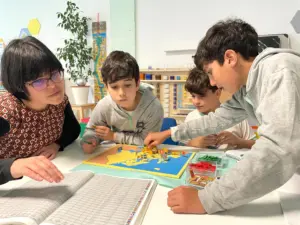
At IMS we work with dual Spanish-English immersion, introducing French from the Children’s House, because immersion surrounds the child with the language inside a complete experience. A bilingual classroom splits subjects between two languages, and a language class teaches the language as a subject. All three models exist, but they serve different goals.
Imagine your 4-year-old hears the same five instructions in English every morning: set the table, tidy the materials, wash your hands, sit in a circle, choose an activity. Within three months, they understand those phrases without translating. That doesn’t happen with a weekly 45-minute class, no matter how good it is.
At what age should a child start learning another language?
The recommended age to start another language is from birth, because a baby’s ear can distinguish every sound in the world and gradually narrows to those of their environment before 12 months. The earlier they hear the second language naturally and consistently, the easier it will be to pronounce and structure later on. There’s no mandatory minimum age, but there is a particularly favourable window between 0 and 6 years old.
Starting at 7 or 10 also works, though the path is different: the child learns more by rules and a little less by absorption. What never pays off is starting with intensity and giving up after a few months.
Bilingual education in Spain: it’s not a trend, it’s a method
Typical mistake: filling the house with English songs and videos, thinking that’s enough. Solution: anchor the language to one short, concrete routine repeated every day, with one key adult who uses it consistently. Ten real minutes a day beat one loose hour on a Sunday.
Cognitive benefits of bilingualism in early childhood
The cognitive benefits of early bilingualism include greater mental flexibility, better selective attention, and an early advantage in understanding that words are arbitrary symbols, which later helps with reading. These advantages appear when the child actively uses both languages, not when they only hear them in passing.
Daily life for a child growing up with two languages
A checklist to guide the process at home
- One key adult who uses the second language naturally and consistently.
- Fixed routines tied to the language (a morning song, a bedtime story).
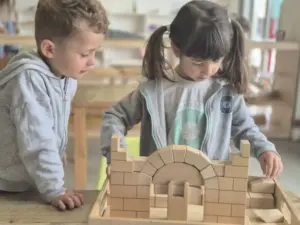
- Real, hands-on materials, not just screens.
- Patience with the silent period: a child understands long before they speak.
Imagine you choose two fixed moments a day for English and stick with them for six months, without adding anything else. That kind of simple consistency usually delivers better results than switching apps, schools and methods every term looking for a quick win.
Frequently asked questions
What does it mean for a child to be bilingual?
It means they can communicate in two languages, understanding and expressing themselves in real, everyday situations. It doesn’t require a perfect accent or equal ability in both, and it’s normal for one to be stronger than the other depending on use.
How long does it take a bilingual child to start speaking?
It takes just as long as a monolingual child: first words around the first birthday, sentences by 2 - 3 years. Sometimes the vocabulary is split across the two languages, which can give the impression of speaking less, when in reality they’re adding words in both.
What is bilingual education?
It’s a model where part of the curriculum is taught in a second language, so the language is learned by living everyday life, not just as a subject. In the early years, the language accompanies routines, play and the social life of the classroom.
At what age should a child start learning another language?
The recommended approach is exposure from birth, because between 0 and 6 years old a child’s ear and ability to absorb language are at their peak. Starting later also works, though the learning will be more analytical and somewhat less spontaneous.
Final thoughts
Bilingualism in early childhood is not a race, it’s a path built day by day. The goal is not a child who speaks two languages perfectly from the start, but one who feels comfortable using both, who understands that each language has its place and its moment. Patience, consistency and a rich linguistic environment do more than any method on its own.
At IMS Sotogrande we accompany families in this process with a clear approach: two languages lived naturally, inside and outside the classroom. If you want to know how we work, get in touch and we’ll show you.