Montessori Children’s House 3-6: Complete Guide to the Environment
The Montessori Children’s House 3-6 is the environment designed for children aged three to six, where self-directed learning and respect for individual pace are the foundation. In this article we explain how it works, its key benefits, and how to choose the best option for your child.
- What is the Montessori Children's House 3-6?
- Key Materials in the Montessori Children's House 3-6
- Benefits of the Prepared Environment in the Montessori Children's House 3-6
- The Role of the Guide in the Montessori Children's House 3-6
- Bilingualism and Trilingualism in the Montessori Children's House 3-6
- How the Montessori Children's House 3-6 Differs from Traditional Education
- Frequently Asked Questions about the Montessori Children's House 3-6
- Key Takeaways
What is the Montessori Children’s House 3-6?
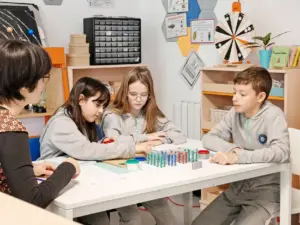
The Montessori Children’s House 3-6 is a prepared environment where children work with manipulative materials that develop their senses, language, mathematics, and practical life. Each material has a specific purpose and allows the child to learn at their own pace.
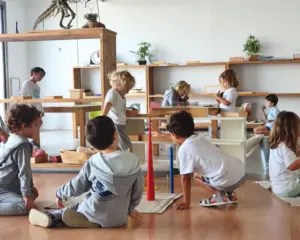
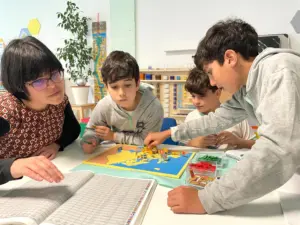
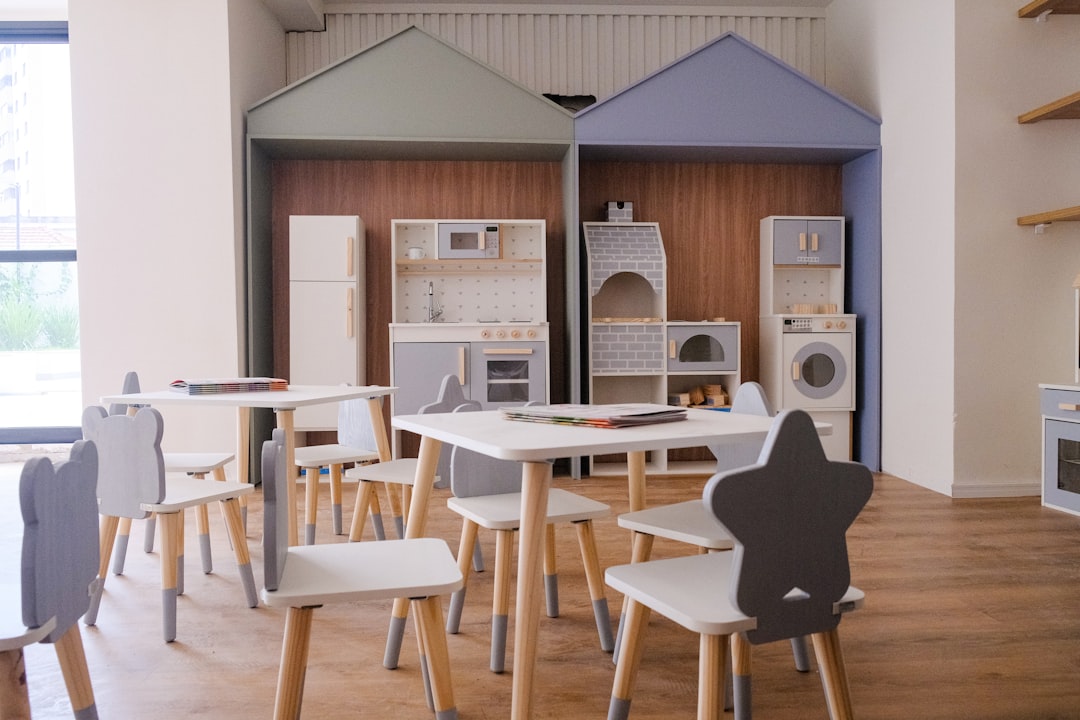
At IMS Sotogrande, our Montessori Children’s House 3-6 follows the standards of the Association Montessori Internationale (AMI) and NEASC. The classrooms are filled with natural light and every corner invites exploration. The guides observe and accompany without interrupting concentration.
Key Materials in the Montessori Children’s House 3-6
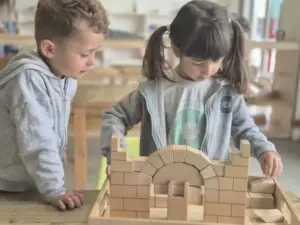
Montessori materials are the heart of the environment. They are not toys, but scientifically designed tools to isolate a single quality, such as color, weight, or sound. Each has a built-in control of error, allowing the child to self-correct.
Practical Life Materials
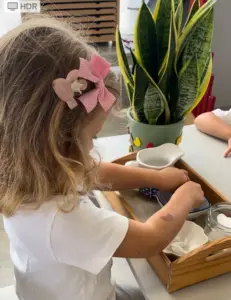
In the practical life area, children learn to pour water, button shirts, wash a table, or prepare a snack. For example, a four-year-old may spend ten minutes repeating the exercise of fastening and unfastening a buckle, because it satisfies their need for order and coordination. These materials develop fine motor skills and concentration.
Sensorial Materials
The pink tower, sound cylinders, color tablets… Each sensorial material refines one of the senses. A child working with the pink tower visually discriminates sizes, while with the sound cylinders they learn to differentiate auditory nuances. According to Maria Montessori, the sensitive periods between ages 3 and 6 are ideal for these experiences.
Language Materials
The movable alphabet, sandpaper letter cards, and object boxes allow the child to connect sounds with symbols. At IMS Sotogrande, we work on bilingualism from the start: the guide speaks in English during part of the day and in Spanish during another. Thus, the child acquires both languages naturally.
Mathematics Materials
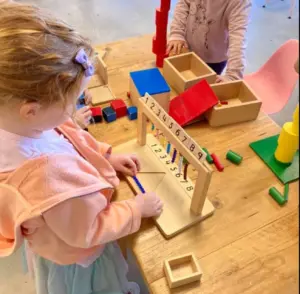
Number rods, spindles, and sandpaper numbers introduce abstract concepts concretely. A five-year-old can add using the red and blue rods, understanding quantity before the symbol. There are no worksheets or homework; everything is manipulation.
Benefits of the Prepared Environment in the Montessori Children’s House 3-6
Children who attend a Montessori Children’s House 3-6 develop:
- Autonomy: They learn to dress themselves, prepare their snack, and care for their space.
- Order and Concentration: Materials are logically organized, promoting prolonged concentration.
- Social Skills: The mixed-age group fosters respect and cooperation.
- Love for Learning: Freedom of choice generates intrinsic motivation.
As Olimpia Tardá, founder of IMS, notes: “A child who has lived three years in a prepared environment leaves with solid self-esteem and decision-making ability.” Moreover, studies from the University of Virginia show that Montessori students outperform their peers in traditional education in social skills and creativity.
The Role of the Guide in the Montessori Children’s House 3-6
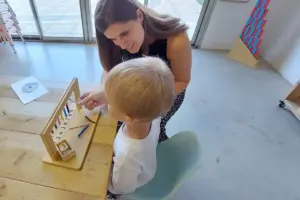
The guide is not a teacher who gives lessons. They observe, prepare the environment, and offer individual lessons when the child is ready. For example, if a child shows interest in numbers, the guide will present the sandpaper numbers in a brief three-period lesson. Then, the child works with the material independently.
At IMS Sotogrande, guides have AMI training and years of experience. They know the sensitive periods and know when to intervene without interrupting concentration. There are no exams, but systematic observations that document each child’s progress.
Bilingualism and Trilingualism in the Montessori Children’s House 3-6
At IMS Sotogrande, English and Spanish coexist in the classroom. One guide may speak to the child in English in the morning and Spanish in the afternoon, or there are two guides each speaking one language. The result is natural immersion: by age six, most children communicate fluently in both languages. Additionally, we offer an introduction to French as a third language starting at age four.
How the Montessori Children’s House 3-6 Differs from Traditional Education
In a traditional school, all children do the same activity at the same time. In the Children’s House, each child chooses their work. The day includes two three-hour blocks of uninterrupted work time, enough to immerse in an activity. There are no homework, no grades, no textbooks. Assessment is continuous through the guide’s observation.
Frequently Asked Questions about the Montessori Children’s House 3-6
At what age can my child enter the Children’s House?
The Children’s House is designed for children aged 3 to 6. At IMS Sotogrande, we accept from age 2.5, provided the child is ready to separate from parents. The full three-year cycle is ideal to reap all benefits.
Do parents need to know Montessori?
It is not necessary, but it helps. We offer parent workshops and observation sessions. The more aligned the family environment is with respect and autonomy, the more consistent the child’s experience.
How do children adapt who come from a traditional school?
Most adapt within a few weeks. They may need guidance initially, but upon seeing they have freedom to choose, they quickly develop their own pace. The guide facilitates the transition with individual lessons and much support.
Key Takeaways
The Montessori Children’s House 3-6 offers a unique environment where the child builds their learning through exploration and repetition. The benefits in autonomy, concentration, and social skills are backed by neuroscience and decades of experience.
If you are considering this model for your child, we invite you to visit our facilities in Sotogrande and observe a live session. You will see how children aged three to six work concentrated, happy, and confident. That is the best proof that Montessori works.