

What is Baby-lead Weaning and why choose this complementary feeding method
In short
Baby-Led Weaning (BLW) is a method of complementary feeding to breastfeeding, where the baby takes food with his hands and puts it in his mouth autonomously.
What is baby-led weaning?
Baby-Led Weaning (BLW) is a method of complementary feeding to breastfeeding, where the baby takes food with his hands and puts it in his mouth autonomously. You can introduce this technique between the first 4-6 months, when your baby begins to use his tongue to chew, and it will provide the ideal nutritional complement to breast milk or formula during the first 12 months.
6 advantages why Baby-Lead Weaning can be important in your baby’s development
The baby will be one more at the table.
Baby Led-Weaning allows your baby to be present at every meal to integrate and develop a good family bond. Through imitation, the baby can begin to learn as a family to relate to food in a fun and relaxed way.
It helps you develop a more tolerant and varied palate.
Introducing your baby to a variety of flavors, textures, smells, etc., allows him to have a healthier relationship with food and prevents him from rejecting some foods because he does not have to start eating them out of obligation.
Develop fundamental cognitive processes.
When your baby starts experimenting with food, he or she needs to smell it, squish it, pinch it, and play with it. This helps him develop good hand-eye coordination between what he sees and what he puts in his mouth. It also helps you establish brain connections, control the amount of food you consume, and develop an enjoyable experience with food.
Strengthens the muscles of the jaw and mouth.
The process of moving food through the mouth, chewing it, and swallowing it strengthens the muscles of the jaw and mouth, which is also important for neural stimulation and speech development.
Learn to be autonomous and independent
Because they learn to eat on their own, little by little the little ones become independent and autonomous beings, both at mealtime and in any of their daily activities.
It allows you to develop good eating habits.
Around 18% of children in Spain suffer from childhood obesity. One of the great advantages of Baby-Lead Weaning is that your baby learns to control his appetite and identify when he is hungry.
How to introduce Baby-Led Weaning into your baby’s meals
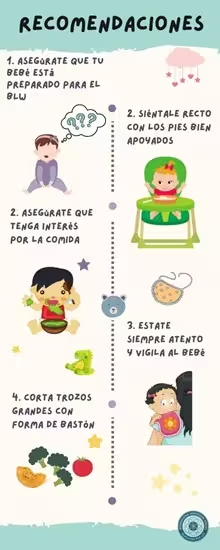
- To know if the time has come to introduce complementary feeding, you should look at how the baby reacts when you put food in his mouth: if he sticks out his tongue and expels it, it means he is not ready yet. If he is no longer exhibiting this behavior, now you can start introducing Baby-Led Weaning!
- Your posture is key: the baby’s trunk must be straight and the feet supported. You should see if he is interested in the food he sees around him.
- It is also important to pay attention to notice if he is gagging because he is learning to swallow, which is a normal process. If you notice that he is choking, help him remove the food from his mouth.
- From 9 months onwards you can start giving smaller pieces of food, such as in the shape of a stick. The baby should be able to chew them with the gum, so one way to know if a piece is suitable for the baby is to try to easily crush it with your fingers. If you can do it, it is suitable for the baby.
- At first he starts with one food and, when he masters it, he gradually introduces another until he even reaches complete dishes.
What should you take into account?
At IMS Sotogrande, Baby lead weaning choose is one of the key topics we explore in Montessori education. At IMS Sotogrande, Baby lead weaning choose is one of the key topics we explore in Montessori education. First of all, it is essential that you observe your baby and see what process of development he is in. This way, you will never force him to eat if he doesn’t feel ready or doesn’t give any indication that he wants to experiment with food.
Sometimes parents are afraid that the baby will go hungry or choke or they do not feel safe to introduce Baby-Led Weaning. In this case it is advisable to obtain prior advice to be able to enjoy all its benefits. If you have any questions or need to know more about this method, contact us to learn more and see how our students enjoy it every day.









