
Toddler Tantrums & Meltdowns: Montessori Guide for Families in Sotogrande & Costa del Sol
In short
If your child has started having intense tantrums, you are not alone. Almost all families go through this stage between 18 months and 5 years. Although it may sometimes seem your child is “misbehaving,” what is actually happening is that their brain is learning to manage emotions they don’t yet know how to handle.

If your child has started having intense tantrums , you are not alone. Almost all families go through this stage between 18 months and 5 years. Although it may sometimes seem your child is “misbehaving,” what is actually happening is that their brain is learning to manage emotions they don’t yet know how to handle. In this article, you will understand why tantrums happen and what you can do today to support your child through them respectfully. In this article we explore toddler tantrums in depth with practical examples.
- Tantrums are a normal manifestation of emotional development between ages 1 and 5.
- They are not willful defiance: a child’s brain lacks the maturity to regulate intense emotions.
- The adult’s response makes the difference between a learning experience and a cycle of frustration.
- Montessori proposes observing, validating, and offering concrete tools for each stage.
- With consistency and empathy, the frequency and intensity of tantrums decrease.
- Why does my child have tantrums?
- How to respond when your child has a tantrum
- The Montessori perspective: Observe before intervening
- Tantrums at different ages: what to expect
- How to prevent tantrums without controlling the child
- How we respond to tantrums at IMS Sotogrande
- Frequently asked questions about tantrums
- Key takeaways
Why does my child have tantrums?
Tantrums occur because a child wants many things at once but cannot express them with words or control their impulses. At two years old, for example, they already have a clear idea of what they want, but their prefrontal cortex, the part of the brain that regulates emotions, doesn’t mature until age 25. So between 18 months and 4 years, there is a constant clash between what they feel and what they can manage. When it comes to toddler tantrums, it pays to listen to what families and lead guides actually report.
Crying, screaming, throwing themselves on the floor, or kicking are the child’s natural way of releasing that tension. They are not doing it against you. If you have ever felt frustrated and needed to cry or scream, you know exactly what your child is going through, but without the tools you have. Daily practice with toddler tantrums reveals nuances no handbook fully captures.
Are tantrums always willful demands?
No. A willful demand is a specific request a child repeats because they know it will get a result. A tantrum is an involuntary emotional outburst. The distinction matters because it completely changes how you should respond. If you think it’s a willful demand, you will tend to punish or give in out of exhaustion. If you understand it’s an emotional crisis, you can respond with calm support. Understanding toddler tantrums from inside the classroom reshapes everyday decisions.

How to respond when your child has a tantrum
The first rule is not to try reasoning with a child in the middle of a crisis. Their primitive brain is in survival mode and does not process speeches. What you can do is stay close, with a low voice and physical presence. This conveys security. Concrete data on toddler tantrums is worth reviewing before acting on assumptions.
Here is a real example from a Montessori classroom: a 3-year-old wanted a material another child was using. He started screaming. The guide did not say “calm down” or “it’s nothing.” She knelt to his level, said “I see you’re very angry because you want that cube,” and waited. In 40 seconds, the child calmed down and accepted an alternative.
Book a personalized school visit and discover how we handle these situations in the classroom with real materials and trained guides.
What NOT to do during a tantrum
Yelling, threatening, offering bribes, or punishing after the crisis only reinforces the frustration cycle. The child learns that their emotion is “bad” and suppresses it, which generates more tantrums in the medium term. Giving in to their demand every time also doesn’t work, because then the tantrum becomes a strategy that succeeds.

The Montessori perspective: Observe before intervening
In Montessori pedagogy, the adult is an observer before being a reactor. This means that before deciding what to do, you pause a moment to understand what triggered the tantrum. Are they hungry? Tired? Do they need movement? Are they frustrated by a task that’s too difficult?
Maria Montessori said the child who “misbehaves” is a child asking us for something they don’t know how to ask for with words. When you identify that need, the intervention changes completely. Instead of “stop it,” you can offer: “Do you need help?” or “Would you like to do it together?”
Prepared environments and materials that reduce tantrums
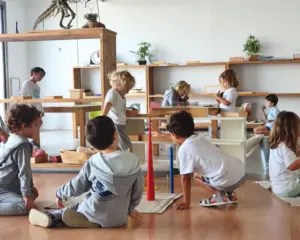
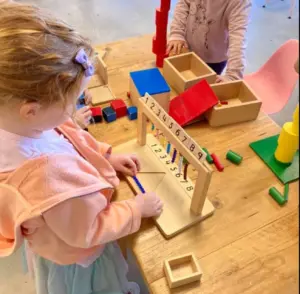
A prepared environment makes a huge difference. In Montessori homes, children have access to their materials at their height, can choose activities, and have safe spaces to move. This decreases frustration because they don’t depend on the adult for everything. In our Montessori Nido (0-3 years) and Children’s House (3-6 years) , the environments are designed exactly for this: reducing unnecessary conflicts and empowering the child.

Tantrums at different ages: what to expect
Between 18 months and 2 years , tantrums are often related to motor frustration: the child wants to do something they cannot yet do. At 3 years , those related to social autonomy appear: sharing, waiting turns, accepting a “no.” At 4 and 5 years , the most intense ones usually link to shame, fear, or comparison with other children.
Knowing these stages helps you not to personalize each episode. Your child is not defying you. They are growing.
How to prevent tantrums without controlling the child
You cannot avoid all tantrums, but you can reduce their frequency with clear routines, adequate sleep, balanced nutrition, and free play time outdoors. At IMS, for example, children have a daily rhythm that includes movement, work with materials, and rest. This is no coincidence: children who know what to expect feel more secure.
Offering limited choices instead of impositions also works. Instead of “put on your shoes,” try “do you prefer the blue ones or the red ones?” The child feels they have control, which reduces conflict.
How we respond to tantrums at IMS Sotogrande
At our school, Montessori guides are trained to accompany emotions without rewarding or punishing. We don’t use time-out chairs, points on the board, or threats. We use observation, verbal validation, and calm presence. Each classroom has a peace corner the child can visit when they need it, not as a punishment, but as a tool.
If your family is in the Campo de Gibraltar , the Costa del Sol , or coming from Gibraltar looking for an education that respects your child’s emotional development, we would love to show you how we work. We are the only Montessori school accredited by both AMI and NEASC in the area.
Frequently asked questions about tantrums
Is it normal for my 2-year-old to have tantrums every day?
Yes, it is completely normal between 18 months and 3 years. Daily tantrums at this stage reflect typical development, not a behavioral problem. If your child has a more intense temperament, episodes may be more frequent, but no less normal.
Should I let my child cry until they calm down alone?
It’s not about leaving them alone, but about accompanying without intervening. You can stay close, in silence or with short phrases like “I’m here.” The goal is not for them to stop crying, but for them to feel that their emotion is valid and that you are a safe haven.
Do tantrums mean I did something wrong as a parent?
No. Tantrums are not a reflection of your parenting. They are part of the child’s neurological development. Even in very respectful Montessori environments, children have emotional crises. The difference lies in how they are supported, not in preventing them entirely.
At what age should tantrums decrease?
Most children reduce the frequency and intensity of tantrums between ages 4 and 5, when they develop more emotional vocabulary and self-regulation skills. If episodes remain very intense or frequent at 5-6 years old, it’s advisable to consult a specialist.
What is the difference between a tantrum and an anxiety attack?
A tantrum usually has a clear trigger and the child seeks a specific outcome. An anxiety attack appears without an obvious reason, with physical symptoms like rapid breathing or trembling. If you suspect your child has anxiety episodes, consult your pediatrician.
Key takeaways
Tantrums are not the enemy. They are an opportunity to teach your child that all emotions, including the most intense, can be felt and managed. The key is not to eliminate them, but to support them with presence, validation, and an environment that reduces unnecessary frustration.
If you want to see how we do this in a real Montessori setting, with certified guides and an environment designed for emotional development, book a personalized visit. We look forward to welcoming you in Sotogrande.