
Setting Boundaries Without Tears: A Montessori Guide for Parents in Sotogrande & the Costa del Sol

Have you ever wondered if you’re setting too many boundaries or too few? That doubt pops up when your three-year-old refuses to tidy their toys or your eight-year-old questions every decision. The good news is that boundaries, when set well, aren’t an obstacle to a child’s freedom, they are the scaffold that supports it. In this article we explore Montessori parenting tips in depth with practical examples.
At IMS Sotogrande, we work with this idea every day. Our guides see how children, within a clear framework, explore with confidence. Because a child who knows where the edges are doesn’t need to constantly test them. When it comes to Montessori parenting tips, it pays to listen to what families and lead guides actually report.
- Key Points on Setting Boundaries
- Why Children Need (and Seek) Boundaries
- How to Set Boundaries Without Losing Your Cool
- Age-Appropriate Boundaries: From 0 to 12 Years
- When Boundaries Don’t Work: Common Mistakes
- Boundaries and Montessori: Freedom Has Structure
- Frequently Asked Questions
- Key Takeaways
Key Points on Setting Boundaries
- Boundaries provide emotional security and help a child develop self-control.
- In Montessori, rules are presented as facts, not threats: “Dinner is served at seven,” not “If you don’t come, you won’t eat.”
- Firmness doesn’t require shouting. A calm tone and a consistent posture communicate more than a thousand words.
- Consistency among all the adults in a child’s environment (parents, grandparents, guides) is the key to making boundaries work.

Why Children Need (and Seek) Boundaries
When a child pushes a boundary, they aren’t being “bad.” They’re exploring the structure of the world. Boundaries tell them: “This is safe, this is predictable.” Without them, a child doesn’t experience freedom, but anxiety. A study from the American Academy of Pediatrics (AAP) confirms that children with clear structures at home show lower anxiety and better emotional regulation. Daily practice with Montessori parenting tips reveals nuances no handbook fully captures.
Maria Montessori described this with a powerful image: a child walks along a path. If the path has clear edges, they advance with confidence. If the edges disappear, they stop, look back, hesitate. Boundaries are those edges. Understanding Montessori parenting tips from inside the classroom reshapes everyday decisions.
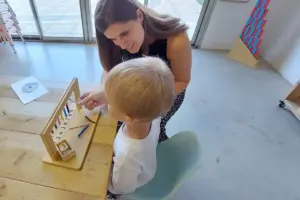
In our Nido and Children’s House, adults observe before intervening. They don’t shout “Don’t touch!” from across the room. They come close, get down to the child’s level, and explain with simple words: “That material is used at the table.” That is a clear, respectful, and effective boundary. Concrete data on Montessori parenting tips is worth reviewing before acting on assumptions.
Book a Personalized Visit to the School
How to Set Boundaries Without Losing Your Cool
The way you communicate a boundary matters as much as the boundary itself. If you shout, the child hears the volume, not the message. If you threaten, they learn to negotiate or to fear you. Neither option teaches them self-control.
The Montessori Three-Step Model
This approach works from 18 months to 12 years, with language adjustments:
- Observe : What is actually happening? Don’t interpret the intention. “My child wants to break the vase” might be “my child is exploring gravity.”
- Validate : “I see you want to throw that.” The child feels seen, not attacked.
- Reorient : “The vase stays still. You can throw this ball in the garden.” You offer a concrete alternative.
This model eliminates the power struggle. You’re not prohibiting. You’re teaching. And each time you repeat it, the child internalizes the rule a little more.
What to Say (and What Not to Say)
Instead of “If you don’t tidy up, I’ll throw the toys away,” try: “Toys are put away before snack time. Do you want to start with the cars or the books?” The first phrase is an empty threat (would you really throw them away?). The second establishes the rule as a fact and offers autonomy within the boundary.
At IMS, we see this difference in the classroom every day. Children in the Elementary (6-12) program who grew up with boundaries presented as facts, not punishments, are the ones who most take responsibility for their actions without constant supervision.

Age-Appropriate Boundaries: From 0 to 12 Years
Rules aren’t the same for a one-year-old baby as for a ten-year-old child. Adjusting the type of boundary to the developmental stage is fundamental for it to work.
From 0 to 3 Years: The Boundary is Physical and Repetitive
At these ages, the child doesn’t understand long explanations. They need the adult to act: “This plug is not for touching” (and you repeat it each time, calmly, while redirecting their hand). Repetition isn’t inefficiency. It’s the brain building circuits. Don’t expect them to “learn” the first time. It might take twenty.
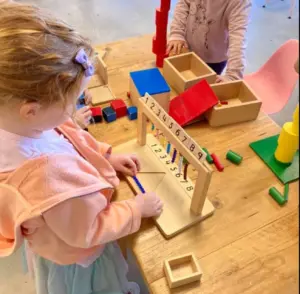
In our Nido, materials are organized on shelves within the child’s reach. What they can touch is available. What they can’t is out of sight. The prepared environment does part of the work of setting boundaries .
From 3 to 6 Years: The Boundary is Verbal and Collaborative
The child now understands simple causes and consequences. You can briefly explain the “why”: “We don’t run in the hallway because someone could fall.” At these ages, offering choices within the boundary increases cooperation: “Do you want to put on the blue jumper or the green one?” (not “Do you want to put on a jumper?” because the answer will be “no”).
From 6 to 12 Years: The Boundary is Partially Negotiated
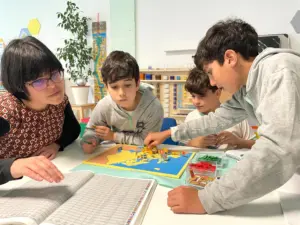
In Elementary, children participate in creating some classroom rules. This isn’t weakness. It’s pedagogy. When a child co-constructs the rule, they follow it better. But be careful: negotiating doesn’t mean giving in on everything. The adult holds the non-negotiable boundaries (safety, respect for others) and is flexible on those that allow it (where to do homework, in what order).
When Boundaries Don’t Work: Common Mistakes
Yes, there are moments when the system fails. These are the most frequent mistakes I see in families:
- Inconsistency : Today you say no, tomorrow you say yes. The child learns that insisting works and doubles the intensity of the tantrum.
- Too Many Boundaries : If every sentence out of your mouth is a prohibition, the child stops listening to all of them. Prioritize: what is really important? Safety, respect, care for the environment. The rest can wait.
- Threats You Don’t Follow Through On : “If you don’t come now, we’re leaving.” But you don’t leave. The child registers the lie and loses trust in your words.
- Shouting : Shouting communicates a loss of control, not authority. A study published in Child Development (2013) found that severe verbal punishment has effects similar to physical punishment on a teenager’s self-esteem.
If you recognize any of these patterns, don’t blame yourself. There’s still time to change. Parenting isn’t about perfection. It’s constant practice.
Boundaries and Montessori: Freedom Has Structure
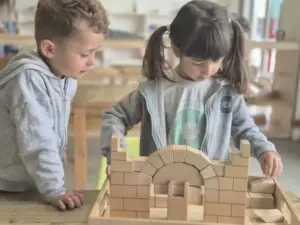
There’s a myth about Montessori: that children “do whatever they want.” False. In a Montessori classroom, there are very clear boundaries . The child chooses what work to do, but they can’t take another child’s work. They can move around the classroom, but not run. They can talk, but in a quiet voice. Freedom occurs within a framework, and that framework is what enables the deep concentration that so amazes anyone visiting a Montessori classroom for the first time.
At IMS Sotogrande, each level adapts these principles. In Nido (0-3), boundaries are more repetitive and physical. In Children’s House (3-6), they are verbalized and reinforced with routine. In Elementary (6-12), the child can already reflect on why rules exist and how to improve them. It’s a process of progressive development, not sudden imposition.
If you want to see how this works in practice, I invite you to visit us. Nothing replaces direct observation: seeing a four-year-old work concentrated for forty minutes without anyone telling them what to do. That’s what happens when boundaries are built with respect.
Book a Personalized Visit to the SchoolFrequently Asked Questions
At what age should you start setting boundaries for a child?
Boundaries start from birth, although their form changes with age. A six-month-old baby already needs you to redirect their hand when they try to bite. It’s not about scolding, but offering safe alternatives. From around one year, the baby begins to understand that certain actions have predictable consequences, and there the adult’s calm repetition becomes fundamental for building habits.
What do I do if my child doesn’t respect the boundaries I set?
First, check if the boundary is clear, consistent, and age-appropriate. Sometimes the child isn’t “disobeying,” but hasn’t understood or the boundary is too vague. Try reformulating it with simple words and concrete actions. If the problem persists, verify that all the adults at home (parents, grandparents, caregivers) are applying the same rule. Inconsistency is the number one reason boundaries fail.
Is setting boundaries the same as punishing?
No. A boundary describes an acceptable behavior and offers alternatives. Punishment seeks to make the child suffer to “learn.” In Montessori, when a child breaks a material, we don’t say “bad job”. We teach them to repair it. The consequence is natural (the broken work requires repair), not arbitrarily imposed. This approach, endorsed by the Spanish Montessori Association, fosters internal responsibility instead of fear.
How many boundaries are too many?
There’s no exact number, but a good rule of thumb is this: if half of your interactions with your child are corrections or prohibitions, you’re overdoing it. Prioritize three or four fundamental rules (safety, respect, care for the space) and let the rest flow. Children who live in an environment with too many boundaries tend to become overly submissive or, conversely, to rebel systematically.
Key Takeaways
Boundaries are not the enemy of respectful parenting. They are its backbone. A child who grows up with clear rules, presented with firmness and love, develops self-control, empathy, and security. The key lies in the method: explain, offer alternatives, be consistent, and adapt the type of boundary to the child’s age.
If you want to see how this is lived in a real classroom, book a visit at our campus in Sotogrande. Seeing children work with autonomy within a clear framework will give you more tools than any manual. We are in the Campo de Gibraltar, minutes from La Línea, Algeciras, or Estepona, and open to families from across the Costa del Sol.