
![Montessori School Reviews: Real Guide for Families [2026] | Sotogrande, Costa del Sol](https://ims-sotogrande.com/wp-content/uploads/2026/06/unsplash-75181f284818.jpg "Montessori School Reviews: Real Guide for Families [2026] | Sotogrande, Costa del Sol")
Montessori School Reviews: Real Guide for Families [2026] | Sotogrande, Costa del Sol
In short
When you're considering a Montessori school, reviews from other families can be your first real glimpse into what happens inside the classrooms. As a Montessori guide myself, I've seen dozens of parents arrive at our school with a mix of excitement and uncertainty after reading countless online reviews.

When you’re considering a Montessori school , reviews from other families can be your first real glimpse into what happens inside the classrooms. As a Montessori guide myself, I’ve seen dozens of parents arrive at our school with a mix of excitement and uncertainty after reading countless online reviews. Often those reviews reflect isolated experiences, not the daily reality that defines an authentic Montessori education. In this article we explore Montessori school Costa del Sol in depth with practical examples.
That’s why sharing this guide with you isn’t a marketing ploy, but an honest explanation of what you should look for when reading reviews about a Montessori school and how to distinguish a serious project from one that just uses the name. When it comes to Montessori school Costa del Sol, it pays to listen to what families and lead guides actually report.
What do Montessori school reviews really say?
It’s easy to collect Montessori school reviews on forums and social media. But most talk about feelings: “my child is more independent”, “they don’t force him to sit still”, “he learns at his own pace”. That’s fine, but behind a true Montessori education there is much more. Daily practice with Montessori school Costa del Sol reveals nuances no handbook fully captures.
The reviews that really matter are those that reflect three pillars: AMI training of the guides, a prepared environment without mixing methodologies, and individualized tracking of development. Without these three elements, a school can call itself Montessori without being one, as happens with many centers that adopt only a few “tools” and mix them with traditional methods. Understanding Montessori school Costa del Sol from inside the classroom reshapes everyday decisions.
At IMS Sotogrande, families who have been with us for more than two years often highlight in their reviews the coherence between what we say and what happens every morning. That coherence is not improvised. It is the result of a team trained in AMI standards and continuous supervision of the environment. Concrete data on Montessori school Costa del Sol is worth reviewing before acting on assumptions.

Key tips for reading Montessori school reviews without falling for myths
There are three myths that often creep into reviews and should be clarified.
First, “in Montessori they do whatever they want”. A review like that indicates that the writer hasn’t seen the structure of autonomous work within clear limits. In a 3-6 Montessori classroom, each child chooses their work, but the guide has previously presented that material, records it, and observes when the next one is needed. It’s not aimless freedom.
Second, “they don’t learn to read until very late”. In reality, literacy is seeded from age 2 with sounds and sensory tracing. The reading explosion usually occurs between ages 4 and 6, often earlier than in conventional schools. The statistics from our Children’s House confirm this year after year.
Third, “it’s only for quiet children”. Nothing could be further from the truth. A Montessori environment embraces diversity of temperaments and channels energy through purposeful movement. Here an active child is not a problem, but a welcome challenge.
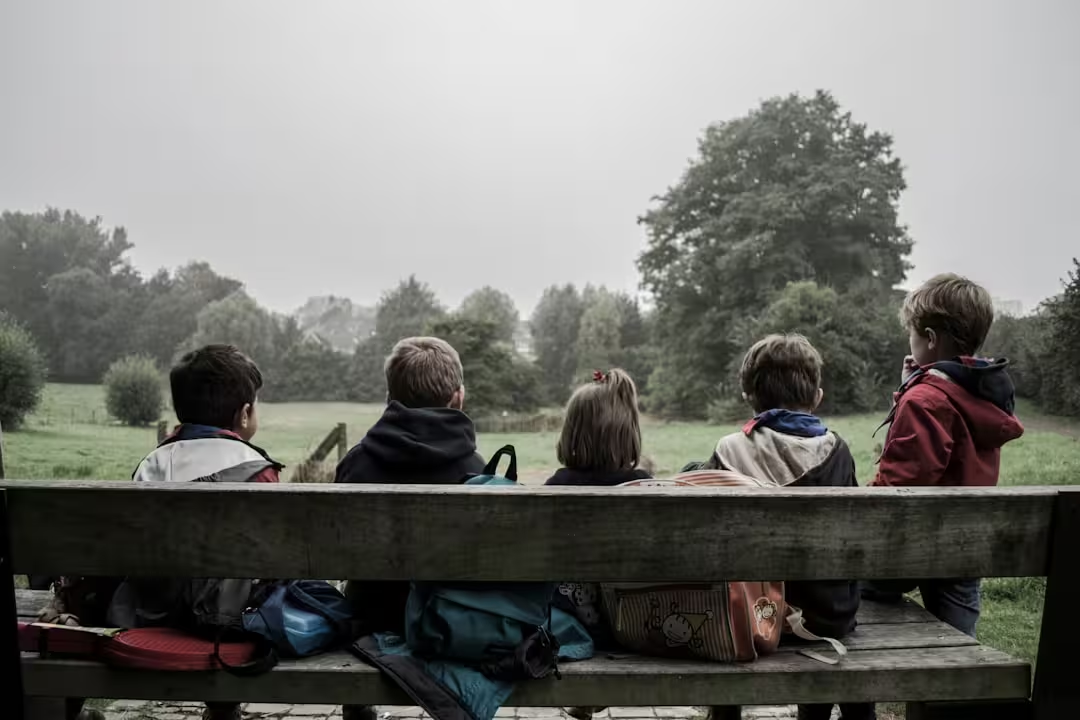
What families say about their Montessori experience at IMS Sotogrande
One of the things families most often repeat in their reviews about our Montessori school is that they notice the change in their children outside of school. “We no longer have to tell him to pick up, he does it on his own,” they tell us. Or “he started asking about the names of letters on street signs.” That transfer to daily life is the most reliable proof that the method is working.
In Sotogrande, we welcome families from all over the Campo de Gibraltar. They come from San Roque, Algeciras, La Línea and even Gibraltar, because they value the Spanish-English bilingual immersion and the AMI and NEASC accreditations that guarantee the quality of the program.
If you are evaluating several Montessori schools, I encourage you to ask for references from other families, but also to visit the classroom. Book a personalized school visit so you can see for yourself the dynamics behind the reviews.
Frequently asked questions
Is a Montessori school suitable for every child?
Yes, because it respects the individual developmental plane. We accompany children from ages 0 to 12, and each stage has its prepared environment. In the Nest (0-3) motor independence is fostered. In Children’s House (3-6) the absorbent mind is nurtured. In the Workshop (6-12) reason and cooperation are encouraged.
How can you tell if a Montessori school is authentic or just uses the name?
Look at accreditations. A serious Montessori school is recognized by the Association Montessori Internationale (AMI) or an equivalent body. Additionally, guides must have AMI training. Always ask about credentials: anyone can put up wooden shelves and call it Montessori.
What’s the difference between reviews of a Montessori school and a traditional one?
Reviews of a Montessori school often highlight aspects like independence, calmness in the classroom, and respect for the child’s pace. In a traditional school, you’ll see more comments about external discipline, exams, or homework. The key is to see whether the review describes an environment where the child is a protagonist or merely a receiver.
Key conclusions
In the end, reviews about a Montessori school are a starting point, not the destination. Look for coherence between what you read and what you observe. And remember: a solid Montessori project shows in everyday details, not in website promises.
If you are in the Campo de Gibraltar area and considering making the move, I invite you to visit IMS Sotogrande at your leisure. Spend a morning with us and then compare what you see with the reviews you’ve read. Only then can you make an informed decision based on your own opinion.









