
Montessori School Play: How It Transforms Your Child’s Learning
In short
Have you ever watched your child completely absorbed in lining up objects and wondered if they’re really learning anything? In Montessori pedagogy, that moment of total concentration is exactly where the magic happens. Montessori play isn’t wasted time, it’s the most natural and powerful way a child builds intelligence, coordination, and confidence.

Have you ever watched your child completely absorbed in lining up objects and wondered if they’re really learning anything? In Montessori pedagogy, that moment of total concentration is exactly where the magic happens. Montessori play isn’t wasted time, it’s the most natural and powerful way a child builds intelligence, coordination, and confidence.
Key Takeaways
- Montessori play is based on real-life activities and sensorial materials with a clear educational purpose.
- Children freely choose their activity within a carefully prepared environment that offers limited options without coercion.
- You don’t need expensive toys: everyday household objects make perfect Montessori materials.
- The adult observes more than they direct, stepping in only when the child needs it.
- Sensitive periods (natural windows of interest) guide what to offer at each age.
What Is Montessori Play and How It Differs from Regular Play
Montessori play is the set of activities a child freely engages in within a carefully prepared environment, where each material has a specific educational goal. Unlike conventional play, where many toys are just for entertainment, every object here invites the child to explore a concrete skill: sorting, classifying, coordinating fine movements, or solving real problems.
Maria Montessori observed that young children don’t distinguish between work and play. When a three-year-old pours water from one jug to another, they’re not wasting time. They’re developing concentration, movement control, and autonomy. That’s the foundation of play in Montessori pedagogy: meaningful activities a child repeats for pleasure until they master them.

How Montessori Play Works at Each Stage
0 to 3 Years: Movement and Sensory Exploration
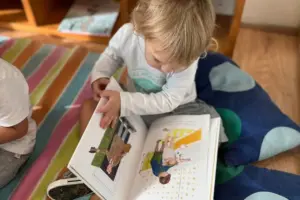
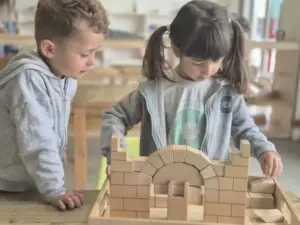
In the Infant Community (Nido), babies and toddlers explore through their senses. A fabric treasure basket with different textures, a cube to fit inside another, or a basket with natural objects are typical Montessori materials for this stage. Montessori play here focuses on free movement: crawling, climbing, and carrying objects from one place to another.
At IMS, our Nido guides observe what interests each child during their sensitive period and offer the right material at that exact moment. There’s no rush or pressure. The child repeats the activity as many times as needed until they feel satisfied.
3 to 6 Years: Practical Life and Sensorial Work
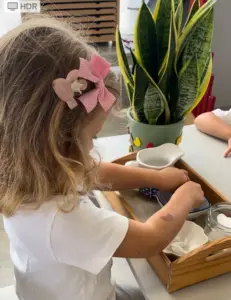
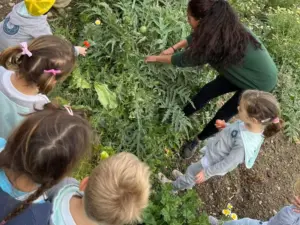
In Children’s House (Casa de Niños), Montessori play expands with practical life activities: sweeping, setting the table, washing dishes, and cutting fruit. They may look like adult chores, but for a four-year-old, they are fascinating games. Each one develops coordination, sequencing, and real self-esteem.
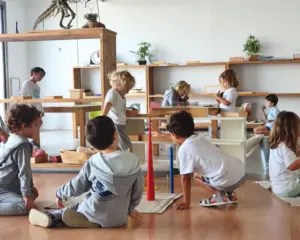
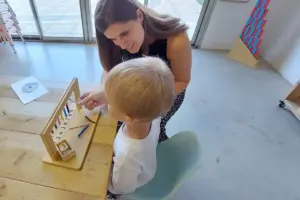
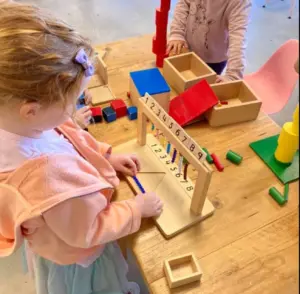
Sensorial materials like the Pink Tower, roughness tablets, or knobbed cylinders train visual and tactile perception. Children use them as games, but they’re designed to prepare for mathematical and language concepts that will come later.
6 to 12 Years: Abstraction and Cooperation
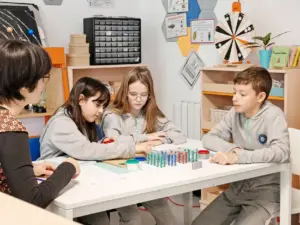
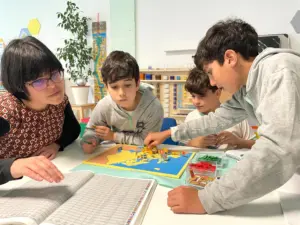
In the Elementary Workshop (Taller), Montessori play evolves into cooperative projects, research, and work with abstract materials. Children at this age need to understand the ‘why’ behind things. Strategy games, scientific experiments, and group projects replace the individual exercises of earlier stages.
During this period, play includes real socialization: negotiating roles, resolving conflicts, and making collective decisions. These are skills no textbook can teach, but they are practiced every day in a Montessori classroom.
If you’d like to see how we apply Montessori play in our classrooms, book a personalized school visit.

5 Key Ways to Bring Montessori Play into Your Home Today
You don’t need to buy expensive materials or transform your living room. Applying Montessori play at home starts with simple changes:
- Prepare the environment: Place objects the child can use independently at their height. A low coat rack, a shelf with 4-5 activities, and an accessible reading corner are enough.
- Offer real activities: Pouring beans from one bowl to another, scrubbing a plate, buttoning buttons. These are Montessori games that truly develop fine motor skills.
- Observe before intervening: If your child is focused, don’t interrupt them even if it looks like they’re ‘doing nothing.’ That deep concentration is the engine of learning.
- Limit choices: Too many toys cause distraction. Rotate 4-5 activities on the shelf each week.
- Respect their pace: If a 2-year-old wants to repeat the same activity 20 times, let them. Repetition is how their brain consolidates learning.

Common Mistakes When Applying Montessori Play at Home
The first mistake is confusing Montessori with aesthetic minimalism. It’s not about having pretty wooden shelves. It’s about offering activities with a real purpose that the child can do independently.
The second mistake is directing too much. If you set up the activity and tell them exactly how to do it, it’s not Montessori play. The adult shows (presents) the material once, without unnecessary words, and then leaves it in the child’s hands.
The third is expecting immediate results. A child might ignore a material for weeks and then suddenly use it obsessively. Sensitive periods don’t follow an adult calendar. Patience is part of the method.
The Role of the Adult in Montessori Play
The adult’s role isn’t to teach or entertain. It’s to prepare the environment, observe, and be available. In Montessori pedagogy, we call adults ‘guides’ because they accompany, not direct.
When a child asks for help, the adult shows without doing. If the child spills water while pouring, you don’t clean it for them: you offer a sponge and teach them how to wipe it up. That’s the difference between an adult who solves problems and an adult who teaches how to solve them.
In IMS classrooms, our guides are trained by the Association Montessori Internationale (AMI), ensuring every intervention respects the method’s principles. You can check the training standards at ami-global.org.
Frequently Asked Questions
What age should you start Montessori play?
Montessori play begins from birth. In the first months, it involves offering simple objects to grasp and a safe environment for free movement. There’s no minimum age: a 6-month-old baby can already explore a treasure basket with objects of different textures and shapes.
Do I need to buy special Montessori materials?
No. Many Montessori materials are everyday objects: small jugs, sponges, brushes, trays, dried beans, and fabrics with different textures. What matters isn’t the material itself, but that it has a clear purpose and the child can use it independently. Commercial materials are useful but not essential.
How do I know if my child is learning through play or just wasting time?
If your child shows deep concentration (fixed gaze, repeats the activity, doesn’t respond when you speak), they’re learning. In Montessori pedagogy, concentration is the most reliable indicator of real learning. If you interrupt that moment to ‘teach them something,’ you’re breaking their natural work cycle.
Does Montessori mean the child does whatever they want?
No. The child chooses freely within a clear set of limits. In a Montessori classroom, the child can choose from 4-5 activities presented on the shelf, but they can’t take out all the materials at once or make noise disturbing others. Freedom within limits is one of the method’s basic principles, as explained by the Spanish Montessori Association.
Key Takeaways
Montessori play doesn’t require major investment or transforming your home. It requires observation, patience, and trust in your child’s natural ability to learn. Every everyday activity, from setting the table to tidying up toys, becomes a developmental opportunity when the environment is prepared and the adult knows when to step in and when to step back.
Start today with a single change: prepare a low shelf with 4 simple activities and observe. Within a week, you’ll see which activities your child chooses, what truly interests them, and how their concentration grows without anyone forcing them. If you’d like to see how we apply all this in the IMS classrooms, email us at [email protected] or call +34 653 04 17 39.