
Montessori Pros and Cons: Honest Guide for Expat Families in Sotogrande & Costa del Sol
In short
When a family starts weighing the pros and cons of the Montessori method, they usually arrive with a mix of excitement and uncertainty. I've been accompanying children and parents on this path for over ten years, and the first thing I say is that there are no magic formulas. Montessori is a philosophy that transforms, but also demands commitment.

When a family starts weighing the pros and cons of the Montessori method, they usually arrive with a mix of excitement and uncertainty. I’ve been accompanying children and parents on this path for over ten years, and the first thing I say is that there are no magic formulas. Montessori is a philosophy that transforms, but also demands commitment. Here I’ll tell you, without filters, the good and the not-so-good we’ve observed in our daily life at IMS Sotogrande. In this article we explore Montessori pros and cons in depth with practical examples.
What is the Montessori method?
The method developed by Maria Montessori at the beginning of the 20th century is based on a simple idea: the child is the protagonist of their own learning. Instead of a teacher at the front giving lessons, the prepared environment and manipulative materials allow each child to progress at their own pace. At IMS, for example, our AMI guides observe, guide, and accompany, but never interrupt a moment of deep concentration. That trust in the child’s potential is the backbone of everything else. When it comes to Montessori pros and cons, it pays to listen to what families and lead guides actually report.
Advantages of the Montessori method
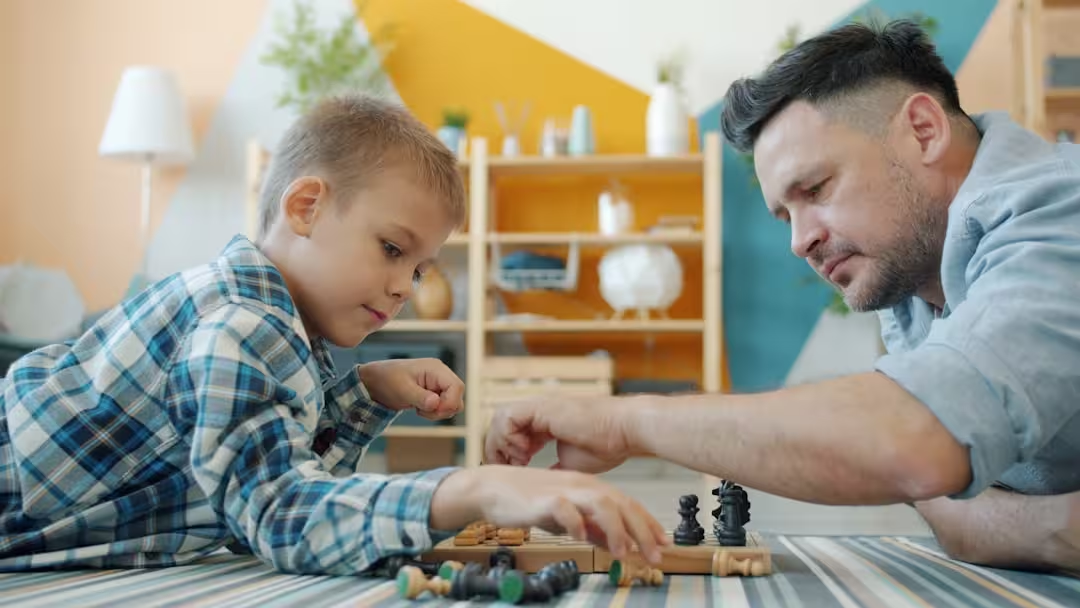
Over the years, I’ve seen benefits that go far beyond academics. These are the five big advantages that families usually notice even before finishing the first term. Daily practice with Montessori pros and cons reveals nuances no handbook fully captures.
1. Fosters independence and self-discipline
In a Montessori classroom, everything is designed so that the child can do things for themselves: from pouring water to choosing between math or language trays. This independence builds natural self-discipline. They don’t obey out of fear of punishment or expectation of reward, but because they internalize order and respect for the environment and peers. My colleague in Taller always says that a child who cleans their own table at three years old becomes a teenager who makes thoughtful decisions. Understanding Montessori pros and cons from inside the classroom reshapes everyday decisions.
2. Personalized learning and respect for individual pace
Each child has a different sensitive period. While one is fascinated by numbers, another may spend weeks exploring the sound of letters. In Montessori, that isn’t forced. Guides present materials when they detect that spark of interest. That’s why at IMS there are no standardized tests until advanced stages, and yet the academic level usually matches or exceeds that of traditional education. The secret is intrinsic motivation. Concrete data on Montessori pros and cons is worth reviewing before acting on assumptions.
3. Development of social and emotional skills
The mix of ages, three years in the same classroom, creates a small community where older children help younger ones and everyone learns to resolve conflicts with words. Emotional education is not a subject: it’s lived every day. In our Nido, for example, we see how two-year-olds learn to wait their turn by holding an object that symbolizes the word, without an adult imposing it. That empathy consolidates over the years.
4. Prepared environments that stimulate the senses
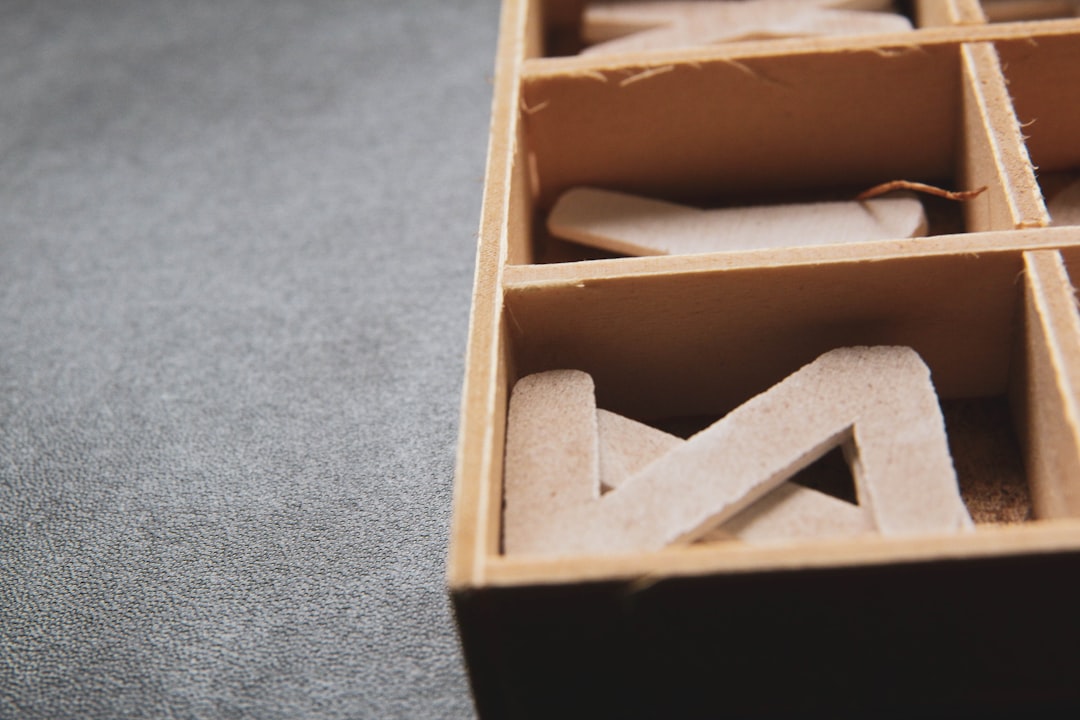
The Montessori classroom is a sensory laboratory. Materials like the pink tower, color boxes, or sandpaper letters are designed for the brain to abstract concepts through manipulation. It’s not just theory: neuroscience confirms that multisensory learning better fixes neural connections. At IMS, every environment is cared for down to the smallest detail, from natural light to the aesthetics of plants and works of art.
5. Bilingual or trilingual immersion from an early age
This advantage is not intrinsic to the method, but it is a reality in schools like ours. At IMS Sotogrande, dual Spanish-English immersion is total from Nido, and in Casa de Niños, French is introduced. Children absorb languages effortlessly, just as they absorb order or courtesy. For expatriate or local families looking for an international education near Gibraltar, this makes a huge difference.
If you want to see how all this works live, book a personalized school visit and we’ll chat without obligation.
Disadvantages of the Montessori method
It would be unfair to paint an idyllic picture. Accompanying childhood through Montessori also has its challenges, and you need to face them to make an informed decision.
1. It can be disconcerting for families used to traditional education
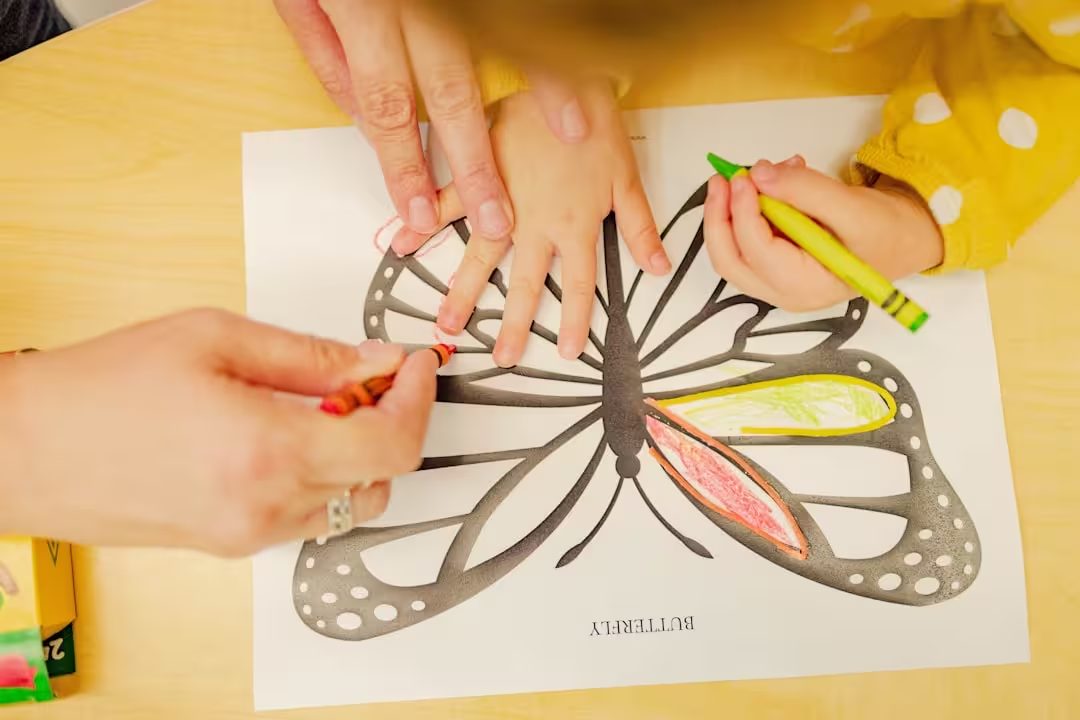
If you come from a system of worksheets, daily homework, and report cards, the mindset shift is strong. At first, many parents ask why their child “just chooses” or if they are wasting time. Later, seeing them concentrated for an hour on a practical life tray, they understand that something deeper is happening. But the trust process isn’t immediate, and it can sometimes generate anxiety.
2. The transition to other educational systems can be a challenge
Although Montessori children are usually curious and resourceful, the rigid structure of a traditional secondary school can be a shock. We’ve seen cases of students who, after several years in our Taller, miss the freedom of movement or project-based work. That’s why at IMS we accompany families in choosing the next step and recommend looking for schools with active methodologies. The encouraging data: most adapt within a few weeks because they bring a solid foundation of autonomy and critical thinking.
3. The cost of a private Montessori school
This is an unavoidable reality. Montessori schools with AMI guides and approved materials require an investment that not all families can afford. At IMS Sotogrande we offer a trilingual education with AMI and NEASC accreditations, which entails a budget commensurate with the quality of the project. We don’t publish rates here because we prefer each family to evaluate them on a personal visit, but I can tell you that there are sibling discounts and a bonus for annual payment. The key is to understand it as an investment in your children’s educational foundation.
4. Limited secondary school options
The Montessori method covers up to adolescence, but in practice there are few centers in Spain that go beyond age 12. IMS, for example, accompanies up to age 12. That means that after finishing Taller, families must find another school. We help with personalized guidance, but it’s a point to consider from the beginning.
Our experience at IMS Sotogrande with the Montessori method
After more than two decades accompanying families from Campo de Gibraltar, Sotogrande, La Línea, and Estepona, we’ve verified that the pros and cons of the Montessori method are experienced very differently depending on the family’s commitment. Children who maintain consistency between home and school, involving them in cooking, tidying up, or everyday decisions, are the ones who shine the most. It’s not necessary for the home to be a classroom, but it should share the same values of respect and autonomy.
One of the keys to our project is the continuous training of AMI guides and the commitment to real bilingualism. Because a Montessori school is not just about pretty aesthetics: it’s about scrupulous respect for sensitive periods and freedom within limits. When that is done well, the disadvantages are relativized and the advantages multiply.
Frequently asked questions
What are the main pros and cons of the Montessori method?
The advantages revolve around autonomy, personalized learning, sensory education, and socio-emotional development. The disadvantages are usually related to the cultural shock for traditional families, the possible difficulty of transitioning to very structured systems, and the economic investment involved. In any case, most disadvantages are mitigated when the family trusts the process and the school maintains open communication.
Is the Montessori method suitable for all children?
In principle yes, because it respects individual pace and doesn’t force fitting into a mold. However, each child is unique, and in cases of very specific needs, a personalized assessment is advisable. At IMS, we have a Rainbow Classroom to accompany diversity, always from the Montessori perspective.
How is progress evaluated in Montessori?
We don’t use traditional exams until the final years of primary. Guides keep a detailed record of presentations, trays the child masters, and daily observations. We share a descriptive report with families each term and meet for individual tutorials. This allows us to detect progress or blocks early without subjecting the child to the pressure of a grade.
Deciding with criteria
The pros and cons of the Montessori method are not black or white. Knowing them in advance will help you decide if this pedagogy fits your family. And if you finally go for it, look for a school with AMI-trained guides, authentic environments, and a community that makes you feel at home.
At IMS Sotogrande, we open our doors year-round so you can see for yourself. There’s no better way to understand Montessori than to watch a three-year-old pour water from a small glass pitcher, concentrated and happy.









