
Montessori Music for Children (Ages 0-6) | Guide for Expat Families in Sotogrande & Costa del Sol
In short
Montessori music for children is much more than a soothing lullaby or a leisure activity. From the womb, the ear begins to process sounds and rhythms that lay the foundation for language and concentration. In Montessori, music education is not a separate subject: it is a living language that permeates every environment, from the Nido to the Children's House.
Montessori music for children is much more than a soothing lullaby or a leisure activity. From the womb, the ear begins to process sounds and rhythms that lay the foundation for language and concentration. In Montessori, music education is not a separate subject: it is a living language that permeates every environment, from the Nido to the Children’s House.
If you have ever seen a baby move to the beat of a melody or a three-year-old hum while working with the pink tower, you have witnessed what Maria Montessori described as “the inner ear”. But you don’t have to be a musician to support this awakening. With a few materials, respect for the child’s pace, and plenty of listening, any family can transform their home into a musically rich space.
- Montessori Music for Children: The Approach from the First Months
- Why Is Music So Important in the Early Years?
- How to Foster Music at Home Without Being a Musician
- Montessori Materials for Music Education
- Music and Language Development: A Natural Connection
- Music at IMS Sotogrande: How We Work on the Ear from Nido to Taller
- Frequently Asked Questions
- Key Takeaways
Montessori Music for Children: The Approach from the First Months
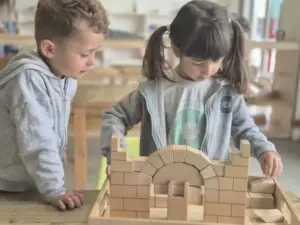
In Montessori pedagogy, music is not taught with worksheets or forced lessons. It is absorbed, lived, and discovered. Prepared environments include real instruments, not toys, within the children’s reach, because we know that sound quality educates the ear with the same subtlety that a black-and-white mobile educates the eye.
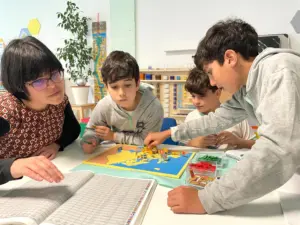
Last month, in the Nido environment, Tatiana, our music specialist, placed a set of diatonic bells on a mat. Two 14-month-olds crawled toward them, tapped them gently, and stayed still, listening to the vibration. That is the essence: expose, don’t impose. Let the child be the protagonist of their own sound experience.
Why Is Music So Important in the Early Years?
Neuroscience confirms what we already suspected: early auditory training sharpens the ability to discriminate sounds, improves attention, and lays the groundwork for reading and writing. A longitudinal study from the University of Helsinki (2016) showed that babies who participated in regular music sessions had greater brain activity in areas related to language processing at 9 months.
So, when we sing lullabies, recite rhymes, or simply pause in silence, we are building a more plastic brain ready to learn. It’s not about turning the child into a virtuoso, but about offering a sensory diet rich in nuances. In Montessori, we say the hand is the teacher of the mind , but the ear is the first great teacher.
How to Foster Music at Home Without Being a Musician
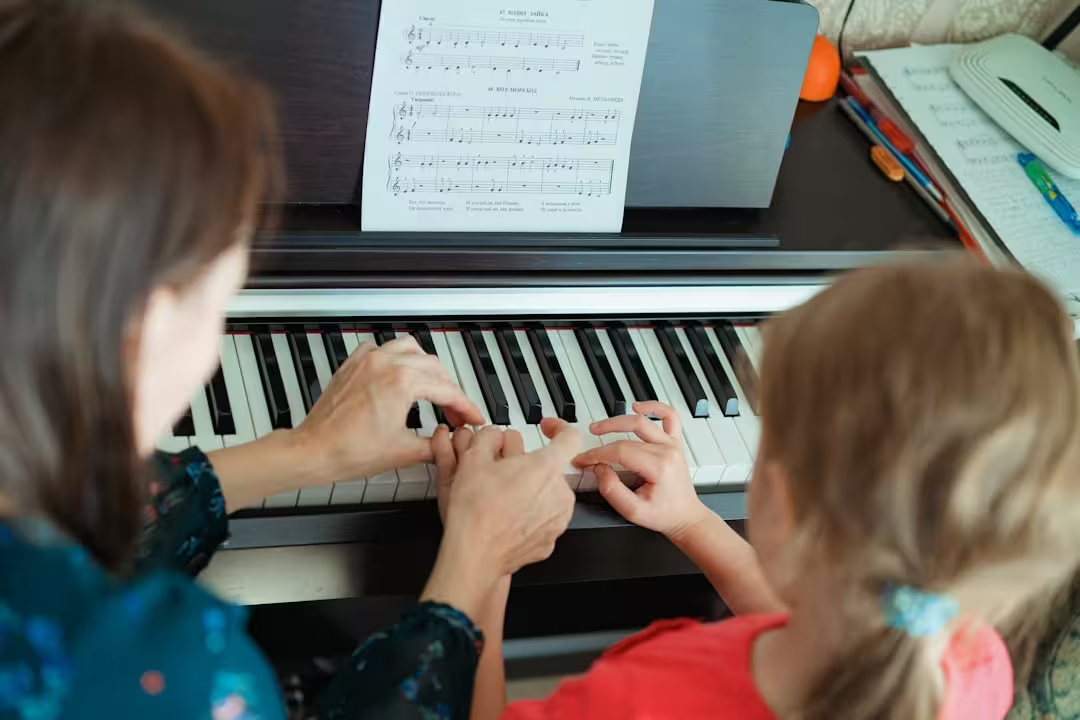
You don’t need to play the violin or have perfect pitch to create a musical home environment. These three pillars will help you:
- Quality silence. It sounds contradictory, but the first step to educating the ear is knowing how to be quiet. Spend a few minutes a day listening to environmental sounds: the wind, a clock, a dripping faucet. The Montessori silence game is one of the most powerful activities.
- Real instruments within reach. Offer bells, xylophones, or a good-quality drum instead of toys that distort sound. Better few and good. Rotate them weekly to maintain interest.
- Varied repertoire, without overloading. Alternate classical music, folk, jazz, and nature sounds. Avoid commercial children’s music with repetitive beats. The idea is to nourish, not overwhelm.
At IMS Sotogrande, we recommend families start with a music corner at home: a basket with a bell, a wooden rattle, and a silk scarf for dancing. With that, you already have a minimal prepared environment. Book a personalized visit to the school and we’ll show you how we organize it in our Nido and Children’s House environments.
Montessori Materials for Music Education
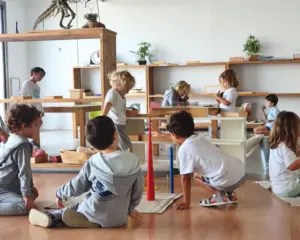
In IMS environments, music is present in all areas. We don’t need a special classroom: the bell set is on the sensorial life shelf, next to the sound cylinders and sound boxes. The child chooses when to explore sound, and does so with the same naturalness as watering a plant or counting golden beads.
The key materials we use, and that you can adapt at home, are:
- Montessori bells. Each note precisely tuned. The child strikes them, compares them, orders them. Thus, they understand the musical scale sensorially, without labels.
- Sound cylinders. Two sets of six cylinders that produce lower or higher sounds when shaken. Matching them sharpens the ear and concentration.
- Percussion instruments. Tambourines, triangles, claves, or wooden maracas. Always with supervision at first, because young children tend to suck or hit excessively.
These materials are not toys but developmental tools. That’s why at IMS we present them with an individual lesson, as we do with all other Montessori materials. The adult shows how to use them once and then steps back, letting the child explore at their own pace.
Music and Language Development: A Natural Connection
When a two-year-old hums a song, they are practicing rhythmic patterns that they will later apply to speech. Rhymes, stressed syllables, and lullaby intonation are the first scaffolding for grammar and phonetics. In bilingual environments like ours (Spanish-English, with French from Children’s House), music is an exceptional ally for second language acquisition.
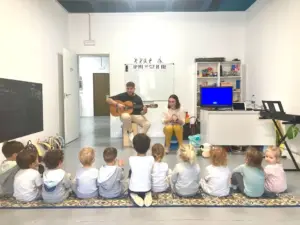
An example: in our morning circle sessions, Tatiana sings the same song in Spanish and English, pointing to body parts or actions. Children respond without realizing they are building vocabulary in two languages. It’s pure learning by absorption, without stress or translation.
Music at IMS Sotogrande: How We Work on the Ear from Nido to Taller
At IMS, music education is not an extracurricular but an integrated pillar of the curriculum. We don’t have an isolated “music” teacher: music flows through all environments, guided by our guides and specialists like Tatiana Gavira and Adrián Rodríguez, who work closely with classroom guides.
In Nido (0-3), the approach is purely sensory: lullabies, nature sounds, and small percussion. In Children’s House (3-6), we introduce bells, choral singing, and rhythmic movement. From Taller (6-12), children compose their own pieces and explore musical notation, always starting from sensory experience. Additionally, our Summer Camp includes bilingual music workshops that are a hit among families in Sotogrande and Campo de Gibraltar.
If you live in the area, Sotogrande, San Roque, La Línea, Algeciras, or even Gibraltar, and are looking for a school that understands music as a language and not as a subject, check our admissions process. You’ll be investing in an education that prepares for life, with an educated ear and a heart that knows how to listen.
Frequently Asked Questions
At what age can you start stimulating music for children?
From birth. The ear is fully developed by the fifth month of gestation, so babies already recognize their mother’s voice and melodies heard before birth. At home, simply sing to them, play soft music, and respect moments of silence.
Do parents need musical training?
No. What matters most is attitude: listen together, dance, sing even if off-key. The child doesn’t judge, they only absorb your enthusiasm. Montessori materials do the rest: they are designed for the child to discover the properties of sound independently.
How to choose suitable instruments for my child by age?
For babies, wooden rattles or bells with handles. From 1 to 3 years, a small drum, rainstick, or maracas. From 3 on, a real diatonic xylophone (not a toy) and tuned bells. Avoid electronic instruments or those that imitate pre-recorded sounds: the child needs to experience real vibration and sound production themselves.
Key Takeaways
Montessori music for children has a direct impact on brain development, language, and emotional self-regulation. It is not a luxury but a sensory right. In Montessori, we don’t seek for children to play an instrument “well,” but to learn to listen, feel rhythm, and express themselves freely.
If you want to see how we turn that principle into reality every day, we invite you to our next virtual or in-person Open Day. You’ll hear bells, laughter, and maybe a trilingual song. And if you can’t wait, start today at home: turn off the TV, put on a Bach record, and observe what your child does. Music is already there. It just needs space.
For more information, visit the Association Montessori Internationale and the study on music and brain development from the University of Helsinki.