
International Montessori School Sotogrande: What is the Montessori Method? A Complete Guide for Families
In short
International Montessori School Sotogrande: Are you looking for an international Montessori school near Gibraltar or on the Costa del Sol? Then you've probably asked: what is the Montessori method and why do so many families trust it?
Are you looking for an international Montessori school near Gibraltar or on the Costa del Sol? Then you’ve probably asked: what is the Montessori method and why do so many families trust it? It’s not a passing trend but an educational approach with over a century of history that puts the child at the center of learning. In this practical guide, we explain its origins, core principles, and how you can apply its ideas in daily life, both at school and at home.
- What is the Montessori Method? Definition and Origins
- The Pillars of the Montessori Method
- Montessori Materials: Learning with Hands
- Benefits of the Montessori Method, Supported by Science
- The Montessori Method in Real Life: Practical Examples
- Differences Between Montessori and Traditional Education
- Montessori at IMS Sotogrande: An International School in the Costa del Sol near Gibraltar
- Frequently Asked Questions about the Montessori Method
- Key Takeaways
What is the Montessori Method? Definition and Origins
The Montessori method is an educational system developed by Italian physician and educator Maria Montessori in the early 20th century. By observing children from different backgrounds, Montessori discovered that young children have a natural ability to learn by themselves when provided with a suitable environment. In 1907, she opened her first “Casa dei Bambini” in Rome, and since then her philosophy has spread to thousands of schools worldwide.
The essence of the Montessori method lies in deep respect for the child as an individual. It is not about transmitting knowledge in a one-way manner, but about preparing an environment where the child freely chooses from activities designed for their development. The Association Montessori Internationale (AMI), founded by Montessori herself, today ensures the authenticity of this approach in all accredited schools.
The Pillars of the Montessori Method
To understand what the Montessori method is in depth, it is essential to know its fundamentals. These principles not only guide educators but also help parents better understand their children and accompany them without rushing.
The Absorbent Mind
Maria Montessori observed that children under six years old possess a unique ability to absorb information from their environment without conscious effort. She called this faculty the “absorbent mind.” During this period, the child acquires language, habits, social norms, and movement patterns simply by being present in a rich and orderly environment. That is why in Montessori classrooms, every material and every corner is carefully curated: everything communicates.
Sensitive Periods
Children go through phases where they show a special interest in specific areas: order, language, movement, and the senses. These sensitive periods are windows of opportunity for deep learning. The Montessori method identifies these moments and offers activities that satisfy them. For example, when a young child insists on opening and closing drawers repeatedly, they are not “being naughty”: they are refining their motor coordination. Respecting those impulses is key.
The Prepared Environment
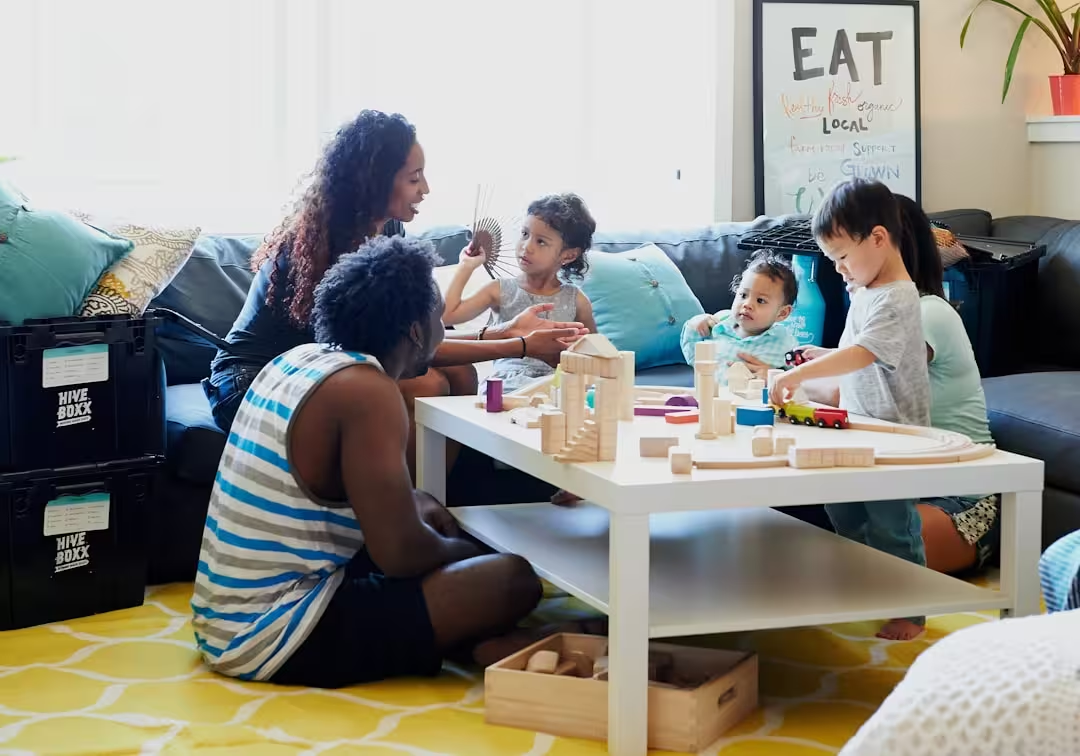
A prepared environment is a space designed to the child’s scale. Furniture is wooden and accessible, materials are arranged on open shelves, and each object has a purpose. There is no chaos or overstimulation. External order helps the child build internal order, resulting in calm and concentration. At IMS Sotogrande, each classroom is designed following this philosophy, with natural light, plants, and defined work areas.
If you live in the Campo de Gibraltar area, whether in Sotogrande, Algeciras, La Línea, or Estepona, and want to see how the Montessori method is implemented in a real classroom, we invite you to book a personalized visit. Nothing replaces the experience of observing a Montessori environment in action.

Montessori Materials: Learning with Hands
Another fundamental pillar of the Montessori method is its materials. Each is designed with a specific purpose and contains a control of error, allowing the child to self-correct without needing an adult to say right or wrong. This fosters autonomy and confidence.
- Practical Life: activities like pouring water, sweeping, or buttoning. They develop fine motor skills and independence.
- Sensorial: such as color tablets, sound cylinders, or fabric boxes. They refine the senses and prepare for abstract concepts.
- Language: sandpaper letters, movable alphabet. They associate sound and writing through touch.
- Mathematics: golden beads, number rods. They turn operations into concrete experiences.
These materials are not ordinary toys. Their design results from years of scientific observation. For example, the golden beads allow the child to “see” and “touch” units, tens, and hundreds, making addition and subtraction not a mystery but a logical manipulation.
Benefits of the Montessori Method, Supported by Science
Beyond theory, numerous studies have analyzed the effects of the Montessori method on child development. Psychologist Angeline Lillard from the University of Virginia compared children from Montessori schools with children from traditional schools and found that the former scored higher in social skills, abstract reasoning, and creativity.
Moreover, the Montessori approach fosters self-regulation. By allowing the child to choose their work and finish it without interruptions, they exercise the ability to maintain attention. In a world full of distractions, this skill is more valuable than ever. However, it is important to clarify that not all schools using the word “Montessori” faithfully follow the method. AMI accreditation guarantees that original standards are met.
The Montessori Method in Real Life: Practical Examples
One of the great advantages of the Montessori method is that its principles can be transferred to the home without significant investment. Many families notice how everyday dynamics change when they start observing their children instead of constantly directing them.
- Instead of storing toys in a chest, place them on low shelves in organized baskets. The child will see the options and can put them away independently.
- Include a stool in the kitchen so they can participate in food preparation. With adapted utensils, even a two-year-old can slice a banana or wash vegetables.
- Establish visual routines: a poster with pictures showing the morning steps (dress, breakfast, brush teeth). This gives them security and reduces conflict.
The important thing is not to replicate a classroom at home, but to respect the child’s natural impulses and trust their ability. As Maria Montessori said: “Never help a child with a task at which they feel they can succeed.”
Differences Between Montessori and Traditional Education
If you are wondering what the Montessori method is compared to the conventional educational system, these are the most visible differences:
- Role of the adult: In Montessori, the guide observes and connects the child with the environment. In traditional school, the teacher imparts the lesson.
- Grouping: Montessori uses mixed-age groups (e.g., 3-6 years), while typically children are separated by birth year.
- Assessment: There are no exams or grades. Progress is assessed through continuous observation and the child’s portfolio.
- Pace: Each child advances at their own pace. There is no curriculum that everyone must complete at the same time.
These characteristics make the Montessori environment especially respectful of diversity. Children of different maturity levels coexist and learn from each other, enriching the educational experience.
Montessori at IMS Sotogrande: An International School in the Costa del Sol near Gibraltar
In southern Spain, more and more families are choosing this pedagogy. IMS Sotogrande is a trilingual international school (Spanish, English, and German) accredited by the AMI and NEASC. We serve children from 4 months to 12 years, covering the planes of development that Montessori described.
We have Nido, Casa de los Niños, and Taller environments, each adapted to the needs of each stage. Additionally, we offer a bilingual immersion program in English and Spanish from the early years, something hard to find in the area. Families from Sotogrande, San Roque, Alcaidesa, La Línea, and even Gibraltar trust us because they know their children develop in a safe, warm, and stimulating environment.
One of the things parents value most is constant communication. Through the Growappy platform and weekly reports, they can follow their child’s day-to-day and understand how they learn. We also organize workshops for families because we believe the educational community is the key to success.
Frequently Asked Questions about the Montessori Method
What is the Montessori method for children 0 to 3 years?
The Montessori method for early childhood is based on free movement and sensory exploration. Instead of baby chairs or playpens, a firm floor is prepared with mirrors, mobiles, and natural objects that invite crawling and discovery. The adult does not interfere. They observe and ensure a safe environment.
Does the Montessori method only work in private schools?
No. Although IMS Sotogrande is a private school, there are public Montessori schools in many countries. The key is that the school is accredited by a serious entity like AMI, which ensures that guides have proper training and that environments meet the scientific standards of the method.
What is the ideal age to start Montessori?
The earlier, the better. The benefits of the Montessori method multiply when applied from birth. The first three years are critical for brain development. In our IMS Nido, we welcome babies from 4 months, and it is noticeable how autonomy and self-confidence flourish when their rhythm is respected.
What is the difference between Montessori and other alternative pedagogies?
Although they share some values with pedagogies like Waldorf or Reggio Emilia, Montessori is distinguished by the use of specific scientific materials and the standardized training of its guides. Additionally, Montessori places great emphasis on practical independence and individualized learning, while other methods may prioritize symbolic play or the arts more.
Can I apply the Montessori method at home without studying pedagogy?
Absolutely. You don’t need to be a certified guide to incorporate the Montessori method into family life. Start by observing less and doing less. Prepare a simple environment, organize toys with criteria, establish routines, and above all, trust your child’s instincts. If you want to go deeper, at IMS we offer workshops for families that can guide you.
Key Takeaways
The Montessori method is not a magic recipe or a set of expensive materials. It is a philosophy based on observation and deep respect for childhood. Its pillars, absorbent mind, sensitive periods, prepared environment, remind us that every child has immense potential that only needs the right conditions to flourish.
If after reading this guide you feel this approach resonates with your understanding of education, we encourage you to take the next step: visit us in Sotogrande and experience Montessori firsthand. We would be delighted to accompany you in this important decision for your family.









