
Montessori Method Explained: 12 Principles, Common Mistakes & Home Checklist

The Montessori method is an educational approach created by Italian physician Maria Montessori in the early twentieth century that places the child at the center of their own learning. It’s built on prepared environments, self-correcting materials, and long, uninterrupted work periods. It’s not a system of exams or homework - it’s a way of supporting development while respecting each child’s own pace.
In a nutshell
- The Montessori method grew out of Maria Montessori’s medical observation of children and relies on prepared environments and independent work.
- The 12 principles include freedom within limits, sensitive periods, self-correcting materials, and mixed-age grouping.
- The adult guides and observes - they don’t lecture from the front or interrupt concentration.
- A common mistake at home: buying extremely expensive materials and confusing freedom with a total lack of limits.

What is the Montessori method, exactly?
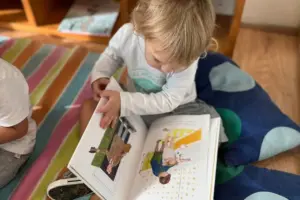
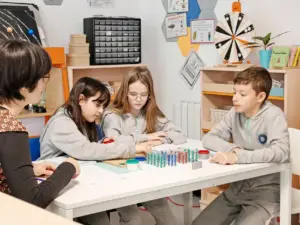
The Montessori method is a scientific pedagogy based on direct observation of the child. Montessori found that young children learn best when they handle real objects, choose their own activity, and repeat without being rushed. From this came the three pillars you’ll see in any authentic classroom: the prepared environment, the developmental material, and the adult as a guide.
The Association Montessori Internationale is the organization Maria Montessori founded in 1929 to preserve the integrity of her work. When you’re evaluating schools, asking about the team’s AMI training is one of the most reliable signals. In the Spanish context, the Sociedad Española Montessori also brings together schools and families.

The 12 essential principles of the Montessori method
These are the principles that underpin the entire Montessori practice, ordered so you can recognise them in a real classroom.
Freedom within clear limits
The child chooses their work, but within a framework: they respect the material, respect others, and respect the person. Choosing doesn’t mean doing whatever they want at any moment.
A prepared, orderly environment
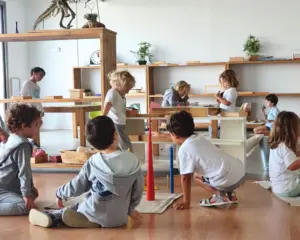
Every object has its place and its height. That order lets an 18-month-old tidy up on their own and lets the classroom run without the adult constantly issuing instructions.
Sensitive periods
At certain ages a child shows an absorbing interest in language, order, or movement. Seizing that window is far more effective than forcing learning outside its time.
Self-correcting materials
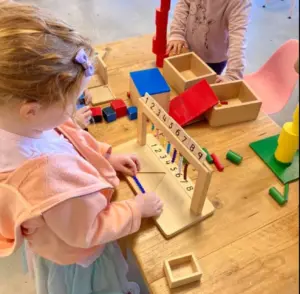
The materials build in a control of error. If the tower of cubes topples, the child sees it without anyone saying “you got it wrong.”
The adult as a guide
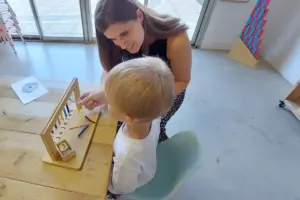
The adult observes, presents, and steps back. Interrupting a concentrated child breaks something valuable Montessori called normalization.
Movement and cognition linked
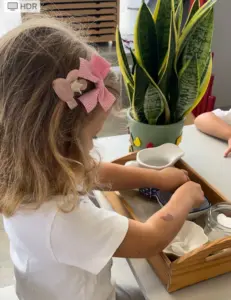
Carrying a tray, pouring water, or polishing wood are mental activities as much as physical ones. The body learns through the hands.
Mixed-age grouping
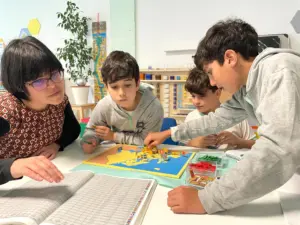
Three-year age spans let older children reinforce what they’ve learned by teaching, and let younger children observe models close to them.
Three-hour uninterrupted work cycles
A full morning without interruptions lets the child move from one activity to the next until they reach a point of satisfaction.
Freedom of pace and repetition
Repeating a pair of tweenties twenty times isn’t immaturity - it’s consolidation. Nobody cuts a repetition short because it’s time for another subject.
Observation as a tool
The guide takes notes and adapts the environment to the child, not the other way around. Observation is pedagogical work, not dead time.
Positive discipline and respect
Behaviour is corrected without humiliation, with firm limits and emotional closeness. Tantrums are accompanied, not punished.
Connection with nature and real life
Cooking, tending plants, or cleaning their own shoes are part of the curriculum. Practical life is the first material.
Summary table of the principles
For a quick comparison:
- The child : protagonist, with freedom within limits.
- The environment : orderly, child-sized, with self-correcting materials.
- The adult : guide who observes and presents, never directs.
- Time : three-hour blocks and the child’s own pace.
- Ages : mixed-age groups spanning three years.

How to apply Montessori at home without buying an entire classroom
You don’t need to spend a fortune on materials. What works is adapting the house to your child’s height and giving them real time to be independent.
Example: the pink tower and a Tuesday morning sequence
Imagine you have a 3-year-old. In the morning, for 25 minutes with no screens and no visitors, they choose between two activities laid out the night before. If they pick the clothes-peg activity on a tray, they carry it to the table, work, finish, and return it to the shelf. Those 25 uninterrupted minutes are worth more than an hour broken up every five minutes.
Another example: if your 5-year-old resists tidying up, instead of organising everything for her, place cardboard silhouettes on the shelf. She then knows exactly where each object belongs, and the task stops being a negotiation.
Common mistakes and how to fix them
The most common mistake is confusing freedom with permissiveness. If the child throws the material and nobody rebuilds it with them, the house descends into chaos and parents end up abandoning the method within two weeks.
The fix is simple: brief, concrete, repeated limits. “Materials are used at the table. If it’s thrown, we put it away and try again tomorrow.” The second trap is copying a picture-perfect classroom without training - it’s better to choose a few materials and understand what each one is for than to fill decorative shelves.
Quick home checklist
- Can your child reach their clothes, cup, and cloth without asking for help?
- Is there a work space free of noise and screens for 20 minutes in a row?
- Are the toys on individual trays and rotated?
- Are limits explained before the behaviour, not after?
- Can you observe for ten minutes without intervening?
Frequently asked questions
At what age can you start the Montessori method?
The Montessori method can be applied from birth, because its foundation is respecting the child’s natural development. In the 0 - 3 stage, preparing the environment and offering autonomy is enough. In the children’s community, from 3 to 6 years old, working with concrete materials really comes into its own.
Do Montessori children socialise just like everyone else?
Yes - and with an advantage: mixed-age groups spanning three years force children to negotiate, wait their turn, and help younger ones. Socialisation isn’t taught with lessons; it’s practised every time two children want the same material and agree on who waits.
Can the Montessori method be combined with traditional school?
Yes, as long as you don’t expect both ways of working to be identical. Many families keep the principles of autonomy and clear limits at home even if the school is traditional. Being consistent on the essentials is enough to notice changes in behaviour.
Is Montessori suitable for children with special educational needs?
The Montessori philosophy respects each individual’s pace, which makes it highly adaptable to a wide range of profiles. Even so, every case needs professional assessment. If you have concerns about your child’s development, speak with your paediatrician and with specialists in special educational needs.
If you’d like to see how this looks in a real classroom, at IMS Sotogrande we welcome families from across the Campo de Gibraltar, La Línea and Gibraltar in a bilingual environment with AMI accreditation and NEASC. Book a personalised school visit and see whether this approach fits your family.