
Montessori Learning Tower Guide: A Must-Have for Expat Families in Sotogrande
In short
If you have a child between 18 months and 6 years old, you’ll recognize this scene: you’re in the kitchen and your little one wants to be with you, see what you’re doing, touch, and help. The learning tower is precisely the tool that turns this natural desire into a real and safe developmental opportunity.

If you have a child between 18 months and 6 years old, you’ll recognize this scene: you’re in the kitchen and your little one wants to be with you, see what you’re doing, touch, and help. The learning tower is precisely the tool that turns this natural desire into a real and safe developmental opportunity. In this article we explore Montessori learning tower in depth with practical examples.
In the Montessori prepared environment, a child’s participation in daily life isn’t an extra, it’s the heart of their autonomy. The learning tower allows the child to reach the height of the countertop, sink, or worktable, with total safety and without needing an adult to lift them. When it comes to Montessori learning tower, it pays to listen to what families and lead guides actually report.
- The learning tower positions the child at the right height to participate in real tasks, like cooking or washing hands.
- It’s designed to be safe and stable, preventing falls while the child works with freedom.
- It fosters autonomy, motor coordination, and confidence from 18 months.
- It’s not a toy: it’s a bridge between the adult world and small hands that want to explore.
- What Exactly Is a Montessori Learning Tower?
- Real Benefits of a Learning Tower for Your Child
- What Age Can You Start Using a Learning Tower?
- How to Use a Learning Tower at Home: Practical Examples
- Common Mistakes with a Learning Tower
- Learning Tower and Montessori Pedagogy
- Where to Place the Learning Tower at Home
- Learning Tower: Frequently Asked Questions
- Key Takeaways
What Exactly Is a Montessori Learning Tower?
A learning tower is a wooden structure, typically with safety rails, that allows a child to climb up and be at the height of an adult work surface. Unlike a chair or stool, the tower surrounds the child at the front and sides, minimizing the risk of a fall. Daily practice with Montessori learning tower reveals nuances no handbook fully captures.
The design is simple but thoughtfully conceived: the child enters, climbs onto the step, and is at the perfect height to observe, touch, and participate. They don’t need help getting up or down, which reinforces their sense of competence. Understanding Montessori learning tower from inside the classroom reshapes everyday decisions.
At IMS, where we work with AMI-certified prepared environments, we see every day how participation in real daily tasks transforms children’s confidence. Having a learning tower at home is the natural extension of this principle.

Real Benefits of a Learning Tower for Your Child
The tower is not a decorative piece of furniture or a passing fad. Its benefits are directly connected to how young children learn: through action, repetition, and participation in real life.
Autonomy and Safety
When a child can wash their hands alone, help set the table, or watch you prepare a salad without needing to be held, their self-esteem grows. The learning tower gives them that margin of independence within a safe environment.
This isn’t about leaving the child unsupervised. It’s about giving them an active role. The adult is still there, accompanying, but the child is the one who acts. This is the exact dynamic we promote in our Nido and Children’s House in Sotogrande.
Motor and Sensory Development
Climbing in and out of the tower works gross motor skills. Manipulating food, pouring water, or kneading dough develops fine motor skills. The senses are activated: the smell of food, the texture of flour, the sound of water. It’s real multisensory learning, not artificial.
Family Bond
The learning tower creates moments of genuine connection. You’re not just “entertaining” your child while you cook: you’re doing a task together. For many international families relocating to the Costa del Sol, these small daily rituals help create a sense of home and stability.
Would you like to see how we foster autonomy and real participation in our classrooms? Book a personalized school visit and discover the Montessori environment at IMS.

What Age Can You Start Using a Learning Tower?
Most children can start using a learning tower between 18 months and 2 years old, when they walk steadily and show interest in what adults are doing. There’s no universal exact age: it depends on each child’s motor development.
The key is that the child can get in and out on their own, without help, and that the tower has rails to prevent a fall forward. If the child shrinks back or feels insecure, they’re probably not ready yet and it’s best to wait a few weeks.
In our Nido program (0-3 years), we work precisely with this criterion: observe the child, respect their rhythm, and offer tools when they show signs of being ready. The learning tower follows that same logic at home.

How to Use a Learning Tower at Home: Practical Examples
The tower isn’t just for the kitchen. It’s useful in the bathroom, hallway, and even the craft area. Here are real ideas that work:
- Kitchen: washing vegetables, mixing ingredients, putting dough in a mold, cutting banana with a child-safe knife.
- Bathroom: washing hands and teeth alone, brushing hair, putting toothpaste on the brush.
- Hallway: hanging their coat on its hook, putting on slippers, storing their backpack.
- Cleaning: wiping a surface, sweeping with a small broom, helping load the washing machine.
The key is that the task is real and useful. It’s not about pretending: when a 3-year-old truly peels a carrot, their concentration and pride are incomparable to a plastic toy.
Common Mistakes with a Learning Tower
Using the tower incorrectly can be counterproductive. These are the mistakes I see most frequently:
- Using it as a throne: if the child climbs up just to watch TV, it loses all its meaning. The tower is for participatory tasks, not for lounging.
- Forcing the child: if they don’t want to participate today, that’s fine. The invitation is always open, never forced.
- Not supervising: although the tower is safe, a small child always needs at least one adult nearby, especially in the kitchen.
- Buying one without front rails: safety comes first. A tower that’s open at the front is a real fall risk.
Learning Tower and Montessori Pedagogy
Maria Montessori spoke of the child as an “active being” who needs an environment adapted to their size and abilities. The learning tower is an exact materialization of that principle: it modifies the environment so the child can act independently, instead of asking them to adapt to an adult world.
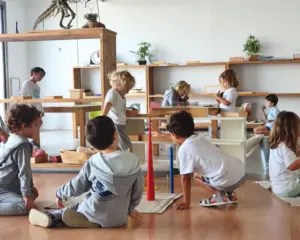
At IMS Sotogrande, every classroom is designed with child-sized furniture: tables, shelves, materials. The learning tower at home applies the same philosophy. If you want to delve deeper into how to adapt your home for your child, the Spanish Montessori Association offers excellent resources for families.
Furthermore, the Association Montessori Internationale (AMI), which accredits us as a center, emphasizes the importance of children participating in practical life from the earliest years. The tower is one of the most accessible tools to achieve this at home.
Where to Place the Learning Tower at Home
The ideal location depends on your family routine, but there are three options that work best:
In the kitchen, next to the countertop, is the most common and useful spot. If your kitchen is small, find a corner where the tower doesn’t obstruct the walkway but allows the child to be near the water and stove (with supervision, of course).
In the bathroom, next to the sink, it allows the child to wash their hands and teeth alone. It’s especially useful when they start potty training, because they can pull down their pants and sit without help.
In the hallway or entryway, if your child is old enough to dress themselves, the tower gives them access to the coat hook and mirror. It’s a detail that makes a difference in the morning routine.
Learning Tower: Frequently Asked Questions
Is the learning tower safe for an 18-month-old?
Yes, as long as it has safety rails on all four sides or at least on three, including the front. At 18 months, balance is fragile, so the tower must be stable and wide. If the child shows fear or can’t hold on well, wait a few more weeks.
Can I make a homemade learning tower?
You can, but with great caution. A poorly built tower or one without proper rails is a real fall risk. If you decide to build it, use sturdy wood, secure all joints, and add front rails. Generally, a commercial tower with safety certification is the most reliable option.
Until what age is a learning tower used?
Most children stop needing it between 5 and 6 years old, when they reach enough height to work at the countertop without help. However, some older children still use it because they find it comfortable. There’s no expiration date: when the child no longer needs it, they simply stop climbing up.
What’s the difference between a learning tower and a stool?
A stool has no safety rails, and the child can fall forward or to the sides. The learning tower is specifically designed so the child is protected while working at height. It’s a matter of safety, not comfort.
Key Takeaways
The learning tower is a simple but powerful tool for fostering autonomy, coordination, and family bond from the earliest years. Its real and supervised use, not as a toy or a throne, makes the difference in a child’s development.
If you’d like to see up close how we apply these principles in the IMS Sotogrande classrooms, book a personalized visit and discover a real Montessori environment for your child.