
Kids Yoga Montessori: Benefits & How to Practice at Home - Parent Guide (Sotogrande)
In short
Every morning in our Casa de Niños classrooms at IMS Sotogrande, it’s common to see children aged 3 to 6 practicing yoga for kids. It’s not a structured class, but a natural moment of mindful movement that arises during the day.

Every morning in our Casa de Niños classrooms at IMS Sotogrande, it’s common to see children aged 3 to 6 practicing yoga for kids. It’s not a structured class, but a natural moment of mindful movement that arises during the day. The benefits of children’s yoga go far beyond flexibility: they touch concentration, self-control, and mind-body connection, pillars that fit perfectly with the Montessori philosophy. In this article we explore Montessori yoga for kids in depth with practical examples.
Benefits of Yoga for Children in Early Childhood
Regular practice of yoga for kids has a direct impact on their physical, emotional, and cognitive development. In the early stages, from 0 to 6 years, the body is still forming. Simple postures adapted to their size and ability strengthen muscles, improve balance, and promote more conscious breathing. For example, poses like downward dog or tree not only entertain but also work on proprioception and coordination. When it comes to Montessori yoga for kids, it pays to listen to what families and lead guides actually report.
Emotionally, children’s yoga helps kids manage daily frustrations. In a world that often demands stillness and silence, yoga gives them a safe space to move and express themselves. I’ve seen children who arrive agitated at the morning gathering regain calm after a few minutes of guided stretching and are ready to choose their first material. It’s not magic, it’s applied neuroscience (a 2012 study in the Journal of Developmental & Behavioral Pediatrics already pointed to improvements in attention and childhood anxiety with yoga programs). According to the American Academy of Pediatrics, yoga helps children manage stress and improves sleep quality (see this guide). Daily practice with Montessori yoga for kids reveals nuances no handbook fully captures.
Yoga for Kids: Physical Development and Coordination
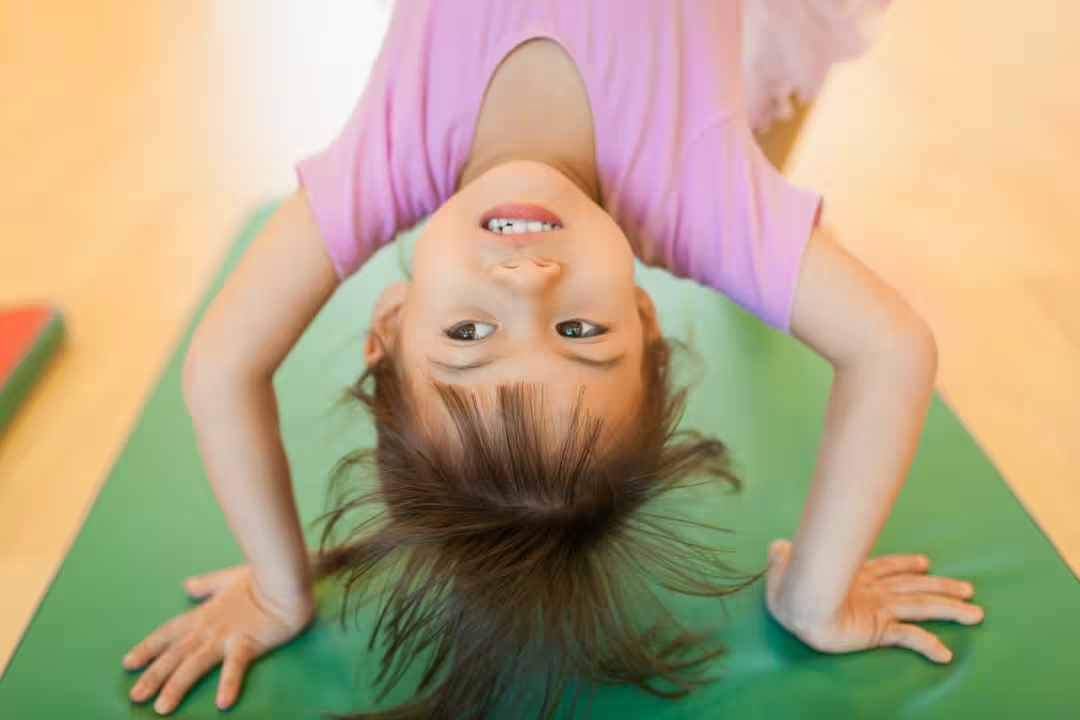
From a motor perspective, yoga for kids is gold. Many children aged 3 to 6 are still fine-tuning their gross motor skills. By imitating animals or nature elements, they practice movement patterns that strengthen arms, legs, and trunk. Body control is a key area of the Montessori curriculum (remember “grace and courtesy lessons” or line exercises). At IMS Sotogrande, we don’t separate yoga from practical life. It’s an extension. Sometimes after a yoga session, children show greater precision when pouring water or carrying a tray. The connection is evident.
Yoga for Kids and the Montessori Method: A Natural Alliance
Montessori and yoga share a holistic view of the child. Maria Montessori spoke of the “absorbent mind” and the importance of movement for learning. Yoga, with its gentle sequences and focus on breath, fits seamlessly into this philosophy. It’s not about children memorizing Sanskrit poses, but about them experimenting with their bodies, discovering their limits, and learning self-regulation.
In our school, yoga for kids is part of the routine, but never mandatory. If a child doesn’t want to participate, they can observe or engage in another activity. Respect for individual pace is sacred. One Tuesday, in the 3-6 classroom, three children decided to do butterfly pose while a classmate sang to them. The guide just observed. That’s the spirit: the child leads, the adult supports.
Yoga for Kids in the Classroom: How We Integrate It at IMS Sotogrande
Although we don’t have a separate “yoga” class on the schedule, we integrate it transversely. During the morning gathering, we often start with deep breaths or a simplified sun salutation. The guides, trained in Montessori observation, detect when the group needs an active pause and propose a short sequence. Sometimes it’s just five minutes, other times fifteen. The key is not the duration, but the quality of attention.
Families often ask us, “But will my child learn yoga like in an extracurricular class?” The answer is that we don’t aim for technical learning, but for a life tool. And the results show. Parents from La Línea, Algeciras, or Estepona who drive a few minutes to Sotogrande tell us that their children reproduce at home the poses they did at school. If you want to see how it works in practice, I invite you to book a personalized school visit and see for yourself.
How to Practice Yoga for Kids at Home: Practical Tips
You don’t need to be an instructor or have a spacious room. Just ten minutes a day and a willingness to play. Here are three ideas that work at home:
1. Animal Imitation : turn poses into a game. “Let’s do cobra,” “let’s fly like an eagle.” Kids get hooked immediately.
2. Movement Stories : invent a story while they adopt different poses. For example, a jungle journey where each animal offers a challenge.
3. Object Breathing : place a feather on their palm and ask them to lift it only with the air from their nose. Or place a stuffed toy on their belly and watch it rise and fall.
The important thing is not to force. If one day they don’t want to, that’s fine. Yoga for kids is a path, not an obligation. As in Montessori, we follow the child.
Frequently Asked Questions
At what age can children start yoga?
From age 2, they can imitate basic poses. From age 3, with a little more body awareness, they especially enjoy animal sequences. In our Nido Montessori (0-3), guides introduce stretching exercises within the free movement routine.
Do you need to be flexible to do yoga?
No. Children are naturally flexible, but even those with less elasticity benefit. Yoga for kids doesn’t seek postural perfection, but exploration. What counts is the process, not the outcome.
How is kids’ yoga different from adult yoga?
Children’s yoga is more dynamic, playful, and shorter. While an adult might hold a pose for 30 seconds, a 3-year-old holds it for 5 and then moves on to something else. There are no long meditations. They are replaced by breathing games and guided relaxations like “we are a statue” or “listen to the silence.”
Key Takeaways
Yoga for kids is an accessible and powerful tool. At IMS Sotogrande, we don’t teach it as an extracurricular class. We weave it into everyday classroom life. The benefits are not just physical: they help children know their inner world, calm themselves, and connect with others.
If you’re thinking of trying it at home or want to see how children experience it in a Montessori environment, I encourage you to visit us. Yoga, like education, is a journey. And the first steps can start today, in your living room, with a simple butterfly pose and a big smile.









