
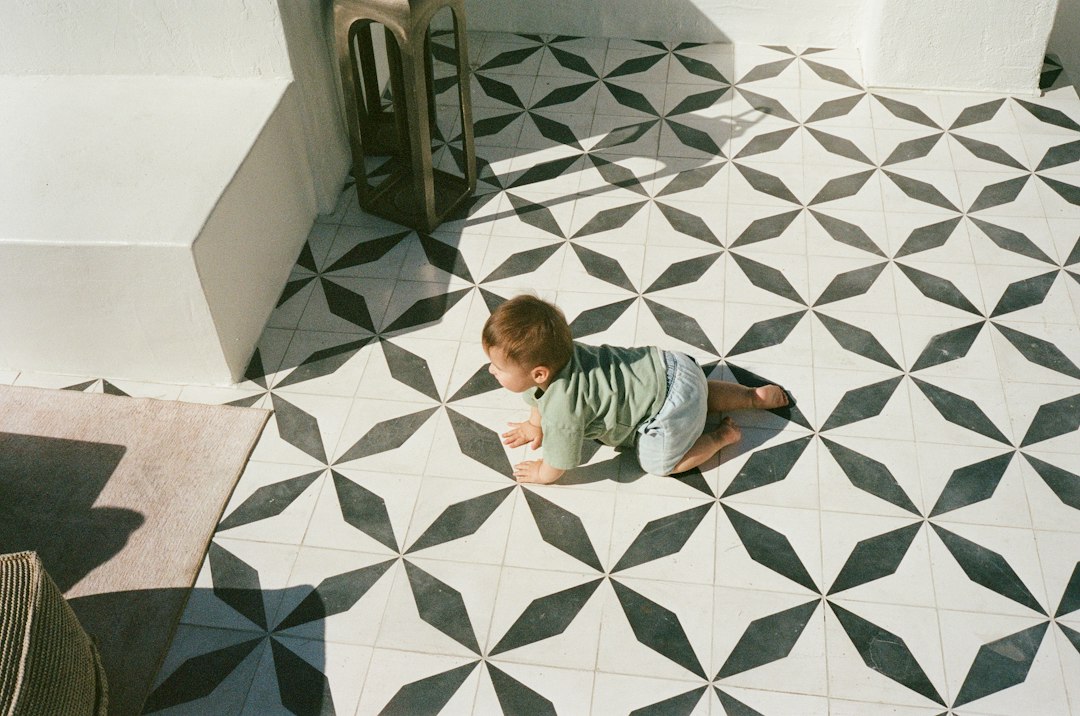
How to Encourage Baby to Crawl: Age-by-Age Tips & Common Questions

Encouraging your baby to crawl is about facilitating movement, not racing a calendar: you set up a safe space, invite them with an object, and let coordination build itself. Crawling emerges very differently from baby to baby, on average anywhere between six and ten months. The Spanish Association of Pediatrics stresses that every child follows their own pace, and that’s exactly how we work in our Montessori Nido (0-3 years), accompanying without comparing.
In summary
- Crawling appears on a very wide timeline, usually between 6 and 10 months, and some babies never crawl in the classic way.
- What really helps: daily tummy time from the first weeks, clear floors and open spaces.
- A 7-month-old reaching for a cloth 20 centimetres away, by rolling or shifting, is already training the coordination they’ll use when they crawl.
- Check with your paediatrician if there’s no voluntary movement by 12 months, if your baby only uses one side of the body, or if they lose skills they once had.

What if my baby isn’t crawling at 6 months?
Six months is nothing to worry about: most babies still aren’t crawling then. Crawling usually appears between 6 and 10 months, though the normal range is very wide and some babies get around in other ways.
At six months, it’s typical for your baby to roll over, sit with support, and explore whatever’s within reach. Lying on their tummy with a eye-catching object about 20 centimetres away, there’s already something valuable happening: the desire to get there. That intention prepares the muscles, balance and coordination that later support crawling. Ask your paediatrician any questions about your baby’s developmental milestones.
According to the developmental surveillance guidelines of the American Academy of Pediatrics, paediatricians look at the whole trajectory, not one exact month.

Practical ways to support movement at home
Encouraging your baby to crawl at home takes few resources and a lot of consistency. Here are the decisions that make the biggest difference, ordered by impact.
Ground rules: fewer walkers, more open floor
Babies learn to move by moving, by trying and failing. Walkers and seats that hold them upright without support cut down on practice opportunities. A blanket on the floor, with nothing in the way, is the best gym in the world. Tummy time from the first weeks strengthens neck, back and arms, just as the American Academy of Pediatrics recommends.
Ways to invite movement that actually work
The goal isn’t to train, it’s to spark the urge to get there. These ideas suit a baby between 6 and 9 months:
- If your baby is 7 months and sits with support, place a colourful cloth about 30 centimetres away, in front and slightly to one side. Watch whether they lean, reach an arm out, or twist their trunk to get it.
- Say your 8-month-old usually rolls in one direction. Put the object on the opposite side of their body, at the usual distance. This widens their repertoire without frustration.
- At 9 months, try placing two objects at different distances, one close, one far, so they choose which to go for first. That choice is already an exercise in motor planning.
A common mistake and how to fix it
Mistake: sitting your baby in the middle of an empty room with every toy out of reach, waiting for them to launch into crawling. Fix: shrink the distance and raise the interest. A real, everyday object (a wooden spoon, a handkerchief) at 20-30 centimetres, swapped every two or three days, moves them more than a pile of distant toys. And if your baby cries or gets frustrated, remove the invitation, this is about accompanying, not pressuring.

What if my baby skips crawling?
If your baby skips crawling and goes straight to pulling up or scooting, it’s usually a normal developmental variant. Many children develop their own system of movement without ever crawling in the classic way.
Some babies move from the floor to standing by pulling on furniture and cruise sideways (what’s called “cruising” in English). Others scoot sitting up or on one hip. What paediatricians evaluate isn’t the look of the pattern but the quality of the movement: that both sides of the body are used, that the environment is explored, that independence grows. When you notice these movements, the team at the Spanish Association of Pediatrics reminds us that what matters is the whole set of skills, not one milestone in isolation.
Still, classic crawling has real value: it crosses the body’s midline, integrates both hemispheres, and strengthens hand-eye coordination. So it’s worth keeping offering chances to crawl even once your baby is pulling to stand. In our Nido we set up clear floors and low bars so that vertical movement, too, is born from the child.
What comes first: sitting up or crawling?
Usually sitting up comes first. Most babies sit unsupported between 6 and 8 months, and crawling follows, around 7 to 10 months. Even so, the sequence isn’t rigid: some babies crawl before they can sit alone, and others sit up and take months to start moving.
Thinking about “what comes first” helps less than observing how the pieces fit together. A baby who sits alone has already gained trunk balance. From that base, they reach an arm out and lose stability, that game of losing and regaining balance is the engine of crawling. So when your baby can sit, invite them to reach for something placed just slightly off-centre, so they can practise that adjustment. Maria Montessori described movement as a route to building intelligence, and the Association Montessori Internationale carries that idea into its 0-3 guide training.
What is the crawling stage in baby development?
The crawling stage is the phase in which your baby coordinates arms and legs to move voluntarily. It normally appears between 6 and 10 months and connects the world of lying down with the world of standing up.
While crawling, your baby solves problems in real time: gauging an object’s distance, deciding which arm to move first, adjusting speed to avoid falling. It’s full cognitive work, not just muscular. What’s more, crawling lets your baby choose their own path, which supports autonomy and concentration. If you’d like to see how this process is supported in a prepared environment, we show you what a day looks like in the Nido and Infant Community at IMS.
Quick checklist for the week ahead
If you want to take action right away, print or copy this list and tick it off over seven days. It’s the condensed version of everything above:
- 15 minutes of tummy time daily, spread across two or three short sessions.
- A blanket on the floor, with no cushions or toys in between.
- An enticing object at 20-30 centimetres, refreshed every two or three days.
- Zero minutes in a baby walker or a rigid seat.
- One moment of observation: note what your baby did today that they couldn’t do yesterday.
Frequently asked questions
What if my baby isn’t crawling at 6 months?
At six months it’s normal for your baby not to be crawling yet: most crawl between 6 and 10 months, and the normal range is wide. What matters is interest in movement, reaching an arm toward an object, twisting their trunk, or rolling over. Keep offering tummy time every day, and check with your paediatrician if your baby only uses one side of the body.
What if my baby skips crawling?
If your baby skips crawling and goes straight to standing up or scooting, it’s usually a normal developmental variant, not a problem. Many children develop their own movement pattern without classic crawling. Even so, it’s worth keeping offering chances to crawl on the floor, because the cross-body coordination built through crawling will be useful later on.
What comes first: sitting up or crawling?
Sitting up usually comes first, between 6 and 8 months, and crawling follows, around 7 to 10 months. The sequence isn’t fixed: some babies crawl before sitting alone, others sit up and take months to start moving. What paediatricians look at is the whole set of skills, not the exact order of milestones.
What is the crawling stage in baby development?
The crawling stage is the phase in which your baby coordinates arms and legs to move voluntarily, normally between 6 and 10 months. During this phase your baby solves motor and cognitive problems at the same time: gauging distances, deciding what to move first, and adjusting balance. It’s one of the richest stages of the first year.
How long should I keep encouraging crawling if my baby isn’t doing it?
It’s worth calmly offering opportunities to crawl up to 12 months, without forcing it or comparing with other babies. If there’s still no voluntary movement after the first birthday, if your baby only uses one side of the body, or if skills they once had are lost, ask your paediatrician for an assessment. He or she knows your child’s full trajectory and will guide you.
Keep offering, keep the floor open, and let the timeline do its work. Crawling appears when your baby’s body and brain are ready, not when the calendar says so.