Fine Motor Skills: Toys and Games by Age (0 to 6 Years)

Choosing the right fine motor skills toys that accompany your child changes the way their hand learns completely. Fine motor skills are the ability to control the fingers, wrist and hand with precision to make small, adjusted movements. Drawing, writing, dressing themselves or opening a zipper are all built on that dexterity later on. Here is a selection by age, games for fine motor skills without spending money, and the mistake that is repeated most often in homes.
In summary
- The best fine motor skills toy is one that requires adjusting, fitting, turning or pouring: pegs, blocks, shape sorters and small objects with supervision.
- Age sets the challenge: at 12 months fitting and inserting, at 3 years fastening and modelling, at 5 years threading and cutting.
- Homemade fine motor skills games (hanging laundry, rolling dough, sorting beans) are just as valuable as a bought toy.
- The most common mistake is setting the challenge too high: if the hand cannot manage it yet, the child gives up. Increase the difficulty gradually.

What toys develop fine motor skills?
A simple criterion for choosing in the shop
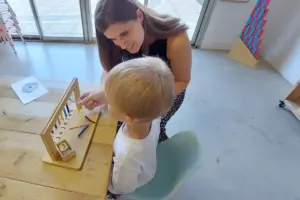
Before buying, ask yourself one question: what hand movement does this toy require? If the answer is “just pressing a button”, skip it. The best fine motor skills toys ask the child to grip precisely, vary the pressure of the fingers or coordinate both hands. That is the real work of the hand. The Association Montessori Internationale insists on real, hands-on materials, because manual learning is built through touch.

What are 5 games to improve fine motor skills?
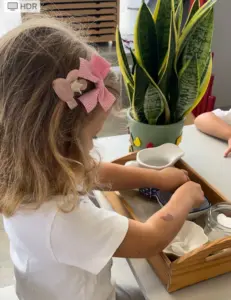
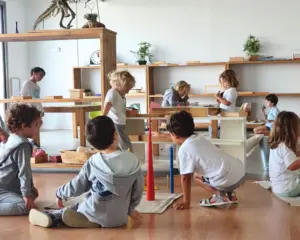
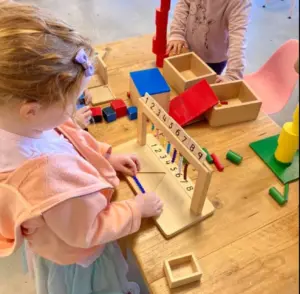
These five games improve fine motor skills using materials you already have at home and work from age 3 to 6. First, transferring beans from one bowl to another with a spoon. Second, rolling and cutting playdough with a rolling pin. Third, hanging laundry with pegs on a line. Fourth, threading large beads onto a string. Fifth, tearing and sticking pieces of paper onto card. In the Children’s House (3-6) classroom this kind of task is part of the daily work with Montessori materials, because repetition is what consolidates the movement.

What games can I play to work on fine motor skills?
The fine motor skills games children enjoy most are the ones with a visible finish: completing a necklace, filling a jar, unfastening a jacket and hanging it up. Working on fine motor skills does not require specialist educational material. Modelling with homemade dough, memory games with small cards, stacking bottle caps, jars with screw-top lids and tearing-and-sticking activities all work too.
Example: how to set it up without turning it into a chore
Imagine your child is 4 years old and on a Tuesday afternoon you do not know what to do. Take out a container of beans, two bowls and a clothes peg, and propose just this: “shall we move all the beans from here to there?” Ten minutes of concentration, no screen and no reward. At age 5, add a second peg in a different colour and ask them to sort at the same time. If your 2-year-old gets frustrated with the peg, let them use their hand: the challenge has to sit just above what they can already do, not far above it.
What ideas are there for working on fine motor skills?
The best ideas for working on fine motor skills are part of the daily routine. Let your child open their backpack, fasten the buttons on their t-shirt, brush their hair or help set the table with cutlery. The richest activity is not a course, it is taking part in everyday life with their hands. The Asociación Española de Pediatría points out that independence in these tasks also strengthens a child’s self-esteem.
A common mistake and how to fix it
The mistake is buying toys that are too advanced: we give a 2-year-old a game with tiny pieces and end up doing it ourselves, or worse, putting it away. The solution is to reverse the order: start with large pieces and real objects (spoons, jars, clothes pegs), and increase the difficulty when you see your child complete the task unaided three or four times. That way the child keeps their interest and the hand progresses without frustration.
Fine motor skills games
This table brings together 20 fine motor skills games ordered by age, with the materials you need. Use it as a menu: pick one or two each week and repeat them until your child has mastered them. Check it whenever you are unsure whether a toy fits your child’s current stage of development.
- 12-18 months: putting objects into a jar, stacking two or three blocks, taking lids on and off, peeling off sticky tape, fitting simple shapes.
- 18-24 months: sliding tokens through a slot, fastening Velcro, dropping coins into a tin, kneading dough, putting clothes pegs on and taking them off.
- 3 years: transferring with a spoon, cutting dough with a rolling pin, stacking bottle caps, hanging laundry, threading large beads, tearing paper.
- 4 years: fastening buttons, modelling balls and sausages, cutting with safety scissors, sorting beans by colour, using a clothes peg with precision.
- 5 years: threading plastic needles, writing their name with a crayon, filling in a board game sheet, unzipping zippers, poking dough with all five fingers.
Fine motor skills games
When to seek advice
If at age 3 your child cannot slot a token into a gap, avoids any game that uses their hands, or clumsiness stops them eating or dressing, mention it with the paediatrician or the educational team. It is not about alarm, it is about ruling out whether extra support is needed. Early detection works.
Frequently asked questions
What toys develop fine motor skills?
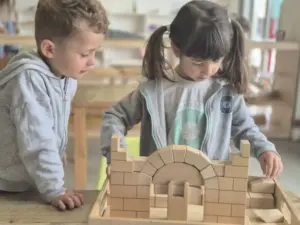
Toys that develop fine motor skills are the ones that demand precise hand adjustments: building blocks, shape sorters, screw games, pegs with large beads, playdough, puzzles with thick pieces and button boards. The important thing is that the toy makes the child grip, turn, squeeze or pour, rather than simply press a button.
What are 5 games to improve fine motor skills?
These five games work from age 3 with household materials: transferring beans with a spoon, modelling and cutting playdough, hanging laundry with pegs, threading large beads and tearing or sticking pieces of paper. All of them require coordination of the fingers and both hands, and can be repeated as many times as needed.
What games can I play to work on fine motor skills?
You can play fine motor skills games such as modelling with dough, memory games with small cards, stacking bottle caps, jars with screw-top lids, tearing-and-sticking activities or fastening and unfastening clothes. All of them work as long as the child repeats the gesture and has a visible finish that motivates them.
What ideas are there for working on fine motor skills?
The best ideas for working on fine motor skills are part of the daily routine: opening the backpack, fastening buttons, setting the table, brushing hair or helping to hang up the laundry. Add simple games such as transferring objects, threading beads or modelling dough, and raise the difficulty little by little according to your child’s age and pace.