Children’s swimming classes in Fuengirola: Montessori guide for aquatic development
In short
If you've typed "children's swimming classes in Fuengirola," it's because you sense that water is much more than a splash. In early childhood, moving freely in the aquatic environment sharpens coordination, confidence, and autonomy. But what if that experience was grounded in an environment that respects the child's natural rhythm, like Montessori?
If you’ve typed “children’s swimming classes in Fuengirola,” it’s because you sense that water is much more than a splash. In early childhood, moving freely in the aquatic environment sharpens coordination, confidence, and autonomy. But what if that experience was grounded in an environment that respects the child’s natural rhythm, like Montessori? For over ten years accompanying families in Campo de Gibraltar, we have seen how the combination of aquatic activity and Montessori pedagogy fosters unhurried development with solid foundations.
- Children's swimming classes in Fuengirola: what to look for
- How to choose the best children's swimming classes in Fuengirola with a Montessori perspective
- Why water is an ally of child development from 0 to 6 years
- The role of the adult: accompany, not train
- How to integrate swimming into the family routine with a Montessori spirit
- Frequently asked questions
- Key conclusions
Children’s swimming classes in Fuengirola: what to look for
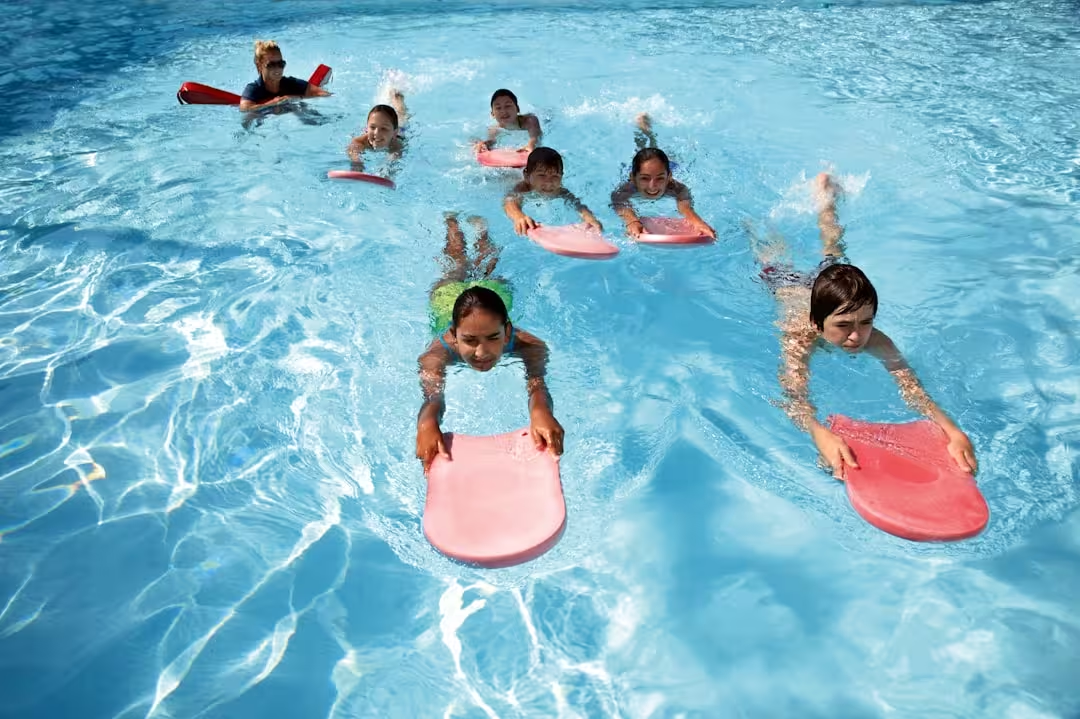
When you browse the options for children’s swimming classes in Fuengirola, it’s easy to focus only on the water temperature or the color of the foam noodles. However, what makes the difference is the adult’s perspective: does it respect the child’s pace or try to accelerate motor achievements? A worthwhile program lets the little one enter the water when ready, without forcing immersions. It encourages sensory exploration with objects that float, splash, and sink, just like in a prepared Montessori environment. It avoids overcrowded classes where the child is a number and prioritizes small groups with an educator who observes more than directs. At IMS Sotogrande we do not offer swimming classes, but we do advise families who want to complement our program with aquatic activities that truly add value.
For a family looking for children’s swimming classes in Fuengirola, the drive from Sotogrande is only 30 minutes. Many parents tell us that they choose the Costa del Sol precisely for the possibility of combining sea and mountains with a school like ours, where their children spend mornings in a trilingual environment and then enjoy the water in the afternoon. That balance between concentration and movement is pure neural development.
How to choose the best children’s swimming classes in Fuengirola with a Montessori perspective
A foolproof clue: if the instructor repeats “Very good!” every time the child puts his face in while holding him like a package, run away. Empty praise interrupts concentration. Instead, look for an adult who describes what they see: “You put your head in and then looked at mom.” That objective narrative builds self-esteem from within. Montessori pedagogy taught us that children don’t need judges, they need witnesses. The same applies in the pool. A good program for children’s swimming classes in Fuengirola will let the child set the pace, offer varied materials (not just boards, but foam bars of different densities, large rings, fabric scarves) and respect observation periods. If the little one stands still watching the water reflection for five minutes, he’s not wasting time: he’s absorbing the world.
Families often ask us if they can apply swimming routines at home. Of course. The bathtub is the first aquatic laboratory. A ladle, a strainer, and a cork boat are enough for an 18-month-old to spend 20 minutes absorbed. That power of concentration that you later see in the Pink Tower of the Children’s House is born from free play with water. If you then take him to children’s swimming classes in Fuengirola, you will have created a common thread between home, school, and pool. That continuity is gold for the developing brain.
Book a personalized visit to the school and discover how IMS Sotogrande integrates movement, autonomy, and bilingualism every day: Book a personalized visit to the school.
Why water is an ally of child development from 0 to 6 years
Neuroscience confirms it: water offers gentle resistance that stimulates proprioception without punishing joints. In the first three years, the brain builds gross and fine motor pathways precisely through free movement. A baby crawling through a warm water puddle is activating connections that will later allow him to hold a pencil or pedal. It is no coincidence that Maria Montessori insisted on movement as the basis of thought. Her book “The Absorbent Mind” dedicates entire chapters to how the hand and body build intelligence. Today we know that the vestibular system, which is refined when the child floats, spins, or submerges (always respecting his signals), is key for reading and attention. So when you enroll your child in children’s swimming classes in Fuengirola, you are not signing him up for mere entertainment: you are giving him a more robust brain architecture.
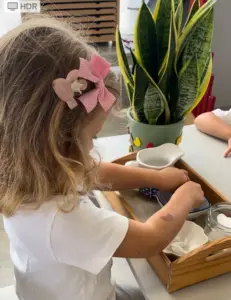
At IMS Sotogrande, we take advantage of that connection. Our prepared environments for Nest (0-3) and Children’s House (3-6) include sensory trays with water, pouring activities, and sponges. Children arrive in the morning and find a space that already speaks to them: “Here you can touch, explore, repeat.” We seek the same philosophy outside school. That’s why we recommend families complement the school day with activities that follow that thread, such as well-conducted children’s swimming classes in Fuengirola.
The role of the adult: accompany, not train
I’ve seen a mother on the beach push her two-year-old daughter’s head underwater while the girl cried. It chilled my blood. That is not swimming. That is ignoring the non-verbal language of a child telling you “not today.” In the Montessori method, the adult is a guide, not a trainer. He observes, waits, connects. If the little one clings to your neck, you hold him and sing to him. The next day he might let go for three seconds. Water confidence is built like classroom confidence: without haste, with presence, and without judgment. Finding children’s swimming classes in Fuengirola that respect this principle is not easy because most sports programs prioritize technical progression. But there are instructors trained in child development who understand that a child floating on his back looking at his father is learning more than one who repeats the breaststroke kick 20 times.
At IMS we work on that same confidence every day. When a child from Workshop 1 (6-9) chooses his project and makes a mistake, we don’t correct immediately. We wait. Most times, he finds the error himself and tries again. That resilience transfers to the water. A child who has internalized that making mistakes is not failure but investigation, enters the pool with curiosity instead of fear of ridicule. It’s one of the reasons so many families living between Fuengirola and Gibraltar choose IMS: they seek an education that prepares for life, not just for the exam.
How to integrate swimming into the family routine with a Montessori spirit
You don’t need to live five minutes from the beach. With a bucket, a jug, and a funnel, you can set up a water station on the terrace. Children from 1 to 3 years spend long hours pouring, filling, emptying. That seemingly simple activity trains fine motor skills, concentration, and the notion of volume (implicit math). Later, when you go to children’s swimming classes in Fuengirola, you’ll see how your child connects those movements: the same gesture of pouring water from one bowl to another he repeats in the pool with a cup. Meaningful learning always transfers.
Another practical tip: choose swimsuits that the child can put on and take off by himself. Autonomy starts long before the pool. If at three years old he already undresses and dresses for water, he is gaining independence that he will later apply to putting on shoes or packing his backpack. In our Children’s House classrooms, the little ones change themselves after recess and put their clothes in their drawer. It’s not a minor detail: it’s a pillar of self-esteem. The same philosophy applies when leaving the pool: towel within reach, easy footwear, no rushing. The moment after swimming is as important as the splash. If the child is hungry or sleepy, attend to him before getting in the car. A post-pool tantrum is often disguised hunger or overstimulation.
Frequently asked questions
At what age can a baby start children’s swimming classes?
The Spanish Association of Pediatrics suggests waiting until four months, when the immune system is more mature. More relevant than age is the baby’s maturity: does he hold his head up? Does he enjoy bath time at home? If the answer is yes, it may be a good time. Look for children’s swimming classes in Fuengirola with small groups and water at 32-34°C. And remember: the goal is not that he “learns to swim,” but that he associates water with safety and pleasure.
Why is swimming important in the 0-3 stage?
Between 0 and 3 years, the brain doubles in size. Free movement in water simultaneously stimulates the vestibular system, proprioception, and bilateral coordination. Additionally, it strengthens the attachment bond with the adult holding him. It’s no coincidence that many pediatricians recommend swimming for babies with colic: the warmth of water and skin-to-skin contact calm the nervous system. At IMS Sotogrande we see how children who have had positive aquatic experiences arrive at Nest more confident and autonomous.
How to choose the best children’s swimming classes in Fuengirola?
Observe three indicators: the ratio (maximum 5-6 children per adult), the instructor’s training (developmental pedagogy, not just water rescue) and the team’s attitude. Do they greet you with a smile or in a hurry? Do they explain how to accompany your child in the water? If the center asks you to stay outside while the instructor does the class, consider other options. The presence of the primary caregiver is key until age 3. When choosing children’s swimming classes in Fuengirola, visit the space beforehand, smell the environment (excessive chlorine reveals poor maintenance) and look at the faces of the children leaving: they will tell you more than any brochure.
Key conclusions
Water is a silent teacher. It offers resistance without judgment, warmth without demands, and a sensory canvas where each child paints their own development. Choosing good children’s swimming classes in Fuengirola is not a luxury, it’s an investment in autonomy, coordination, and confidence. And if that activity is woven with the Montessori pedagogy we practice at IMS Sotogrande, the multiplier effect is guaranteed: an environment that respects the child inside and outside the pool builds resilient and curious adults.
If you live on the Costa del Sol, from Fuengirola to Gibraltar, and are looking for a school where your child is seen as a whole person, not a file, we invite you to get to know us. Our doors are open for you to breathe the Montessori environment and feel if it resonates with your family. Contact Tamara Muñoz at +34 653 04 17 39 or write to [email protected]. And if you want to continue researching first, stop by our blog where we break down every aspect of development with the same honesty with which we accompany our little ones.