
Building Confidence in Children: 7 Signs & What to Do at Every Stage
In short
When your 4-year-old crumples up their drawing because it's 'not good enough' or your 8-year-old refuses to try a new problem, something stirs inside you. Building confidence in children isn't an abstract concept. It's visible in small daily gestures that, when understood, give you real tools to support them.
When your 4-year-old crumples up their drawing because it’s ‘not good enough’ or your 8-year-old refuses to try a new problem, something stirs inside you. Building confidence in children isn’t an abstract concept. It’s visible in small daily gestures that, when understood, give you real tools to support them.
Key Takeaways When it comes to building confidence in children, it pays to listen to what families and lead guides actually report.
- Healthy self-esteem isn’t about feeling ‘the best,’ but knowing your worth even when you make mistakes.
- Each Montessori plane of development (0-6 and 6-12) has distinct signs and needs.
- Real autonomy, not empty praise, builds lasting self-confidence.
- At IMS, we nurture a positive self-image from Nido through Taller using Montessori materials and language.
- What is healthy self-esteem in children, and why isn't it the same as ego?
- 7 Signs of Healthy Self-Esteem in Children (By Age)
- How to Build Self-Esteem in Children Without Empty Praise
- Common Mistakes That Damage Self-Esteem (and How to Avoid Them)
- The Role of the Montessori Prepared Environment in Building Confidence
- Frequently Asked Questions
- Key Takeaways
What is healthy self-esteem in children, and why isn’t it the same as ego?
Children’s self-esteem is the assessment a child makes of themselves: what they feel they can do, how they think others see them, and how much they accept themselves as they are. It has nothing to do with feeling superior to others. A child with healthy self-esteem says, ‘I can try’ without needing constant applause. A child with an inflated ego needs to win to feel good and crumbles when they lose. Daily practice with building confidence in children reveals nuances no handbook fully captures.
Neuroscience confirms this: between 0 and 6 years old, the brain is actively forming emotional connections. What a child experiences during these years sets lasting patterns. That’s why, in Montessori pedagogy, we talk about ‘sensitive periods’: windows where certain experiences have a huge impact. Understanding building confidence in children from inside the classroom reshapes everyday decisions.
7 Signs of Healthy Self-Esteem in Children (By Age)
There’s no universal checklist, but these signs frequently appear in children who feel secure. Observe which ones you recognize in your child.
0 to 3 Years (Montessori Nido)
At this stage, self-esteem is built through bonding and safe exploration. Signs it’s developing well:
- They separate from you to explore a room but return when they need comfort.
- They try to eat alone, get dressed, or wash their hands, even if clumsily.
- They express frustration without aggression (crying, pointing, seeking help).
In our IMS Nido, we see daily how 18-month-olds start putting on their shoes by themselves. They don’t do it perfectly, but the simple act of trying is self-confidence in action.
3 to 6 Years (Children’s House)
Here, the child begins to compare themselves to others. Children’s self-esteem is put to the test:
- They choose activities based on their interest, not just to impress the adult.
- They accept a mistake without breaking into tears (or recover quickly).
- They play with other children by negotiating turns, not just imposing their will.
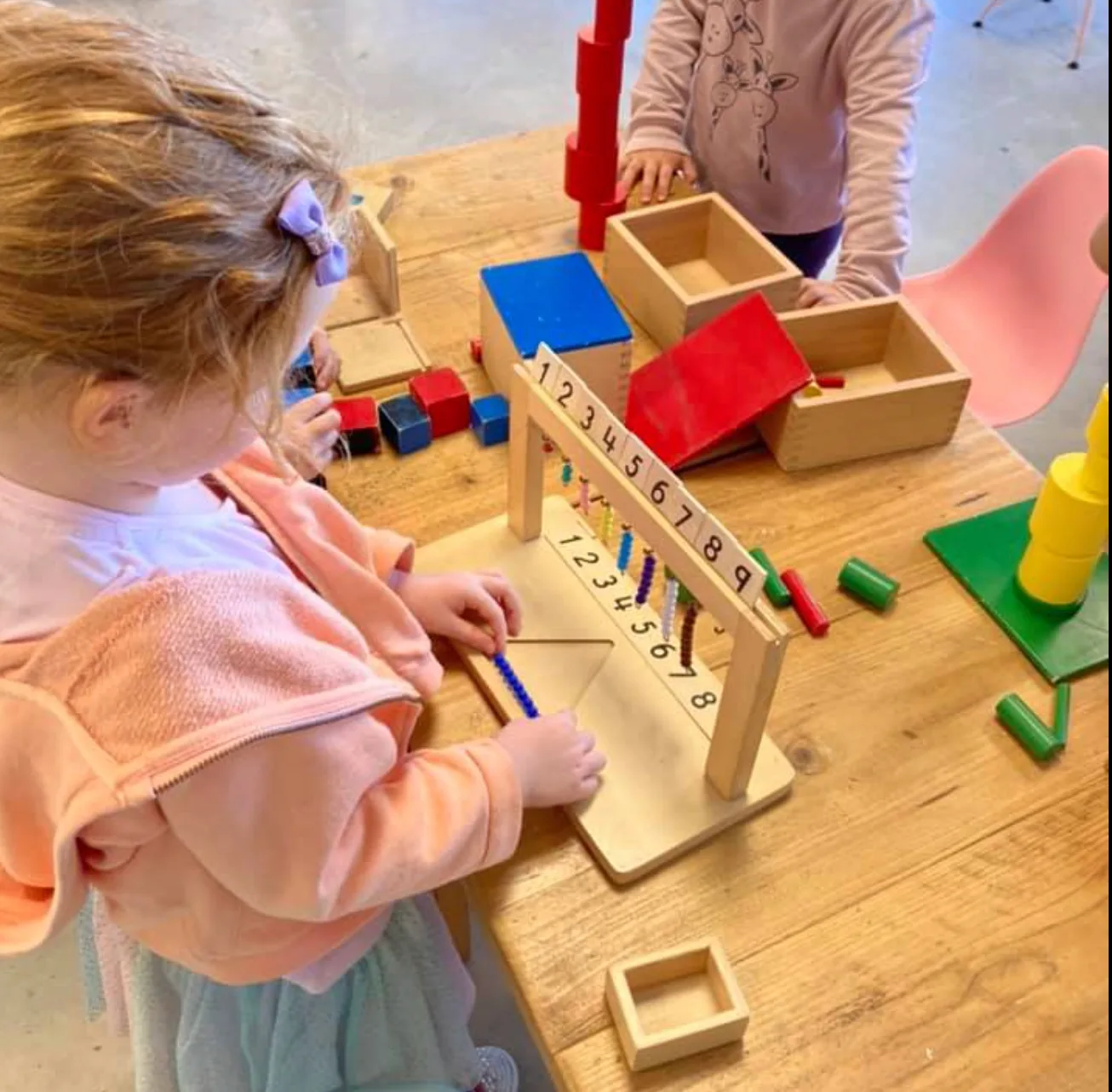
In our Children’s House at IMS, we use Montessori materials because each one has built-in error control. The child discovers for themselves if they did it correctly, without an adult needing to say ‘good job!’ or ‘wrong!’ This protects self-esteem because the judgment doesn’t come from outside.
6 to 12 Years (Taller / Elementary)
In Taller, children’s self-esteem is nourished by abstract thinking and a sense of justice:
- They ask complex questions and aren’t ashamed of not knowing.
- They work on long projects without giving up at the first difficulty.
- They defend their opinion with respect and listen to others.
A 9-year-old in Taller who debates a historical topic and changes their mind because they heard a better argument has solid self-esteem. They don’t need to be right to feel valuable.
How to Build Self-Esteem in Children Without Empty Praise
‘You’re the best!’ or ‘So smart!’ seem positive, but they can do more harm than good. Psychologist Carol Dweck from Stanford demonstrated that praise directed at the person (‘you’re smart’) creates a fear of mistakes, while praise for the process (‘you tried it another way’) builds resilience.
What to do at home:
- Describe, don’t judge. Instead of ‘what a nice drawing,’ say ‘I see you used a lot of blue colors.’ The child feels seen without depending on your approval.
- Give them real responsibilities. Let them set the table, water the plants, or choose which fruit to eat. Montessori autonomy isn’t a slogan. It’s the engine of self-esteem.
- Normalize mistakes. When you make an error, say it aloud: ‘I miscalculated, now I’ll fix it.’ They learn that failing is human.
- Avoid comparisons. ‘Look how your brother does his homework’ destroys in 5 seconds what took you months to build.
At IMS, we accompany every family on this journey. If you’d like to see how we do this in the classroom, book a personalized visit to the school.
Common Mistakes That Damage Self-Esteem (and How to Avoid Them)
No parent wants to undermine their child’s self-confidence, but certain everyday habits do just that without us realizing:
- Overprotecting. ‘Don’t touch that, you’ll get hurt’ repeated a hundred times tells the child they are incapable. Better: ‘Be careful here, how would you do it?’
- Rescuing too quickly. If the child is frustrated with a puzzle and you finish it, they learn they can’t do it alone. Wait, offer a hint, not the solution.
- Using labels. ‘You’re a mess,’ ‘you’re shy,’ ‘you’re the naughty one.’ Labels become self-fulfilling prophecies.
- Ignoring emotions. ‘Don’t cry about that’ tells them what they feel doesn’t matter. Better: ‘I see you’re sad, do you want to tell me what happened?’
The Role of the Montessori Prepared Environment in Building Confidence
In Montessori pedagogy, the environment is the third educator. A space designed for the child’s size, rhythm, and interests allows them to act without asking permission each time. This is freedom within structure, and it’s the foundation of strong self-esteem in children.
At IMS, our classrooms are designed with low shelves, materials within reach, and nooks where each child chooses their work. The guide doesn’t direct from the front: they observe, present the material when the child is ready, and step back. The result: children who know what they want to do, how to do it, and when they need help. This security isn’t given by us. They build it themselves.
If you live in Sotogrande, La Línea, Algeciras, or any town in the Campo de Gibraltar area and are looking for an environment where your child can truly develop self-confidence, we invite you to get to know us. We also welcome families from Estepona, Marbella, and the Costa del Sol who choose IMS for our AMI accreditation and Spanish-English bilingual program.
Frequently Asked Questions
At what age does self-esteem start forming in children?
Self-esteem starts forming from birth, through the bond with primary caregivers. Between 0 and 3 years, the baby builds the foundation of ‘I am loved’ or ‘I am not’ based on how their needs are met. From age 3, when social comparison begins, self-esteem becomes more visible in their behaviors.
Is all praise good for a child’s self-esteem?
Not all praise helps. Generic praise (‘you’re the best,’ ‘so smart’) creates dependence on external approval and fear of failure. Descriptive praise (‘I notice you worked really hard on that puzzle’) reinforces the process and builds real self-confidence. The key is to acknowledge effort, not just the outcome.
What do I do if my child says ‘I can’t’ all the time?
When a child constantly says ‘I can’t,’ they are expressing a fear of failure, not a lack of ability. Don’t correct them with ‘yes you can.’ Instead, break the task into small steps and celebrate each advancement. ‘First, we put this foot here, then the other one.’ Over time, they will see they can, step by step. At IMS, we use Montessori materials because each one allows for this gradual progress without pressure.
Can self-esteem be damaged at school?
Yes, a school environment that punishes mistakes, compares children to each other, or ignores their individual rhythm can erode self-esteem. That’s why at IMS, we train our team in Montessori observation: each child works at their own level, without competitive exams or public comparisons. Children’s self-esteem is protected when the environment respects their uniqueness.
Key Takeaways
Building confidence in children isn’t built with nice phrases, but with real experiences: autonomy, respect for mistakes, and an environment that trusts the child’s capabilities. Each stage has its signs and its tools, from the bonding in Nido to the critical thinking in Taller.
If you’d like to see how this looks in an accredited Montessori classroom, book a visit to IMS Sotogrande. We are located in Sotomarket, just a few minutes from wherever you live in the Campo de Gibraltar or Costa del Sol area.









