
Bilingual Montessori School Near La Línea: Complete Guide for Expat Families | IMS Sotogrande
In short
Searching for a bilingual Montessori school near La Línea? You’re not alone. Many families in the area tell us that after looking, they end up expanding their search to Sotogrande, and for good reason. Just a 20-minute drive separates La Línea from an educational project that transforms how children learn a language.
![Colegios bilingües en La Línea: Guía Montessori para familias [Guía para Familias]](https://ims-sotogrande.com/wp-content/uploads/2026/06/post-365-img-1-1780777239011-13589843.avif)
Searching for a bilingual Montessori school near La Línea? You’re not alone. Many families in the area tell us that after looking, they end up expanding their search to Sotogrande, and for good reason. Just a 20-minute drive separates La Línea from an educational project that transforms how children learn a language. At IMS Montessori Sotogrande, we’ve spent over two decades proving that bilingualism isn’t just another subject: it’s the very air children breathe in the classroom. In this article we explore bilingual school La Línea in depth with practical examples.
In this article, we’ll share why families from La Línea choose a bilingual Montessori school just minutes from home, how we approach language immersion, and what you should consider when making this important decision for your children. When it comes to bilingual school La Línea, it pays to listen to what families and lead guides actually report.
- What Does a Bilingual Montessori School Really Mean?
- Educational Options in La Línea: Why Look Beyond for a Bilingual Montessori School?
- IMS Sotogrande: Real Bilingual Immersion 20 Minutes from La Línea
- How We Work on Language Immersion Day by Day
- Keys to Choosing a Bilingual School: The Montessori Advantage
- Is the Commute from La Línea Worthwhile?
- Frequently Asked Questions
- Key Takeaways
What Does a Bilingual Montessori School Really Mean?
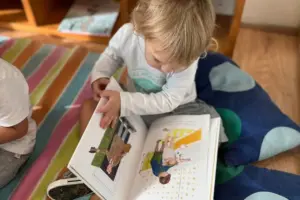
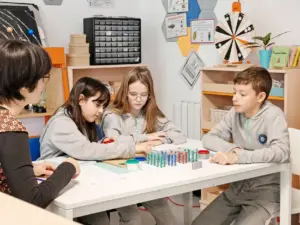
When families search for bilingual schools near La Línea, they often find centers offering just a few hours of English a week. That’s not bilingualism. In Montessori, language isn’t taught, it’s lived. From the moment a child enters the prepared environment, they hear and use Spanish and English naturally, just like at home with their parents. There’s no forced translation or vocabulary lists. The guide speaks in one language, and the child responds and builds their thinking in that language. Daily practice with bilingual school La Línea reveals nuances no handbook fully captures.
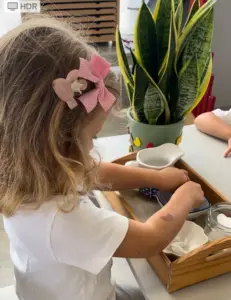
Neuroscience backs this approach. A study by the American Psychological Association (APA, 2011) confirms that bilingual children develop greater cognitive flexibility and better executive control. And in a Montessori environment, where movement and sensory experience drive learning, language sticks more firmly because it’s lived in real context. Preparing a snack in English while counting fruit pieces isn’t a lesson, it’s daily life. Understanding bilingual school La Línea from inside the classroom reshapes everyday decisions.

Educational Options in La Línea: Why Look Beyond for a Bilingual Montessori School?
La Línea de la Concepción has state schools, charter schools, and a few private ones. But if your priority is genuine bilingual immersion, with native guides and a pedagogical approach that respects each child’s pace, the options shrink drastically. Many families tell us during visits: “We want more than English worksheets.” And that “more” exists, but it’s 20 minutes away. Concrete data on bilingual school La Línea is worth reviewing before acting on assumptions.
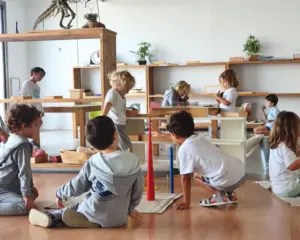
We’re not afraid of the commute. In fact, every morning children from La Línea, Algeciras, Estepona… walk through our doors, and their parents confirm that those minutes in the car are worth it when they see their child happy. The A-7 highway makes the trip fast and safe. And upon arrival, the child finds an oasis: bright classrooms, materials designed by Maria Montessori, and a team of guides who speak either Spanish or English depending on the time of day. That real immersion wasn’t available in La Línea, but it’s just around the corner.

IMS Sotogrande: Real Bilingual Immersion 20 Minutes from La Línea
Our school, International Montessori School Sotogrande, is located in the Sotomarket building, above Mercadona, in San Roque. From La Línea, it’s about 20 minutes on the A-7, depending on traffic. We are the only school in the area accredited by the Association Montessori Internationale (AMI) and by NEASC, ensuring we meet international educational quality standards. Additionally, we are authorized by the Junta de Andalucía as an early childhood and primary education center.
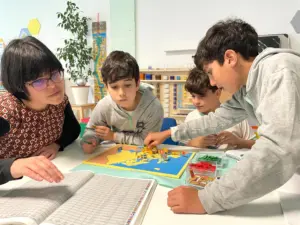
If you’d like to see it for yourself, book a personalized school visit. We’ll welcome you with no obligation, and you can observe how a 4-year-old pours water in English or how a group of 7-year-olds discusses a science project in both languages.
Our bilingual program starts in the Nido (0-3 years), where guides speak English for most of the day, and continues in Casa de Niños (3-6 years) with the introduction of French as a third language. As a result, a child who finishes primary school at IMS leaves with functional proficiency in Spanish and English, plus a solid foundation in French. It’s not magic, it’s daily consistency and a team trained in immersion bilingualism.

How We Work on Language Immersion Day by Day
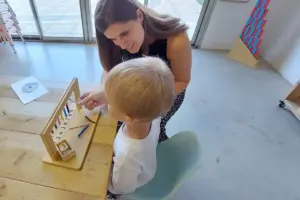
Forget the one-hour English class. In our environment, each guide communicates exclusively in one language. The English guide never speaks Spanish in the classroom, and vice versa. The child associates each language with a person and context, just as they would with an English-speaking parent and a Spanish-speaking parent. It’s not forced, it flows.
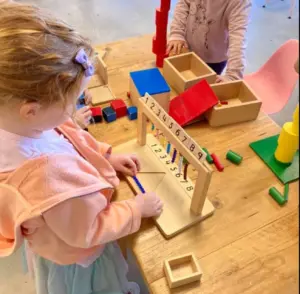
Moreover, Montessori materials are designed to build language from concrete experiences. In the language area, the child traces sandpaper letters while pronouncing the sound, first in their mother tongue and then in the second language. This multisensory anchoring accelerates acquisition without stress. And because the child chooses their activity, they are never forced into decontextualized tasks.
A real example: this week in the Taller (6-9 years), a group researched ecosystems. The guide suggested they create a mural with labels in both languages. They decided on their own which part each would explain in English or Spanish. There was no test, but everyone learned technical vocabulary. That’s active bilingual learning.
Keys to Choosing a Bilingual School: The Montessori Advantage
If you’re evaluating bilingual schools near La Línea or the surrounding area, here are three points that often go unnoticed but make a big difference:
- Bilingual credentials of the team. It’s not enough for the school to say it’s bilingual. Ask if the guides have language proficiency certification and, most importantly, if there are native speakers in the classroom. At IMS, the English team consists of native guides or those with accredited C2 level.
- Actual exposure hours. A school offering 5 hours of English per week is not bilingual. Look for at least 50% of the day in the second language. In our case, daily exposure exceeds 60% in English throughout all preschool and primary stages.
- Connection between language and real life. Language must serve a purpose: preparing a dish, resolving a conflict, researching a topic. In a Montessori classroom, language is integrated into practical life and intellectual work, not isolated in a textbook.
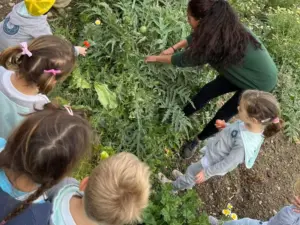
The Association Montessori Internationale (AMI) supports this vision: children learn best when language has a purpose and is connected to their interests. That’s why, instead of memorizing grammar rules, our students write real letters to their families or create field guides after a nature outing.
Is the Commute from La Línea Worthwhile?
Many parents ask us if the 20-minute drive each morning is worth it. And we understand the doubt, daily life is already a race against the clock. But families who have made the leap tell us the commute becomes a ritual. In the car, children have breakfast, listen to music, or talk with their parents. And upon arriving in Sotogrande, the change of environment prepares them for an intense day of learning. Plus, IMS’s flexible hours help: we offer Breakfast Club from 8:00 am and pickup until 5:00 pm, allowing families to adapt logistics to work schedules.
A father from La Línea told us that after a year, his 5-year-old daughter was correcting his English pronunciation. “That confirmed that the trip was worth every minute,” he said. Bilingualism isn’t improvised, it’s built day by day, and a Montessori environment accelerates the process because it respects each child’s natural rhythm.
If logistics concern you, we invite you to try it one morning. Leave La Línea at 8:30 am, arrive at 8:50 am, and see your child happily enter school. Many parents organize carpools with other families from the area, reducing the effort and strengthening the community.
Frequently Asked Questions
What’s the difference between a bilingual school and one with an intensive English program?
A bilingual school teaches at least 50% of the curriculum in the second language naturally, with guides who master the language. An intensive program usually adds extra hours of English, but the rest of the subjects are taught in Spanish. In a true bilingual school, the child does not study English, they learn in English.
What’s the best age to start at a bilingual Montessori school?
The earlier, the better. The first years of life are a window of opportunity for language acquisition. At IMS, we offer bilingual immersion from the Nido (0-3 years). However, children who join later also achieve a high level because the Montessori method respects their pace and uses multisensory materials that facilitate learning.
How will my child adapt to bilingualism if we only speak Spanish at home?
Don’t worry. Children have amazing plasticity. At first, it’s normal for them to go through a “silent period” where they listen and process. Then they start to utter words and phrases. The important thing is that you maintain your mother tongue at home and trust the process. At school, the prepared environment and individualized support do the rest.
Key Takeaways
Choosing a school is one of the most important decisions you will make. If you value an education that respects your child, prepares them for a global world with real English proficiency, and is internationally accredited, we encourage you to consider what IMS Montessori Sotogrande offers, just 20 minutes from La Línea. It’s not just another school. It’s an educational community where bilingualism is lived daily.
Dozens of families from La Línea have already made the move. Now it could be your turn. Request your personalized visit and discover how English sounds when spoken by a happy child.