Bilingual Montessori Nursery Near Manilva: What to Look For
In short
Choosing a bilingual nursery near Manilva is one of the most important decisions you’ll make in your child’s early years. It’s not just about them ‘learning English’, but finding a place where they feel safe, respected, and stimulated every day.

Choosing a bilingual nursery near Manilva is one of the most important decisions you’ll make in your child’s early years. It’s not just about them ‘learning English’, but finding a place where they feel safe, respected, and stimulated every day. In recent weeks, we’ve spoken with families from Sabinillas and La Duquesa who share the same doubt: how do I know this school is the right fit?
Key factors when choosing a bilingual nursery
- Real language immersion happens when English is the medium, not just a subject: a native or bilingual teacher interacts with the child throughout the entire day.
- The physical environment matters: child-accessible materials, bright spaces, and furniture adapted to their size foster autonomy from 12 months.
- The teacher-child ratio should not exceed 1:8 in the 0-3 age group, as recommended by the Asociación Montessori España.
- Families in Manilva and the Costa del Sol often value proximity to home, but a short 10-15 minute commute to a leading school can be worthwhile if the quality is superior.
At IMS Sotogrande, each year we welcome families from La Duquesa, Sabinillas, and Casares who prefer an AMI-accredited Montessori environment over the closer option. The journey is brief, but the impact on your child’s development is enormous. When it comes to bilingual nursery near Manilva, it pays to listen to what families and lead guides actually report.

What is real immersion in the 0-3 stage?
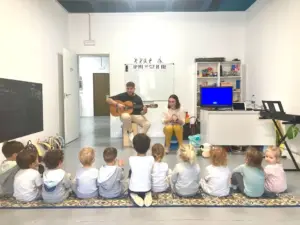
Many schools advertise ‘bilingualism’ when they actually offer just one hour of English a day. A bilingual nursery near Manilva (or anywhere on the Costa del Sol) should guarantee that the second language is a natural part of the routine: songs, spontaneous conversation, reading aloud, and conflict resolution in English.
Studies from UNESCO on early education confirm that constant exposure before age 3 creates neural connections that facilitate learning any language later. It’s not about ‘teaching’ English to a baby, but creating an environment where bilingualism emerges naturally.
In our Montessori Nido (0-3 years), each classroom has one English-speaking guide and one Spanish-speaking guide. The child hears both languages during meals, diaper changes, free play, and care routines. This repeated, affectionate exposure is what makes the difference.
Book a personalized school visit and see how immersion works in a real classroom.

The prepared environment: more than just nice decor
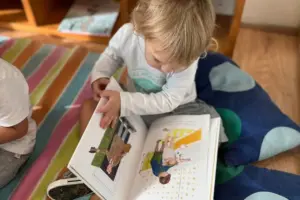
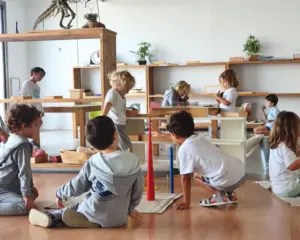
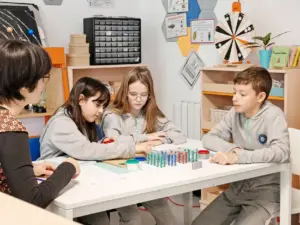
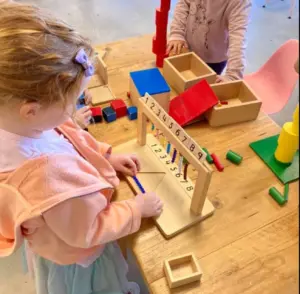
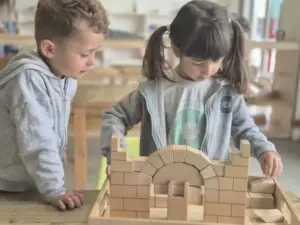
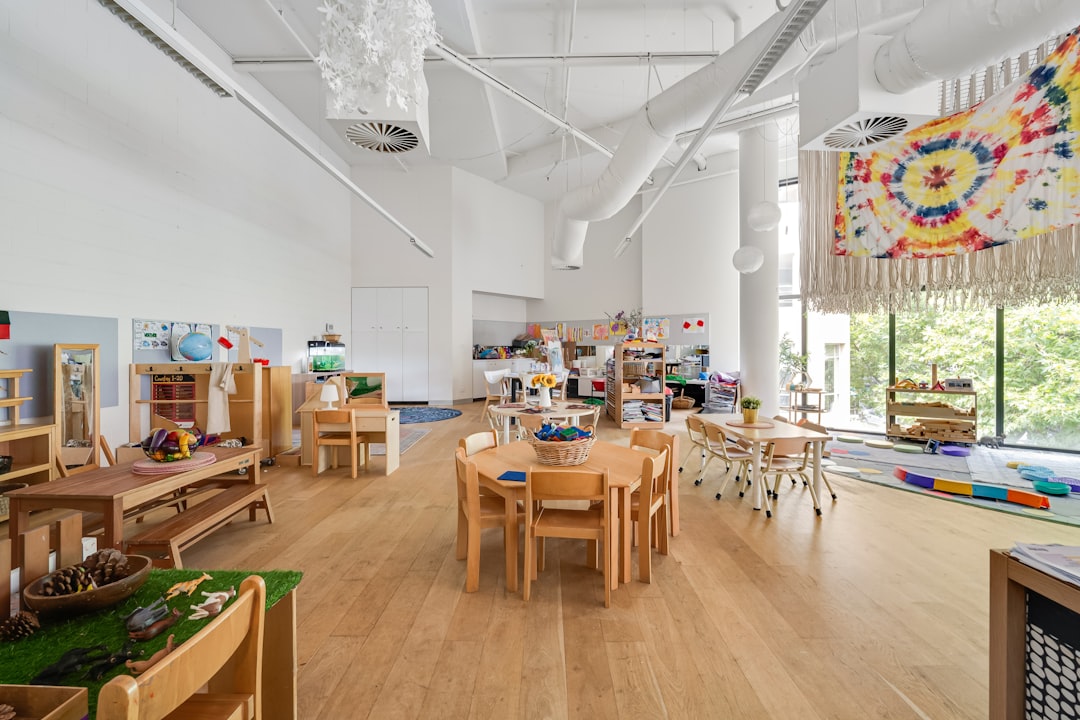
A common mistake is confusing a colorful classroom with a good educational environment. In Montessori pedagogy, the space is designed for the child to act independently: low shelves, individual-use materials, child-sized chairs and tables, and free access to water and food.
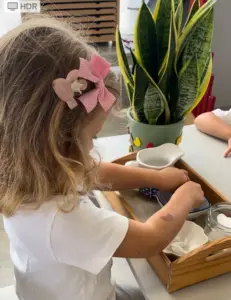
This approach is not a trend. The Association Montessori Internationale (AMI) has documented for over a century how a prepared environment reduces tantrums, increases concentration, and promotes fine motor skills. In practice, an 18-month-old who can pour their own glass of water develops confidence and coordination without depending on an adult.
What to look for when visiting a nursery
When you visit a school, notice these details:
- Are the materials organized on open shelves, within the child’s reach?
- Are there rugs or individual mats to define the work space?
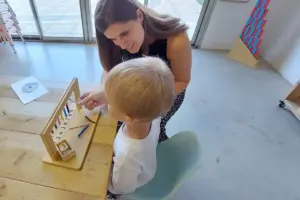
- Do the adults kneel to speak to the children at their eye level?
- Can you observe a meal routine where children actively participate?
If the answer to these questions is yes, you are looking at an environment that respects the child’s natural development. If you are in doubt, ask to spend a morning observing. Any school confident in its proposal will allow it.

Real logistics: is the commute from Manilva worth it?
Manilva and its urbanizations (Sabinillas, La Duquesa, Puerto de la Duquesa) are only a 10-15 minute drive from Sotogrande via the A-7 motorway. Many families who choose a bilingual nursery near Manilva discover that by slightly expanding their search radius, they can access schools with international accreditations not found in their own municipality.
The question is not ‘is there something closer?’ but ‘what environment do I want for my child’s early years?’. If you value genuine language immersion, an AMI-accredited Montessori environment, and NEASC (New England Association of Schools and Colleges) oversight, the 10-minute commute is an investment that pays off from day one.
What does a good 0-3 bilingual program include?
Not all programs are equal. A serious school should offer, at a minimum:
- Dual Spanish-English immersion throughout the entire school day, not just in ‘English classes’.
- Guides trained in the Montessori method with recognized certification (AMI or equivalent).
- Respectful care routines: diaper changes with verbal explanation, meals at the child’s pace, rest without forcing.
- Daily communication with families: brief reports, photos of the day, direct channel with the tutor.
At IMS Sotogrande, our Nido and Children’s House meet these standards. We also offer flexible schedules (until 17:00) for families who need to balance work and family life. If you would like to see our current fees, you can find them on the admissions page or write to us directly at [email protected].
Frequently Asked Questions
At what age does English immersion start at IMS Sotogrande?
Bilingual immersion begins from the Nido stage, i.e., from a few months of age. Children are exposed to Spanish and English simultaneously during all daily activities. There is no official ‘minimum’ age to start: the earlier, the more natural the process.
Do I need to live in Sotogrande for my child to attend the Nido?
No. Many families from Manilva, Sabinillas, La Duquesa, Casares, and other parts of the Costa del Sol choose IMS Sotogrande because they value the quality of the bilingual Montessori program. The journey from Manilva is just 10-15 minutes via the A-7. We invite you to visit us to see if it’s worth it.
What’s the difference between a bilingual nursery and one that ‘teaches English classes’?
In an authentic bilingual nursery, English is not a subject: it’s a language of daily use. English-speaking teachers interact with the children during meals, play, routines, and activities, not just during a specific session. This constant exposure is what allows the child to develop an ear and confidence in the second language spontaneously.
Key Takeaways
Choosing a bilingual nursery near Manilva or anywhere on the Costa del Sol requires looking beyond distance. Genuine language immersion, a prepared environment that respects the child’s rhythm, and guides trained in a recognized method are the pillars that make the difference in the 0-3 stage. If you are looking for these three things, it is worth considering options like IMS Sotogrande, just 10 minutes from Manilva.
Take the next step: book a visit and see how Montessori bilingual immersion works in a real classroom. Your child deserves a start that opens doors.
Viviane Dumont, Director of Studies at IMS Sotogrande.