

Montessori Activities for 4-Year-Olds: A Practical Guide for Expat Families in Sotogrande & Costa del Sol
In short
When your child turns 4, you notice a change. Suddenly they want to dress themselves, help in the kitchen, and explore every corner with insatiable curiosity. Montessori activities for 4-year-olds harness this natural drive for independence and concentration that defines the Children 's House (Casa de Niños) stage (ages 3-6).

When your child turns 4, you notice a change. Suddenly they want to dress themselves, help in the kitchen, and explore every corner with insatiable curiosity. Montessori activities for 4-year-olds harness this natural drive for independence and concentration that defines the Children‘s House (Casa de Niños) stage (ages 3-6). It’s not about accelerating learning, but about providing an environment and activities that meet their real developmental needs.
- Montessori Activities for 4-Year-Olds: The Sensitive Period for Order and Coordination
- Practical Life Activities to Foster Independence
- Sensory and Mathematical Development Through Play
- Language and Literacy in the Children's House Stage
- The Prepared Environment: Key to Development at Age 4
- Frequently Asked Questions
- Key Takeaways
Montessori Activities for 4-Year-Olds: The Sensitive Period for Order and Coordination
At age 4, children are in the sensitive period for order, movement coordination, and language. Montessori observed that during these windows of opportunity, the mind absorbs skills almost effortlessly if the environment is prepared. That’s why the activities in our Children’s House in Sotogrande are not simple games: they are purposeful exercises that children can repeat until mastery.
At home, you can replicate this logic. You don’t need expensive materials. Everyday objects that invite action work just as well: small pitchers for pouring water, sponges for cleaning spills, seedling trays for plant care. The key is that the activity is real and meaningful to the child.
Control of error is another pillar. A learning tower at the counter allows your child to help prepare their own snack: slice a banana with a dull knife, spread cream, pour their own water. If something spills, they clean it up. This builds confidence and fine motor skills, two foundations that later support writing.
Practical Life Activities to Foster Independence
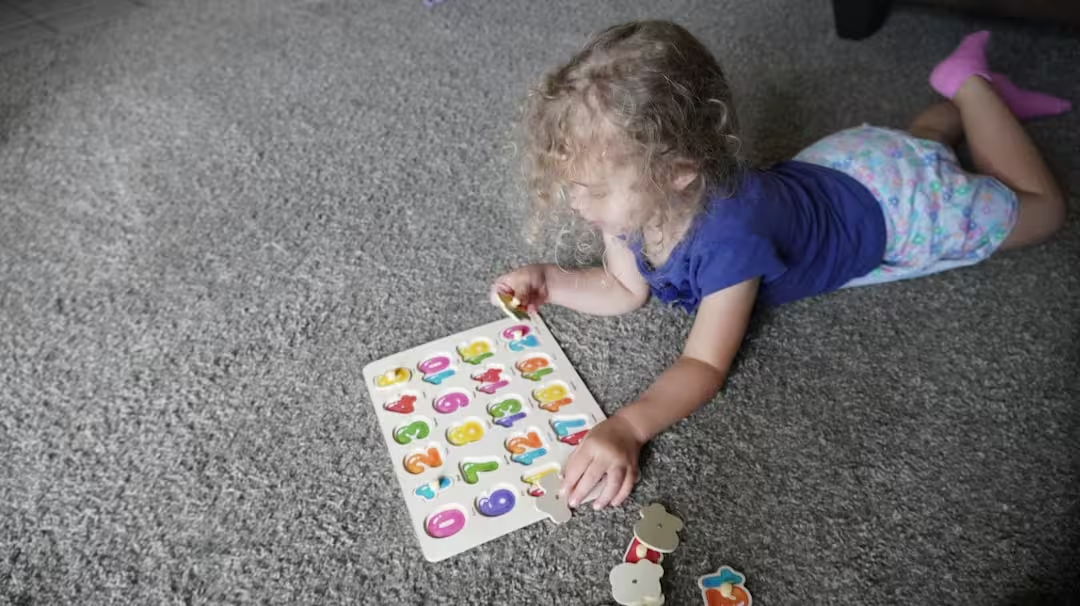
Practical life is the heart of Montessori activities for 4-year-olds . These are not imposed tasks but invitations that connect with the child’s genuine desire to contribute. In our Montessori environment, orderly trays with real materials, a French press, a colander, kitchen tongs, are always within reach. The child chooses freely and returns everything when done, cultivating inner discipline.
The Learning Tower: A Home Ally
A simple, safe step‑stool transforms the kitchen into a laboratory of independence. At age 4, children can wash fruit, scrub dishes with a sponge and natural soap, sweep crumbs, or set the table. These Montessori activities for 4-year-olds also strengthen gross motor skills through carrying objects and hand‑eye coordination. At IMS Sotogrande, we see how these small achievements build genuine self‑esteem, very different from empty praise.
Don’t underestimate the power of dressing themselves. At 4, they can fasten large buttons, zip zippers, and even fold their clothes. Leaving a low shoe rack with only a few pairs and a reachable hook makes the morning routine a game of shared responsibility.
Book a personalized school visit to discover how we prepare these environments so each child finds the right challenge for their developmental stage.
Sensory and Mathematical Development Through Play
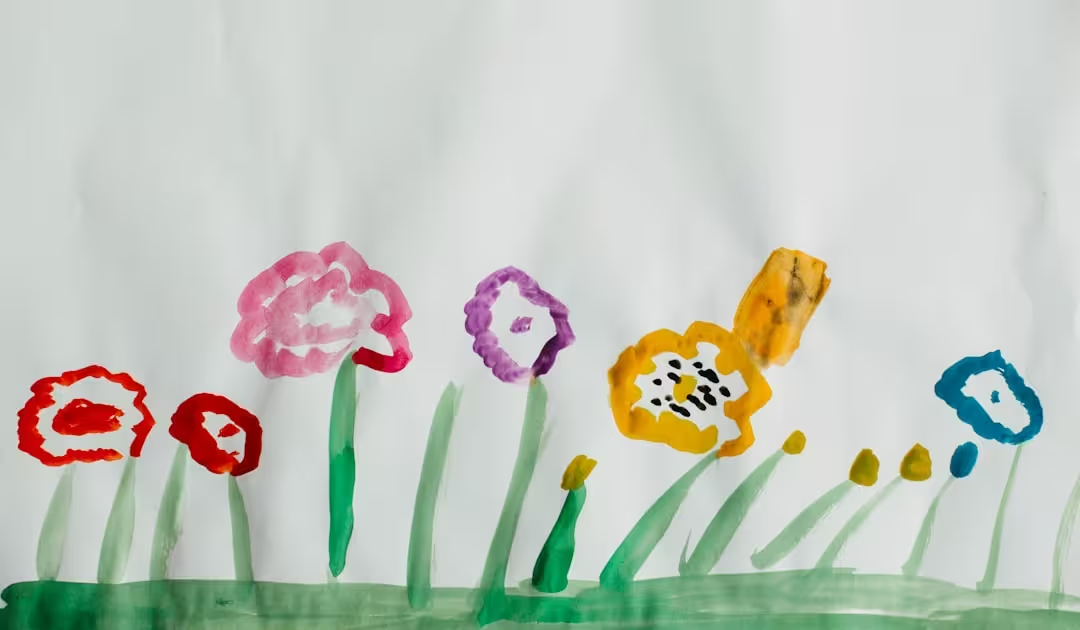
Before age 6, the senses are the gateway to learning. Montessori designed sensory materials that isolate one quality: color, shape, weight, texture, sound. At 4, children enjoy matching color tablets, ordering cylinders from largest to smallest, or exploring fabric boxes blindfolded. These refined activities lay the foundation for a mathematical mind, because classifying and sequencing are logical operations that precede numbers.
You don’t need to buy the Pink Tower or the Brown Stair. Household objects can provide equally rich experiences: collect stones of different sizes to sort, shells to classify by type, or spice jars to smell and match. Original Montessori materials are wonderful, but what truly matters is the process of self‑directed exploration.
Montessori Materials for Counting and Shapes
At age 4, children are often fascinated by numbers. Number rods and spindles are Montessori activities for 4-year-olds that let them touch and count without skipping steps. Before seeing the numeral 3, they experience the quantity three by grouping and separating objects. This builds deep, non‑rote understanding.
In our school in the Campo de Gibraltar (Gibraltar area), Children’s House children move from concrete to abstract at their own pace using sensory math materials they can manipulate again and again. This respect for the process is what sets Montessori apart from other approaches.
Language and Literacy in the Children’s House Stage
At age 4, interest in letters and words explodes. Montessori responds with language materials: sandpaper letters to trace while saying the sound, the movable alphabet to form words before writing them, and nomenclature cards to enrich vocabulary. Montessori activities for 4-year-olds integrate movement and touch because the hand remains the primary instrument of intelligence.
At home, thick markers, chalkboards, and rhythm‑rich books are great allies. But avoid drilling or correcting. The sensitive period for language craves abundant exposure to a rich environment of conversation, poetry, and silence for spontaneous writing to emerge. At IMS, as a bilingual school, we offer immersion in Spanish and English from the earliest years, multiplying opportunities for listening and expression.
The Prepared Environment: Key to Development at Age 4
A 4‑year‑old doesn’t need a constant entertainer. They need an organized, attractive, and predictable space that allows them to choose, concentrate, and return items when finished. Montessori calls this the “prepared environment.” In such a room, toys are grouped by category on low shelves, there are no distracting piles of clutter, and everything has a visible place. That external order helps build internal order.
At IMS Sotogrande, in our bright classrooms and outdoor corners, you’ll find trays and materials arranged with this intention. The guide observes and connects the child with the right activity, then steps back, letting concentration do its work. The result is a calm child able to persist through challenges without expecting external rewards.
By offering Montessori activities for 4-year-olds that respect their pace, you’re not just supporting academic learning. You’re cultivating a healthy relationship with work, error, and patience.
Frequently Asked Questions
What Montessori activities are recommended for a 4‑year‑old?
The most valuable are practical life activities (pouring, sweeping, food preparation, dressing) and sensory activities (sorting by color, matching textures, ordering by size). At this age, language is enhanced with sandpaper letters and the movable alphabet, and math with concrete counting materials like number rods or beads.
Is it necessary to have Montessori materials at home?
No. You can adapt everyday objects for the same purpose: spoons for pouring, clothespins, sponges, small pitchers. The essentials are an orderly environment, free choice, and activities with a real purpose connected to daily life.
How can I help my 4‑year‑old concentrate?
Observe what attracts them and offer an activity they can repeat without interruption. Reduce the number of available toys, avoid screens and background noise, and respect their interest cycles. When a child is absorbed, don’t correct or praise, just give them space.
Key Takeaways
Montessori activities for 4-year-olds are not a catalog of worksheets or a rigid program. They are opportunities that arise from looking at the child with respect and adapting the environment to their thirst for independence. By involving them in real tasks, you’re building their self‑esteem and concentration, gifts for life.
At IMS Sotogrande, every corner is designed so children of this age can explore, make mistakes, and try again in a safe, warm environment. If you’d like to see how the Montessori approach can support your child, we invite you to tour our facilities and speak with our guides.









