Why Your Child Ignores You: Montessori Solutions for Expat Parents
In short
When your child ignores you, it feels like you're talking to a wall. It's exhausting and often makes you doubt if you're doing it right. The first thing you need to know is that disobedience isn't a personal attack: it's a signal that has a lot to tell you about their development and how you're communicating with them.
When your child ignores you, it feels like you’re talking to a wall. It’s exhausting and often makes you doubt if you’re doing it right. The first thing you need to know is that disobedience isn’t a personal attack: it’s a signal that has a lot to tell you about their development and how you’re communicating with them. In this article we explore why my child ignores me in depth with practical examples.
Key Takeaways When it comes to why my child ignores me, it pays to listen to what families and lead guides actually report.
- A child’s brain doesn’t have the same inhibition capacity as an adult’s, especially before age 6.
- Repeating the same command over and over reduces your authority and confuses the child.
- Offering choices within clear limits works better than giving absolute orders.
- Emotional connection before making a request makes the difference between obedience and submission.
- A prepared environment at home reduces the number of daily conflicts.
- Why your child ignores you (and it's not bad parenting)
- The 5 most common reasons behind disobedience
- What to do when your child ignores you: strategies that work
- How to set limits without losing the connection
- The role of the prepared environment at home
- Mistakes that worsen the situation
- Frequently Asked Questions
- Key Conclusions
Why your child ignores you (and it’s not bad parenting)
The child who ignores your request isn’t necessarily challenging your authority. In most cases, their brain simply isn’t ready to manage the transition between what they’re doing and what you’re asking. This is especially true between ages 2 and 6, when the prefrontal cortex (responsible for impulse control and planning) is still in full development. Daily practice with why my child ignores me reveals nuances no handbook fully captures.
According to the Asociación Montessori Española, a child needs an environment that allows them to act with autonomy within clear limits. When they only receive orders without context or participation, their natural response is to disconnect. It’s not rebellion: it’s a protective mechanism. Understanding why my child ignores me from inside the classroom reshapes everyday decisions.
The 5 most common reasons behind disobedience
Your child ignores you for one of these reasons, which often combine with each other. Concrete data on why my child ignores me is worth reviewing before acting on assumptions.
They are immersed in an activity
The child concentrates all their energy on what they have in their hands. Cutting that concentration abruptly generates resistance. In Montessori pedagogy we call this “work” and protecting it is fundamental for their cognitive development. If you stop them abruptly, they will react with frustration.
They don’t understand what you’re asking
Long sentences or those with double negatives confuse young children. “I don’t want you to not pick up the toys” is impossible for a 4-year-old to process. Clear, short requests work better.
They are hungry, tired, or experiencing sensory overload
A tired or hungry child doesn’t have the resources to cooperate. Before thinking about strategies, check the basic needs.
They are seeking your attention
If they only receive your attention when they “behave badly,” they will learn that this is the most effective way to connect with you. The child who doesn’t listen sometimes just needs you to sit with them for five minutes.
The consequences are not consistent
If today you let something pass that tomorrow you scold them for, the child loses the reference. Inconsistency is the biggest enemy of cooperation.
What to do when your child ignores you: strategies that work
It’s not about being stricter or shouting louder. It’s about changing the approach. Book a personalized school visit and discover how we work on these situations in the classroom with children of all ages.
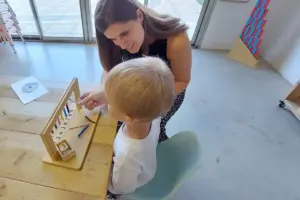
Get close and get down to their level. Instead of shouting from the kitchen, get closer, come down to their height, and look them in the eyes. This simple gesture completely changes the dynamic. Your child will listen to you better when they feel you are present, not just issuing instructions.
Use short, positive phrases. Instead of “don’t run,” try “we walk slowly.” Instead of “don’t shout,” “speak softly.” The child’s brain processes positive instructions better because it doesn’t need to first negate and then imagine the alternative.
Give a prior warning. “In five minutes we’ll tidy up” allows the child to mentally prepare for the transition. Accompany the warning with a visual gesture (pointing to the clock, for example) for the youngest ones.
How to set limits without losing the connection
Limits aren’t the enemy. Without them, the child feels unprotected and anxious. But the way you set them determines whether they obey out of fear or trust. Maria Montessori put it this way: “Freedom without limits is not freedom, it’s abandonment.”
Offer choices within limits: “Do you want to put your shoes on first or your coat?” In both cases they put on shoes and a coat, but the child feels they have control. This technique reduces confrontation in a very high percentage of daily situations.
When the child still doesn’t cooperate, stay calm and repeat the request only once with a firm but calm tone. If the response is still negative, apply the consequence you previously announced. Don’t threaten with something you won’t follow through on: you lose credibility.
The role of the prepared environment at home
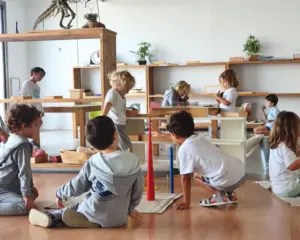
At IMS we design spaces with the child in mind: coat hooks at their height, accessible shelves, organized materials. At home you can apply the same idea. If you want them to get dressed on their own, place the clothes within reach. If you want them to pick up their toys, have a clear and visible place to store them. A child cannot obey an order that the environment prevents them from carrying out.
This approach reduces the number of commands you need to give each day, which reduces the strain on both of you. When the environment cooperates, you also need less effort to achieve it.
Mistakes that worsen the situation
Repeating the same request five times teaches the child that the first four don’t matter. If you say “come here” and nothing happens, don’t repeat it: go to them yourself. If you threaten with “do this or we’re leaving” and then you don’t leave, you’ve just taught them that your words have no weight.
Comparing them with other children also worsens the situation: “Look how your cousin behaves.” This doesn’t motivate, it humiliates. And a humiliated child cooperates less, not more.
Frequently Asked Questions
Is it normal that my 3-year-old doesn’t listen to me?
Yes, it’s completely normal. At age 3, the brain is in full development of inhibitory control. The child doesn’t “decide” not to obey: their capacity to stop an ongoing action and switch to another is still very limited. Patience and appropriate strategies make the difference.
When to worry about disobedience
When the behavior is persistent, affects their social and school life, and is accompanied by intense aggression or extreme withdrawal, it’s advisable to consult a professional. In most cases, however, it’s about developmental phases that are worked on with consistency and affection.
How to distinguish disobedience from an attention problem
The disobedient child ignores specific requests but maintains concentration on activities that interest them. The child with attention difficulties has problems sustaining attention on any task, including ones they choose themselves. If you suspect the latter, consult your pediatrician.
Key Conclusions
Your child who doesn’t listen is communicating something they don’t yet know how to express with words. Behind every “no” there is a need, an emotion, or a developmental limit that deserves to be understood before being corrected. The strategies that work aren’t magic: they require consistency, coherence, and much more connection than we usually offer in our daily lives.
Start today with just one thing: get down to their level, look them in the eyes, and tell them what you need calmly. You’ll see how the relationship changes and, with it, their willingness to cooperate. If you want to discover how we work on these principles in the classroom, book a personalized school visit and experience the Montessori environment firsthand.