
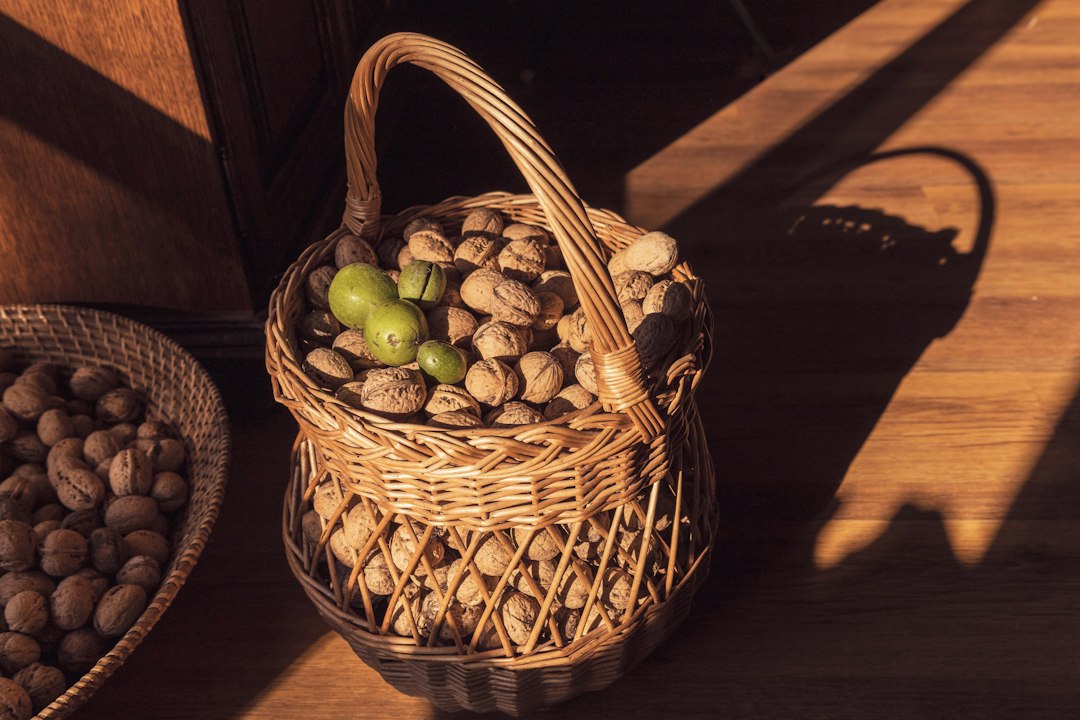
Montessori Treasure Basket for Babies: A Practical Guide

A Montessori treasure basket for babies is an exploration activity that brings together safe, varied everyday objects without turning play into a directed lesson. It is usually offered when a baby can sit independently, at around 6 months, always with close supervision. Its value lies in allowing the baby to touch, look, turn, bang and choose.
- In summary
- What does a Montessori treasure basket help babies develop?
- What is a treasure basket?
- What age is a treasure basket suitable for?
- What should you put in a treasure basket?
- How a Montessori treasure basket fits into the home
- Toys for babies aged 0 to 3 months: what to offer
- Is it a Montessori activity or simply a sensory basket?
- How to tell whether the basket is well prepared
- Frequently asked questions
In summary
- The basket supports sensory exploration, coordination and concentration.
- The most suitable stage usually begins when a baby can sit without help, approximately between 6 and 12 months.
- It should contain a small number of large, sturdy, washable and easy-to-grasp objects.
- An adult stays nearby and observes but does not demonstrate one correct way to use each object.

What does a Montessori treasure basket help babies develop?
A Montessori treasure basket supports sensory exploration, hand-eye coordination, grasping, attention and early independence. Through free manipulation, babies compare weights, textures, temperatures, sounds and shapes. When it comes to Montessori treasure basket for babies, it pays to listen to what families and lead guides actually report.
They also practise simple decisions. A baby may choose a spoon, put it down, reach for a ring and return to the first object. This sequence strengthens concentration without requiring a particular result. The adult also gains insight into the interests and skills emerging at each stage. Daily practice with Montessori treasure basket for babies reveals nuances no handbook fully captures.
At 8 months, for example, a baby may need several attempts to get their fingers into a handle. Learning happens during those attempts, not when an adult places the object in the baby’s hand. Understanding Montessori treasure basket for babies from inside the classroom reshapes everyday decisions.

What is a treasure basket?
A treasure basket is a low, stable container filled with real everyday objects selected for a baby to explore safely with their hands and mouth. It is not a box of random toys or an activity that requires instructions.
The adult prepares the environment, checks the objects and sits nearby. They then observe without interrupting every few seconds. This way of accompanying a child reflects the independence and respect for the child’s individual pace promoted by the Association Montessori Internationale, although a treasure basket should not be presented as an official Montessori material.

What age is a treasure basket suitable for?
A treasure basket is most suitable when a baby can sit steadily and use both hands, normally between 6 and 12 months. Age is not a rigid boundary. Posture, interest and the ability to bring objects to the mouth are better guides.
Between 12 and 18 months, many children begin walking and want to carry, put in, take out and sort objects. At this stage, the basket can still be offered for a few minutes, but it is worth adding movement and practical life activities. For babies aged 0 to 3 months, a sensory basket does not replace free movement on the floor, the adult’s voice or eye contact.
What should you put in a treasure basket?
An exploration basket can contain between 8 and 12 large, safe and varied objects. There is no need to buy specialist materials. A well-chosen everyday object often offers more possibilities than a toy with just one function.
| Type of object | Suitable examples | What the baby can explore |
|---|---|---|
| Wood | Large ring, smooth spoon or soft brush | Weight, temperature and texture |
| Metal | Small bowl or cup with no damaged edges | Sound, reflection and temperature |
| Fabric | Cotton cloth or large fabric ball | Softness, grip and movement |
| Natural materials | Large, checked pine cone or loofah | Texture, shape and resistance |
Avoid small objects, glass, items with flaking paint, long cords, magnets, batteries, sharp edges and food. Check every item before each session. The American Academy of Pediatrics provides general child-safety guidance that should also be applied during exploratory play.
How a Montessori treasure basket fits into the home
A Montessori treasure basket for babies works best when the environment allows the baby to act on their own initiative. Place it on the floor on a firm rug, with space around it and no background music. The basket should be within reach, but not on top of the baby or blocking their movements.
The Montessori approach does not depend on putting a label on the container. It can be seen in practical decisions: offering freedom within safe limits, choosing real materials, observing before intervening and removing items that no longer spark interest. There is little point in filling the basket with twenty objects if the baby can concentrate on only one or two.
A Montessori treasure basket for an 8-month-old baby
Imagine a 12-minute session with nine objects: a wooden ring, a metal spoon, a small bowl, a fabric ball, a cloth, a loofah, a soft brush, a large ring and a piece of cork with no loose pieces. The adult sits one arm’s length away and intervenes only if a risk appears.
- Check that the baby is rested and can remain sitting.
- Place the basket in front of the baby, not around their body.
- Observe which object they choose, how long they handle it and when they change.
- Remove the activity if the baby loses stability, puts a dangerous item in their mouth or shows signs of tiredness.
The common mistake and a practical solution
The most common mistake is showing the baby what each object is for. If the adult bangs the bowl, shakes the ring and brings the ball closer, the child tends to imitate rather than investigate. The solution is to wait a few seconds, describe only when necessary and allow a use different from the one intended.
Toys for babies aged 0 to 3 months: what to offer
Babies aged 0 to 3 months do not usually need a complete treasure basket. At this stage, play is supported by free movement, the adult’s face, their voice, visual contrast and one or two lightweight objects offered for a few minutes.
A realistic example would be placing a 2-month-old baby on their back, awake and calm, on a firm blanket. The adult can position a large fabric ring at some distance for 3 or 5 minutes and remove it when the baby becomes tired. Never leave the object in the cot or out of your reach.
Once the baby can sit steadily, you can introduce a treasure basket with more variety. This respects developmental progression instead of bringing forward an activity simply because it is recommended for another age.
Is it a Montessori activity or simply a sensory basket?
A treasure basket can be consistent with Montessori, but it does not become Montessori simply because it contains natural objects or uses a wicker basket. The difference lies in the purpose and in the adult’s actions. The baby explores actively, the materials remain accessible and the accompanying adult avoids directing every action.
How to tell whether the basket is well prepared
The activity is working when the baby can reach the objects without losing balance, stays focused for a few minutes and changes activities by choice. If they immediately throw all the objects out, they may need a lower basket, fewer items or a break.
Also observe the adult’s state. If you feel the need to correct, encourage or entertain every moment, reduce your involvement. Quiet, close observation allows spontaneous movements to emerge and gives you a clearer picture of what the baby can already do.
Frequently asked questions
What does a Montessori treasure basket help babies develop?
A Montessori treasure basket supports sensory exploration, hand-eye coordination, grasping, attention, early independence and the ability to choose, because the baby handles varied objects at their own pace in a safe, prepared environment. It also encourages concentration and allows the adult to observe interests without directing the play.
What is a treasure basket?
A treasure basket is a play activity in which a baby explores large, safe everyday objects inside a stable basket, without instructions or electronic toys that dictate a single response. The adult prepares the environment, stays nearby and accompanies the baby calmly while the child touches, looks, turns, bangs and compares.
What age is a treasure basket suitable for?
A treasure basket is usually suitable once a baby can sit steadily, approximately between 6 and 12 months, although each child reaches this stage in their own time. Before then, visual activities and lightweight objects with direct supervision are more appropriate. Afterwards, you can combine it with movement and practical life activities.
What should you put in a treasure basket?
A treasure basket usually contains between 8 and 12 large, sturdy, washable objects that differ in texture, weight, shape and sound, such as a metal spoon, wooden ring, cloth or fabric ball. It should not contain small pieces, glass, magnets, batteries, long cords or dangerous edges.
Start with a few objects, observe without rushing and adapt the activity to your baby’s current stage. If you would like to learn how to prepare a Montessori environment for early childhood, book a personalised school visit.









