
Montessori Toys for 9-12 Months: How to Choose the Right Ones

Montessori toys for 9-12 months are simple materials, made from natural substances and with a single purpose, designed for the exact moment your baby sits, crawls, pulls to stand, and starts fitting, dropping, and unscrewing. You don’t need twenty pieces or boxes with lights. With three or four well-chosen materials presented on a tray, your baby works on concentration, hand-eye coordination, and language.
- In Summary
- What Your Baby Is Exploring Between 9 and 12 Months
- Criteria for Choosing Materials in This Age Range
- Three Materials That Work Really Well at Home
- Example: How to Present a New MaterialImagine your 10-month-old receives their first tissue box. Place it on the floor, on a small rug, with the lid open and three colored tissues peeking out. Sit beside them without speaking and pull the three tissues out one at a time with slow movements. Put them back. Wait. They will repeat the gesture many times. Remove the box after a few days and offer something else.The most common mistake in homes is presenting everything at once. If your baby has eight toys on the floor, they run from one to the next and settle on none. The solution is simple: bring out only three materials, place them on separate trays, and store the rest on a closed shelf.How Many Toys and How to Rotate ThemLess is better. Three materials on display, on a low shelf, is a good starting point. Every 7-10 days, put one away and bring out another. Observe: if your baby repeats the gesture several times in a row, the material is teaching them something and deserves to stay.One Question That Will Help You DecideBefore buying anything, ask yourself: what can my child do with this without me intervening? If the answer is "watch how things work," better to skip it. If the answer is "do it themselves over and over," it will work.The Asociación Montessori España reminds us that the adult prepares the environment and then steps back. Choosing well is preparing. Intervening too much, correcting, or cheering them on interrupts concentration.Montessori Toys for 9-12 Months: Common Mistakes and SolutionsOne typical mistake is buying toys "so they last longer," thinking ahead to older ages. An 18-month toy used at 9 months frustrates and ends up at the bottom of the drawer. Buy for the present moment and change when the time comes.Another mistake is confusing Montessori with pale wood and Scandinavian design. What makes a material Montessori is its educational function, not its color. A basket with real kitchen objects is worth more than an expensive block set that doesn't invite action.And a third, very common one: using screens as an "educational toy" before the first year. The American Academy of Pediatrics recommends avoiding screens for children under 18-24 months, except video calls. If you want something educational, the best screen is the window.What to Get If You Can Only Buy Three ThingsIf your budget is tight, prioritize: a small wicker basket, three real objects for putting in and taking out, and two bowls with large pom-poms. That covers transferring, permanence, and the pincer grasp. The rest comes from the rest of the house: spoons, containers, baskets, fabrics.Frequently Asked QuestionsHow many Montessori toys should a 9-12 month old have?Between three and four materials on display at any given time, with the rest stored out of reach. Weekly rotation keeps interest alive and avoids overstimulation. Fewer toys with more educational intention works better than lots of options at once.What's the difference between a Montessori toy and a regular one?A Montessori toy has a single purpose, is made of real materials, and lets the baby self-correct. A conventional toy usually does several things at once and grabs attention with lights or sounds. The educational function, not the aesthetic, makes the difference.From what age can you offer Montessori toys?From birth, with materials suited to each moment of the first plane of development. At 9-12 months, that means treasure baskets, object permanence, and transferring materials. The key is respecting the baby's actual stage and not skipping ahead to materials meant for older ages.Can I make Montessori toys at home with recycled materials?Yes, and it's highly recommended. Wicker baskets, containers, wooden spoons, fabrics, cardboard boxes, and pom-poms offer lots of play value. Make sure pieces are large enough to prevent choking and check that there are no sharp edges.How long should a 9-12 month old play with each material?There's no set time. Observe their concentration: if they repeat the gesture several times in a row, let them continue. When they lose interest and look elsewhere, remove the material without insisting. The autonomy to start and stop is part of the learning. About Tamara Muñoz: Director of IMS Sotogrande and an Emotional Intelligence educator. Holds a Psychology degree from the University of Málaga, is an ICF-certified coach, and an educator in Positive Discipline accredited by the American Positive Discipline Association, with training in leadership and Montessori management Full profile.
- How Many Toys and How to Rotate Them
- Montessori Toys for 9-12 Months: Common Mistakes and Solutions
- What to Get If You Can Only Buy Three Things
- Frequently Asked Questions
In Summary
- Fewer toys, more rotation: 3-4 materials on display, everything else stored away.
- Choose single-purpose objects made of wood, fabric, or metal that invite fitting, threading, dropping, and unscrewing.
- Between 9-12 months, object permanence, containers, and pincer-grasp fine motor skills take center stage.
- Present each material on a tray, slowly and quietly, and remove it when interest fades.

What Your Baby Is Exploring Between 9 and 12 Months
Between 9 and 12 months, your baby shifts from exploring with the mouth to exploring with the hands. They crawl toward what interests them, sit up on their own, pull to stand while holding on, and start dropping objects on purpose to see what happens. These are the foundations of practical intelligence that Montessori described in the first plane of development.
Look for materials that meet three concrete needs: putting things in and taking them out, fitting and removing, and repeating an action until it’s mastered. If a toy does several things at once (sounds, flashes, talks), your baby watches the effect. If it does only one thing, your baby watches their own action. That difference shows up in the duration of concentration.
The Association Montessori Internationale insists that first-year materials be real, beautiful, and hands-on objects. They don’t need the word “Montessori” on the box.

Criteria for Choosing Materials in This Age Range
A good material for this stage meets four conditions. First, it’s real and durable: wood, metal, fabric, lightweight ceramic, or wicker. Second, it has a single clear purpose. Third, it’s the right size for their hand, with pincer-friendly grips. Fourth, it allows for control of error: if the piece doesn’t fit, the material itself shows them without anyone correcting them.
Quick-Reference Table: What to Offer and Why
| Age | What It Develops | Suggested Materials | How Many at Once |
|---|---|---|---|
| 9-10 months | Object permanence, putting in and taking out | Tissue box, lidded baskets, a rattle that sounds when shaken | 3 |
| 10-11 months | Hand-eye coordination, fitting | Stacking cups, stacking blocks, pegboard | 3-4 |
| 11-12 months | Fine pincer grasp, unscrewing, imitation | Wooden screws, spoons and bowls, pouring baskets | 4 |
| 9-12 months | Language and movement | Treasure basket, soft music, crawling materials | Variable |

Three Materials That Work Really Well at Home
The Treasure Basket
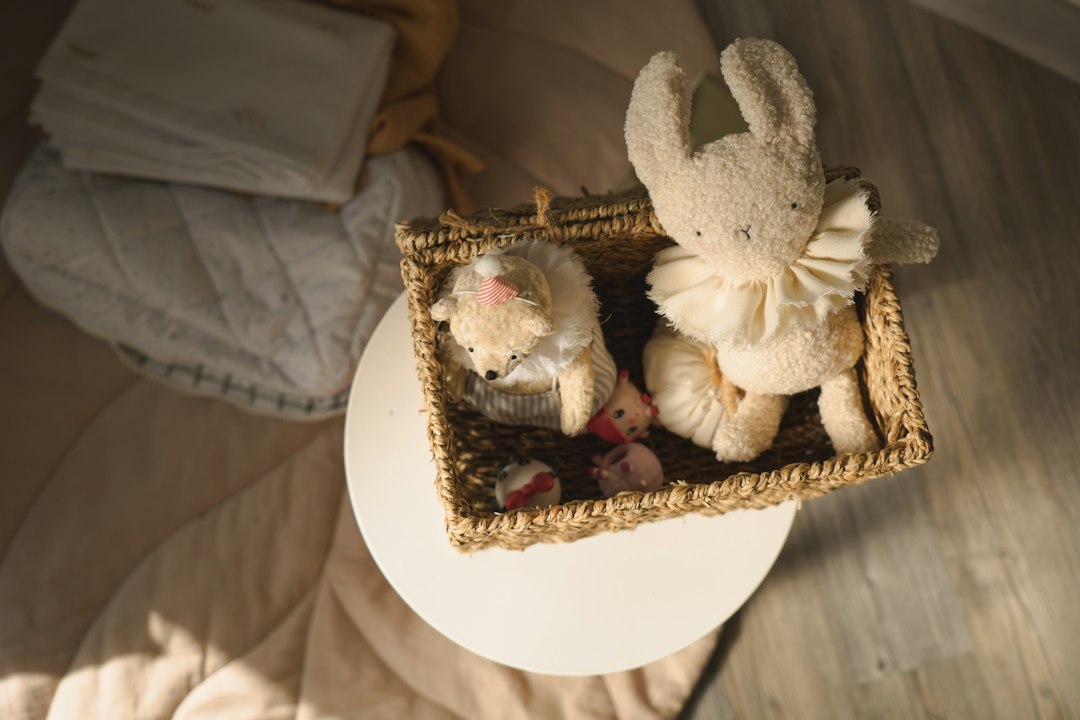
This is the star material from 9 to 12 months. Prepare a wicker basket with 6-8 real, safe objects: a small brush, a wooden spoon, a fabric ball, a clothespin, an old plastic key, a clean tin can. Swap them every week. Your baby examines them one by one and builds their own mental catalog.
Pouring Baskets
Place two bowls and a handful of large pom-poms or fabric balls. Your baby will spend ten minutes moving things from one side to the other. This transferring play prepares writing because it trains the pincer grasp and the wrist. Start with large objects and reduce the size as they improve.
Object Permanence Materials
The tissue box, the tube with a disappearing object, or the container for dropping in large plastic coins all work on an abstract idea: what I can’t see still exists. This is a cognitive milestone around 9 months that the American Academy of Pediatrics describes as a precursor to pretend play.
Example: How to Present a New Material
Imagine your 10-month-old receives their first tissue box. Place it on the floor, on a small rug, with the lid open and three colored tissues peeking out. Sit beside them without speaking and pull the three tissues out one at a time with slow movements. Put them back. Wait. They will repeat the gesture many times. Remove the box after a few days and offer something else.
The most common mistake in homes is presenting everything at once. If your baby has eight toys on the floor, they run from one to the next and settle on none. The solution is simple: bring out only three materials, place them on separate trays, and store the rest on a closed shelf.
How Many Toys and How to Rotate Them
Less is better. Three materials on display, on a low shelf, is a good starting point. Every 7-10 days, put one away and bring out another. Observe: if your baby repeats the gesture several times in a row, the material is teaching them something and deserves to stay.
One Question That Will Help You Decide
Before buying anything, ask yourself: what can my child do with this without me intervening? If the answer is “watch how things work,” better to skip it. If the answer is “do it themselves over and over,” it will work.
The Asociación Montessori España reminds us that the adult prepares the environment and then steps back. Choosing well is preparing. Intervening too much, correcting, or cheering them on interrupts concentration.
Montessori Toys for 9-12 Months: Common Mistakes and Solutions
One typical mistake is buying toys “so they last longer,” thinking ahead to older ages. An 18-month toy used at 9 months frustrates and ends up at the bottom of the drawer. Buy for the present moment and change when the time comes.
Another mistake is confusing Montessori with pale wood and Scandinavian design. What makes a material Montessori is its educational function, not its color. A basket with real kitchen objects is worth more than an expensive block set that doesn’t invite action.
And a third, very common one: using screens as an “educational toy” before the first year. The American Academy of Pediatrics recommends avoiding screens for children under 18-24 months, except video calls. If you want something educational, the best screen is the window.
What to Get If You Can Only Buy Three Things
If your budget is tight, prioritize: a small wicker basket, three real objects for putting in and taking out, and two bowls with large pom-poms. That covers transferring, permanence, and the pincer grasp. The rest comes from the rest of the house: spoons, containers, baskets, fabrics.
Frequently Asked Questions
How many Montessori toys should a 9-12 month old have?
Between three and four materials on display at any given time, with the rest stored out of reach. Weekly rotation keeps interest alive and avoids overstimulation. Fewer toys with more educational intention works better than lots of options at once.
What’s the difference between a Montessori toy and a regular one?
A Montessori toy has a single purpose, is made of real materials, and lets the baby self-correct. A conventional toy usually does several things at once and grabs attention with lights or sounds. The educational function, not the aesthetic, makes the difference.
From what age can you offer Montessori toys?
From birth, with materials suited to each moment of the first plane of development. At 9-12 months, that means treasure baskets, object permanence, and transferring materials. The key is respecting the baby’s actual stage and not skipping ahead to materials meant for older ages.
Can I make Montessori toys at home with recycled materials?
Yes, and it’s highly recommended. Wicker baskets, containers, wooden spoons, fabrics, cardboard boxes, and pom-poms offer lots of play value. Make sure pieces are large enough to prevent choking and check that there are no sharp edges.
How long should a 9-12 month old play with each material?
There’s no set time. Observe their concentration: if they repeat the gesture several times in a row, let them continue. When they lose interest and look elsewhere, remove the material without insisting. The autonomy to start and stop is part of the learning.









