
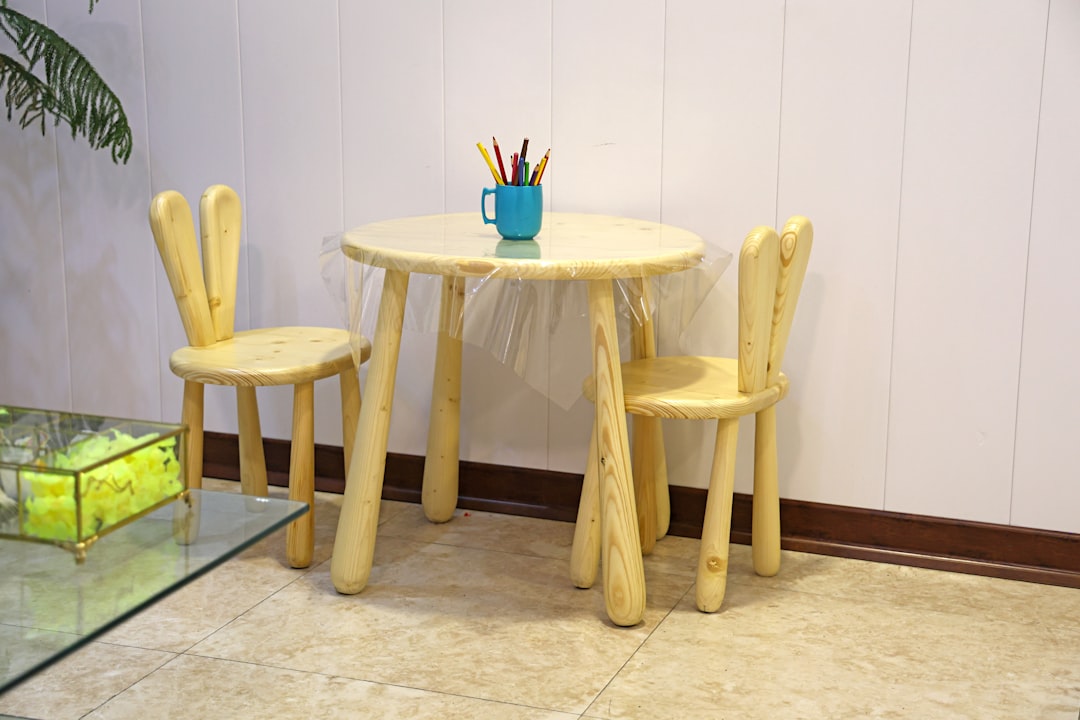
Montessori Table and Chair for Toddlers: When to Introduce Them at Home

If your child is already crawling, pulling themselves up, and starting to explore every corner of the house, you’ve probably wondered if it’s time to set up their own space with a Montessori table and chair . This decision isn’t about aesthetics. It’s about autonomy: that the child can sit down and get up whenever they want, without asking for your help, and that every object in their environment is within their reach.
- Key Takeaways
- Why a Montessori Table and Chair Change the Dynamic at Home
- When to Introduce the Montessori Table and Chair
- How to Choose the Right Montessori Table and Chair
- Where to Place the Table and Chair at Home
- How to Get Started: The First Few Weeks
- Common Mistakes When Introducing the Montessori Table
- Montessori Table vs. High Chair: Real Differences
- Frequently Asked Questions
- Key Conclusions
Key Takeaways
- A Montessori table and chair is introduced when the child walks with stability, typically between 12 and 18 months.
- The furniture should be low, lightweight, and proportional to the child’s body, never adapted with cushions or boosters.
- Placing the table next to a shelf with accessible materials turns a corner into a real prepared environment.
- At IMS Sotogrande, from the Nido (0-3 years), children work at individual tables they choose freely, with no adult chairs or high chairs.

Why a Montessori Table and Chair Change the Dynamic at Home
Maria Montessori observed that young children need furniture sized for them to concentrate. A child whose feet don’t touch the floor or who has to wait to be seated is not in a working position. They’re in a position of dependence. The Montessori table and chair remove that barrier.
When the child sits down on their own, chooses when to stand up, and accesses their materials without help, their brain registers a powerful idea: “I can do it.” That feeling is the foundation of intrinsic motivation, according to the Association Montessori Internationale.

When to Introduce the Montessori Table and Chair
There isn’t an exact age because every child has their own pace. However, there are two clear signs:
- They walk with enough stability to approach the table and sit down without risk of falling.
- They show interest in sitting on low surfaces (sofas, stairs, the edge of the bed) and not just on the floor.
In most children, this happens between 12 and 18 months . Some need until 20 months. There’s no rush. The important thing is that, when the moment comes, the table is ready and the child can use it without being placed there.
In the Nido at IMS, the youngest children work at individual tables from the moment they can sit steadily. There are no high chairs or booster seats. The environment is designed so each child can reach it themselves.

How to Choose the Right Montessori Table and Chair
Not just any low table will do. The important features are:
Size Proportional to the Child
The chair’s height should allow feet to rest completely on the floor, with knees at a right angle. The table should reach approximately the child’s navel. If the child is between 1 and 3 years old, a table about 40-45 cm high and a chair of 20-25 cm usually work well.
Resistant but Lightweight Material
The child must be able to move the chair alone. If the furniture is heavy, you lose the essence: autonomy. Solid wood with natural finishes is the most common choice in Montessori environments because it’s stable but not immovable.
No Unnecessary Adornments
A Montessori table and chair doesn’t need bright colors or animal shapes. Simplicity invites work. The materials on the table are what should capture attention, not the furniture itself.
Book a personalized school visit and discover what our classrooms equipped with authentic Montessori furniture look like.
Where to Place the Table and Chair at Home
Location matters as much as the furniture. Some options by age:
- In the kitchen or dining room (12-24 months): near the eating area, so the child can participate in food preparation or eat autonomously.
- In a corner of the living room (2-4 years): with a low shelf beside it containing art materials, puzzles, or books. This corner becomes their workspace.
- In their bedroom (from 3-4 years): if they already have a prepared environment in their room, the table can be part of the activity area.
Avoid placing the table facing a TV or in a high-traffic hallway. The child needs to be able to concentrate, even if it’s for five minutes. That time of focus is valuable.
How to Get Started: The First Few Weeks
Don’t introduce the table with ten materials on it. In the first few weeks, it’s enough with:
- A simple activity : a bowl with two or three pieces of cut fruit, a plate with a piece of bread, a notebook, and a pencil.
- Time without intervention : don’t tell them what to do. Sit nearby with your own book or coffee cup. Observe.
- Brief routine : offer the table after breakfast or before snack time, when the child has energy but isn’t extremely hungry.
After a few days, the child will start going to the table on their own initiative. That’s when you know the environment is working.
Common Mistakes When Introducing the Montessori Table
Some families get frustrated because the child doesn’t use the table. It almost always comes down to one of these reasons:
- The table is too high or the chair doesn’t support the feet . If the child is rocking or complaining, check the measurements.
- There are too many stimuli around . A table next to the TV or by a busy door doesn’t invite calm.
- The materials aren’t suitable for their age . A 20-piece puzzle for a 15-month-old is guaranteed frustration. Start simple.
- The adult intervenes too much . If you correct every stroke, if you say “not like that,” the child will stop using the table because they don’t feel free.
Montessori Table vs. High Chair: Real Differences
The high chair has its specific function (travel, restaurants, visits), but at home it replaces the child’s autonomy. When a child is in a high chair:
- They can’t decide when to sit down or get up.
- They don’t access their materials on their own.
- They depend on an adult to place and remove them.
The Montessori table and chair reverses that dynamic. The child is the protagonist. This doesn’t mean you throw away the high chair tomorrow. It means that at home, during play and work hours, the child has their own space that respects their body and their will.
Frequently Asked Questions
Can I use a Montessori table and chair if my child isn’t walking well yet?
If the child crawls steadily and pulls themselves up on furniture, you can offer the table as a surface for standing activities, like transferring objects from one bowl to another. The chair will come when they walk confidently. Don’t force the moment: if the child falls from the chair or can’t stay seated, it’s not time yet.
What’s the difference between a Montessori table and a regular low table?
The key difference is proportion. A Montessori table is sized so the child’s feet touch the floor, their back stays straight, and they can work without tension. A garden table or coffee table usually doesn’t meet these measurements, and if the child doesn’t properly support their feet, they lose stability and concentration.
From what age do I no longer need the Montessori table and chair?
It doesn’t disappear. It evolves. From 12 months to 3 years, the low table is fundamental. Between 3 and 6 years, many children still use it, but some prefer to work on the floor with a rug (as we do in Casa de Niños at IMS). From 6 years old, the furniture adapts to growth, with higher tables and adjustable chairs.
Can the same table be used for eating and activities?
In the first few months yes, because activities are brief and simple. But as the child grows, it’s best to differentiate: one table for eating (in the kitchen or dining room) and another for work (in their activity corner). This helps the child associate each space with a different function, which reinforces concentration.
Key Conclusions
The Montessori table and chair isn’t a decorative whim or a trend. It’s a tool with almost a century of pedagogical evidence behind it, designed to make your child feel competent every time they sit down to work, eat, or create. Introduce it when you see they walk with stability and show interest in sitting alone, and give them time to adopt it.
If you want to see how children work in a real Montessori environment, with authentic furniture and AMI-certified guides, book a visit to IMS Sotogrande. We’re in Sotomarket, a few minutes from La Línea, Algeciras, Estepona, or anywhere on the Costa del Sol.









