
Montessori Literacy & Reading: How Children Learn to Read & Write at IMS Sotogrande

Montessori literacy is one of the processes that most astonishes families who join our school. There’s no rush, no pressure, and yet children begin to read and write with a naturalness that seems magical. It isn’t. Behind it is a very precise design that respects the child’s sensitive periods.
At IMS Sotogrande, we accompany children from the entire Campo de Gibraltar and Costa del Sol region on this path. From families in La Línea, Algeciras, or Gibraltar looking for a bilingual school to international families who have just relocated to Sotogrande. The method is the same: observe the child, prepare the environment, and offer the right material at the right moment.
Key Points
- Montessori literacy begins long before a child touches a letter: the ear, the hand, and the eye are prepared from the Nido (0-3 years).
- Sensorial materials (like sandpaper letters) are the bridge between touch and the abstract symbol.
- Reading and writing are not taught at the same time or in the same order: many children write before they read.
- The adult’s role is to observe and offer, never to correct in a hurry or force the pace.
- In Casa de Niños (3-6 years), the environment is full of language, and the child chooses when to take the step.

Why Montessori Literacy Starts with the Senses
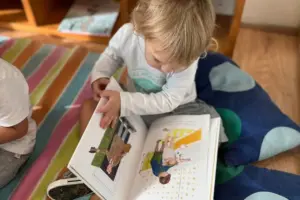
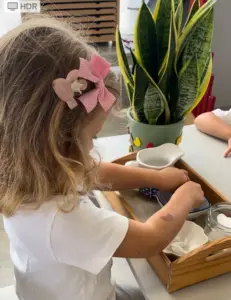
Maria Montessori observed that language is not just a matter of eyes on paper. The young child learns through the body. That’s why preparation for Montessori literacy begins with activities that seem to have nothing to do with letters: sorting objects by sound, recognizing textures with eyes closed, threading, cutting, and buttoning.
Each of these activities strengthens the hand and refines the ear. The three-finger pincer grip that later holds a pencil is built by fitting cylinders in the Nido. Phonetic discrimination is practiced by playing with rhymes and sounds from the environment. This is not anecdotal: it is the real foundation of Montessori literacy.
Families from Algeciras, La Línea, or San Roque who visit our classrooms often ask why we don’t see letter flashcards on the shelves for the youngest children. The answer is simple: the sensorial materials are already working on language indirectly. The child absorbs vocabulary from the bilingual environment (Spanish and English), and their brain organizes itself for the next step.
Book a personalized school visit and discover how we work with language in every classroom.

The Role of Montessori Materials in Literacy
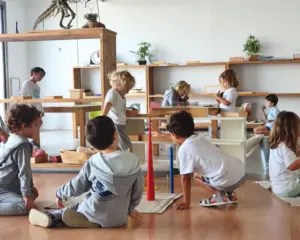
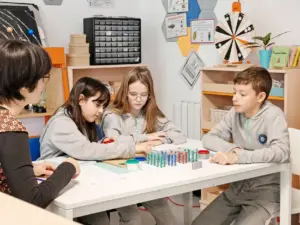
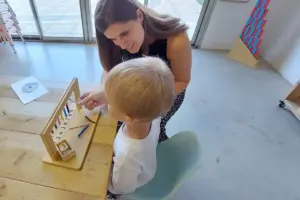
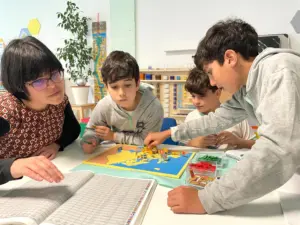
When the child is ready, Montessori materials appear on their shelf. Not all at once. Each has a clear purpose, and the guide presents it in an individual or small group lesson. The most important for Montessori literacy are the following.
Sandpaper Letters
This is the star material. The child traces the shape of each letter with their fingers while the guide pronounces its sound (not its name). This way, sight, touch, and hearing are connected in a single multisensory experience. A three-and-a-half-year-old child can spend ten minutes tracing the “m” and smiling every time they hear that sound. That is the sensitive period for language in action.
The Moveable Alphabet
It allows the child to compose words before knowing how to write with a pencil. The letters are color-coded: red for vowels, blue for consonants. The child chooses the letters they need, places them on the rug, and gradually builds real words. It’s an intermediate step between sound and conventional writing.
The Number Rods and Sound Box
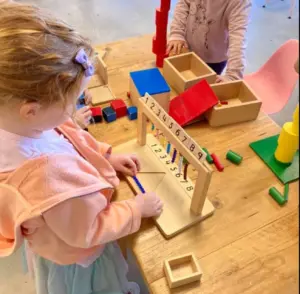
The numbered rods work on visual orientation (left to right, as in Spanish reading). The sound box sorts objects by initial phoneme. Both materials strengthen phonological awareness, the skill that best predicts reading success according to the Association Montessori Internationale (AMI).
Book a personalized school visit and see these materials in action.

Do Children Learn to Read or Write First?
This is one of the most striking differences between Montessori literacy and the traditional method. In conventional school, reading is taught first, then writing. In Montessori, many children write before they read.
Why? Because writing is a motor act: the child reproduces a sound by tracing a shape. Reading is an act of abstract decoding, more complex. When the child composes words with the moveable alphabet, they are “writing” without the demanding fine motor skills of a pencil. When they later discover that the words they’ve formed mean something, they begin to read spontaneously.
At IMS, we have seen four-year-old children compose “cat” with the moveable letters and then read it aloud with genuine surprise. That moment cannot be manufactured with a flashcard. It arises from a process that respects the child’s rhythm.
Not all children follow the same path. Some jump directly to reading. Others need more time with the sensorial materials. The Montessori guide observes and adapts. There is no single calendar or checklist that forces everyone to read by age five.
Creative Writing Before Calligraphy
Many parents are surprised to see that in Montessori, we don’t use calligraphy notebooks or dotted lines for tracing. Writing emerges naturally when the hand is prepared and the child has something to say.
First come scribbles, then individual letters, then invented words. The guide doesn’t correct spelling at this stage: they celebrate that the child is communicating. Conventional spelling comes later, when the child reads fluently and their brain is ready to integrate rules.
In Casa de Niños (3-6 years), it’s common to find “books” made by the children themselves with drawings and words. In Taller (6-12 years), children write long texts, research, and present written projects. Montessori literacy doesn’t end in primary school: it expands.
The Role of the Adult in Montessori Literacy
The adult doesn’t teach in the traditional sense. They prepare the environment, present the materials with clarity, and then step back. They don’t interrupt, don’t correct out loud, don’t compare with other children.
This doesn’t mean the guide is passive. On the contrary: they constantly observe, record progress, and adapt materials to each child. If a child shows interest in letters but their hand isn’t ready, the guide offers more fine motor activities. If a child already composes words but doesn’t read them, the guide presents a new material that bridges the gap.
At home, families can support Montessori literacy in simple ways: read aloud every day, name objects in the environment, play at finding sounds on the street, offer magnetic letters on the fridge without pressure. The key is that the child feels language is something alive and useful, not a school obligation.
If you want to delve deeper, AMI offers guides for families on their official website. You can also consult resources from the Montessori Association of Spain.
Frequently Asked Questions
At what age does Montessori literacy start?
There’s no fixed age, but most children begin to show interest in letters between 3 and 4 years old in Casa de Niños. Sensorial preparation starts much earlier, in the Nido (0-3 years), with auditory discrimination and fine motor activities. The guide observes each child’s sensitive periods and presents the materials at the appropriate moment.
Do Montessori children read later than those in other methods?
Not necessarily. Some Montessori children read at four years old, others at six. What changes is the process: there’s no forcing, no use of fear of failure. AMI research shows that children who learn to read without pressure maintain greater intrinsic motivation throughout their schooling. At IMS, we’ve seen that when the child is ready, progress is fast and deep.
Can I do Montessori literacy activities at home?
Yes, but be careful not to turn it into a chore. Read stories aloud, play rhyming games, offer magnetic or wooden letters, name what you see on a walk. The important thing is that the child feels curiosity, not obligation. If your child attends a Montessori school like IMS, the guide can advise you on which materials to complement at home.
What if my child doesn’t show interest in letters?
This is completely normal up to age 5 or 6. Each child has their own rhythm and interests. In Montessori, we don’t label as “delay” what is simply a different development. The guide continues to offer indirect language materials and observes. If there is a real difficulty, the Rainbow NNEE (special educational needs) team can assess and support. At IMS, we have specialists for every case.
Key Takeaways
Montessori literacy is a long, respectful, and deeply human process. It’s not about your child reading at age four so that you can be at peace. It’s about that when they read, they do so with comprehension, pleasure, and confidence. The sensorial materials, the moveable alphabet, and the freedom to choose make the learning authentic.
If your family is in the Campo de Gibraltar or Costa del Sol area and you want to see how this works in a real classroom, we invite you to visit IMS Sotogrande. Book your visit here or call us at +34 653 04 17 39. We will be delighted to show you how we cultivate childhood, step by step.
Viviane Dumont, Director of Studies at IMS Sotogrande.