Montessori Casa de Niños Near Marbella: How to Choose the Best 3-6 Program
In short
Finding a Montessori Casa de Niños near Marbella involves much more than just choosing the closest school. Between the ages of 3 and 6, your child develops autonomy, language, and concentration at an astonishing pace, and the environment they are in will shape that stage.
Finding a Montessori Casa de Niños near Marbella involves much more than just choosing the closest school. Between the ages of 3 and 6, your child develops autonomy, language, and concentration at an astonishing pace, and the environment they are in will shape that stage. In this article, I share the criteria to review, the materials that should be present, and how an authentic Casa de Niños works so you can make an informed decision. In this article we explore Montessori school near Marbella in depth with practical examples.
- A Montessori Casa de Niños serves children aged 3 to 6 with self-teaching sensorial materials.
- The ideal ratio is no more than 1 guide for every 10-12 children, in mixed-age groups.
- AMI accreditation ensures the program meets the standards of the Association Montessori Internationale.
- Families from Marbella, Estepona, and Puerto Banús choose accredited schools within a short drive via the AP-7.
- What Exactly Is a Montessori Casa de Niños?
- What Makes a Montessori Casa de Niños Different from Traditional Preschool?
- Why Do Families from Marbella Look for a Montessori Casa de Niños Outside the City?
- The Casa de Niños Program at IMS Sotogrande
- Practical Tips for Families Relocating to the Costa del Sol
- Frequently Asked Questions
- Key Takeaways
What Exactly Is a Montessori Casa de Niños?
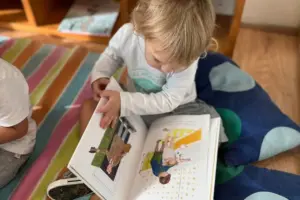
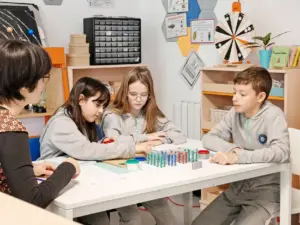
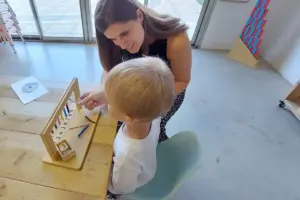
The Casa de Niños is the name Maria Montessori gave to the classroom for children aged 3 to 6. Here, children work with concrete materials for practical life, sensorial, language, and mathematics. Each child chooses their activity from a limited repertoire and works for as long as they need. The guide presents the material in an individual lesson and then observes without interrupting. When it comes to Montessori school near Marbella, it pays to listen to what families and lead guides actually report.
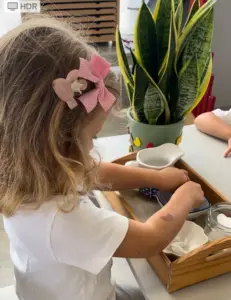
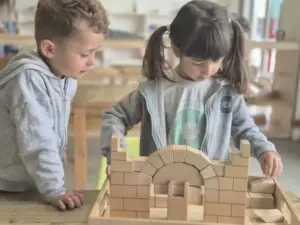
This model differs from conventional preschool because there is no blackboard or mandatory collective explanations. The child builds their learning by manipulating real objects: transferring water, threading beads, sorting by color or size. Free repetition consolidates concentration without rewards or punishments. Daily practice with Montessori school near Marbella reveals nuances no handbook fully captures.
Essential Montessori Materials for Ages 3-6
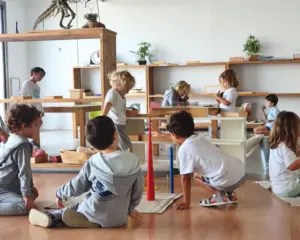
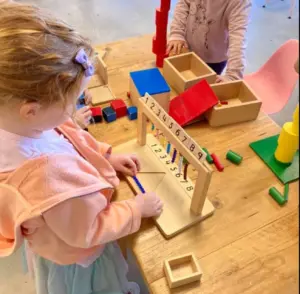
In an authentic Casa de Niños, you will find the pink tower, knobbed cylinders, red and blue number rods, spindle boxes, and the moveable alphabet. Each material isolates a concept (length, thickness, quantity) and has built-in error control: the child corrects themselves without relying on adult validation. If you visit a center and only see generic plastic toys, it is not Montessori. Understanding Montessori school near Marbella from inside the classroom reshapes everyday decisions.
What Makes a Montessori Casa de Niños Different from Traditional Preschool?
In a Montessori Casa de Niños, there are no fixed assembly times or simultaneous directed activities for the whole group. Each child follows their own three-hour uninterrupted work cycle. This contrasts with the daycare or preschool model where activity changes are dictated by the adult’s clock. The difference is especially noticeable in concentration: a 4-year-old can spend 45 minutes threading needles or pouring grains without anyone interrupting them. Concrete data on Montessori school near Marbella is worth reviewing before acting on assumptions.
Another distinctive feature is the mixed-age groups. The older 5-year-olds reinforce their learning by helping the younger ones, who are inspired by what the older children do. This dynamic does not exist in conventional classrooms where everyone was born in the same year.
Ratios and Group Size: What to Ask During a School Visit?
Always ask about the ratio. In an AMI-accredited Casa de Niños, a maximum of 10-12 children per adult guide is recommended, with at least 35 m² of usable space per classroom. If the center tells you there are 20 children with a single teacher and no assistant, the quality of individual observation is diluted. At IMS Sotogrande, for example, the Casa de Niños groups maintain ratios that allow each guide to dedicate real time to each child.
Why Do Families from Marbella Look for a Montessori Casa de Niños Outside the City?
Marbella offers prestigious international schools, but the offer of AMI-accredited Montessori remains limited on the western Costa del Sol. That is why many families from Marbella, Nueva Andalucía, and Puerto Banús extend their search to Sotogrande, where the international Montessori school IMS has been supporting local and international families for over two decades.
The journey from Marbella to Sotogrande takes about 35-40 minutes via the AP-7, a common commute for families who prioritize the quality of the prepared environment over proximity. Some families combine the trip with the lunch service and extended hours, which run until 17:00. If you are relocating to the area with young children, a bilingual Spanish-English Casa de Niños facilitates the linguistic transition without pressure.
Criteria for Comparing Montessori 3-6 Programs
Before choosing, use this checklist: Does the guide have AMI certification? Are the materials authentic (wood, glass, fabric) or plastic imitations? Does the schedule include a three-hour work cycle without interruptions? Is the school accredited by the Association Montessori Internationale or an equivalent body? Do they offer individual development reports and periodic family-teacher conferences? At IMS Sotogrande, weekly reports are sent every Friday via the digital platform, and conferences with the guide are held at least three times per academic year.
The Casa de Niños Program at IMS Sotogrande
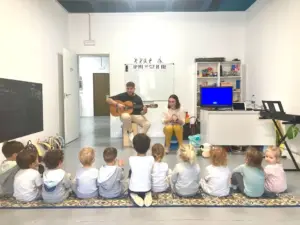
At IMS Sotogrande, the Casa de Niños serves children aged 3 to 6 in a bilingual Spanish-English environment. The program includes practical life, sensorial, language, mathematics, culture, art, music, yoga, and mindfulness. The Montessori materials are certified, and the team of guides has AMI training. From age 4, French is introduced as a third language naturally.
Families can choose between two schedule options: Roots (9:00-14:00) and Wings (9:00-15:00), with the possibility of extension until 16:00 or 17:00 depending on family needs. The lunch service offers a balanced diet prepared on-site. If you want to see the updated fees for the 2026-2027 academic year, you can find them on the admissions page.
The campus is located in Sotomarket, above Mercadona, in Sotogrande (San Roque, Cádiz). Families from Marbella, Estepona, Casares, La Línea de la Concepción, and Gibraltar choose us every year because they value an authentic Montessori program, accredited by AMI and NEASC, with genuine bilingual immersion.
What a Typical Morning in Casa de Niños Looks Like
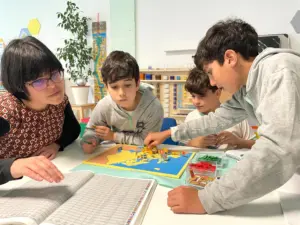
At 9:00, the children enter, change their shoes, and choose their first activity. For the next three hours, each child works at their own pace: one might be pouring water from a jug to another, another sorting triangles by size, a third writing their name with the moveable alphabet. The guide observes, presents new materials when the child is ready, and ensures no one interrupts another’s work. Around 12:00, they gather for the community lunch, where children serve and clear their own plates.
Practical Tips for Families Relocating to the Costa del Sol
If you have just arrived in Marbella or the surrounding area with children aged 3 to 6, choose a bilingual Montessori Casa de Niños to facilitate linguistic adaptation without stress. Always ask to see the classroom in action during a guided tour: a center that only shows photos on its website may be hiding high ratios or inadequate materials. Research whether the school has AMI accreditation, which is the most demanding seal worldwide.
Do not be swayed by geographic proximity alone. A school 10 minutes away that does not respect work cycles or have authentic materials is not Montessori, no matter what the sign says. In contrast, a 35-minute commute to an accredited program with real ratios and trained guides makes a difference you will see in your child’s concentration, autonomy, and joy.
Frequently Asked Questions
What is the difference between a Montessori Casa de Niños and a daycare?
A Montessori Casa de Niños is an educational environment for children aged 3 to 6 where each child chooses their activity from a careful repertoire and works with self-teaching sensorial materials. A daycare, on the other hand, focuses on care and socialization without a structured pedagogical curriculum. In the Casa de Niños, there is an AMI-certified guide, authentic Montessori materials, and a three-hour uninterrupted work cycle.
What accreditation should I look for in a Montessori school for ages 3-6?
The most rigorous accreditation is from the Association Montessori Internationale (AMI), founded by Maria Montessori herself. It guarantees that guides have specific training, that materials are authentic, and that the environment respects the original pedagogical principles. In Spain, you can also look for centers recognized by the Junta de Andalucía or with international accreditation like NEASC.
Is it realistic to take a 3-year-old from Marbella to a school in Sotogrande?
Many families from Marbella, Puerto Banús, and Nueva Andalucía do it every day. The journey via the AP-7 takes about 35-40 minutes and can be combined with extended hours and lunch service. Families who prioritize an AMI-accredited Montessori program with genuine bilingualism consider the commute worthwhile for the quality of the prepared environment.
When does the admission process for the Casa de Niños at IMS Sotogrande start?
Applications can be submitted at any time of year. However, the admission process for the following academic year begins in March, and places are allocated with priority given to currently enrolled students. We recommend booking a personalized visit as soon as possible to see the classroom in action.
Key Takeaways
A Montessori Casa de Niños near Marbella or the surrounding area should offer authentic materials, real ratios, AMI-certified guides, and a three-hour uninterrupted work cycle. If the center you visit does not meet these criteria, it is not Montessori, even if it advertises itself as such.
If your family is considering options, I invite you to book a visit to IMS Sotogrande to see our Casa de Niños in action. There, you can observe how the children work, speak with the guides, and get answers to your questions about the bilingual program, schedules, and the admission process.