Montessori at Home: A Practical Guide for Families with 0-6 Year-Olds

Many families ask how to apply Montessori at home without spending a fortune or becoming professional guides. The good news is that the Montessori method in the home is based on simple principles: respect the child, prepare the environment, and encourage independence from day one. At IMS Sotogrande, in the Campo de Gibraltar, we see every day how these pillars transform childhood inside the classroom. And the best part is that you can bring them into your living room, kitchen, or bedroom with small changes that make a big difference.
- Key Takeaways
- What Does ‘Montessori at Home’ Really Mean?
- The Prepared Environment: Adapt Your Home for Independence
- Practical Life Activities: The Magic of Everyday Moments
- Montessori Materials You Can Make at Home
- Common Mistakes When Trying Montessori at Home
- Frequently Asked Questions
- Key Conclusions
Key Takeaways
- The prepared environment is the foundation: low shelves, reachable objects, and visual order.
- Include practical life activities such as cooking, getting dressed, or watering plants with supervision.
- You don’t need to buy expensive materials, many can be made with everyday items.
- Observe your child without interrupting. Learning happens when they choose and concentrate.

What Does ‘Montessori at Home’ Really Mean?
When people talk about applying Montessori at home, many imagine perfect wooden shelves and spotless trays. But the essence goes much deeper: it’s about creating an environment where the child feels safe, capable, and in control of their movements. Maria Montessori called this the “prepared environment”, a space designed from a child’s perspective, not from adult convenience. Instead of filling the room with noisy toys, choose real, adapted objects: small glasses, a pitcher they can hold, or a low shoe rack. This approach respects their sensitive periods and fosters concentration, the foundation of all future learning.

The Prepared Environment: Adapt Your Home for Independence
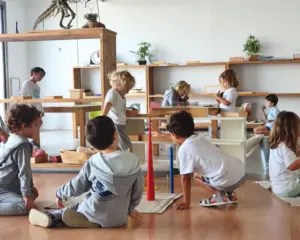
The first step to bringing Montessori into your home is reorganizing spaces. You don’t need to redecorate the whole house: pick a corner of the living room, a spot in the kitchen, or the child’s bedroom. Place low shelves with few materials, keeping them tidy and rotating them according to your child’s interests. A shatterproof mirror at floor level, a floor bed instead of a crib, and a low clothes rail are classic examples of Montessori at home . The key is that the child can access things without help and return each item to its place. In this way, they build inner order, coordination, and self-esteem.
If you live in the Campo de Gibraltar, you have a nearby ally. At IMS Sotogrande, we support families with workshops and coaching on how to bring the Montessori environment into their homes. Book a personal visit to the school and we’ll show you live how we prepare each space so children can thrive.

Practical Life Activities: The Magic of Everyday Moments
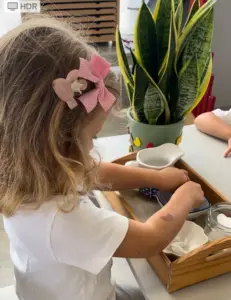
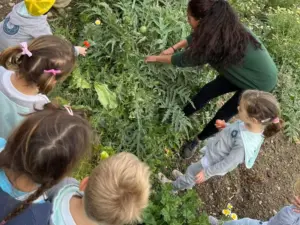
Between 18 months and 6 years, practical life activities are the heart of the Montessori method at home. Sweeping crumbs with a small broom, peeling a tangerine, or watering the plants aren’t just household chores, they are opportunities for motor, cognitive, and emotional development. When your child washes a plate (a plastic one, at first), they repeat movements, coordinate hand and eye, and feel they are contributing to the family. This builds willpower and reduces tantrums, because they feel competent.
Start with one activity a day: put a small pitcher of water and a glass on a low table so they can serve themselves, or a basket of fruit they can wash. Watch without correcting, even if their shirt gets wet. Mistakes are part of the process. Over time you’ll see them gain precision and inner calm.
Montessori Materials You Can Make at Home
Another common worry when starting Montessori at home is whether you need to buy all the classroom materials. The answer is no. Many can be made with recycled objects: a tray of rice for pouring, colored cards made from cardboard, or a sound box with bottles filled with legumes. What matters is that the material isolates one difficulty, just one concept: color, size, texture, and allows self-correction. That way the child learns without an adult telling them “right” or “wrong.”
Montessori Ideas by Age for Home
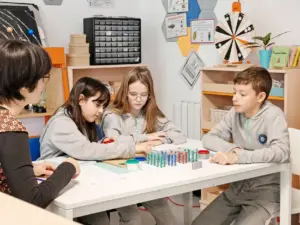
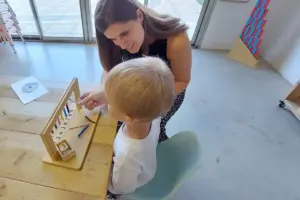
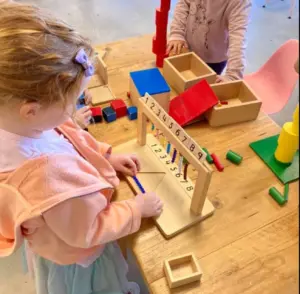
For babies 8-12 months, a treasure basket with natural objects (pinecone, wooden spoon, ball of wool) stimulates the senses. At 2-3 years old, a homemade stacking rings tower or threading macaroni onto a string refines fine motor skills. In the Children’s House (ages 3-6), liquid pouring trays, sorting buttons, or sandpaper letters made with cardboard and sand are always a hit. At any stage, the principle is the same: less is more. Four rotating activities are better than twenty piled-up toys.
Common Mistakes When Trying Montessori at Home
One typical stumbling block is confusing freedom with the absence of limits. Montessori in the family environment does not mean letting children do whatever they want without consequences. Freedom goes hand in hand with respect for the environment and for others. If they throw the glass, we clean it up together. If they are angry, we put words to the emotion. Another mistake is overloading children with directed activities. Sometimes the most Montessori thing to do is to let them be bored, so creativity emerges from within.
It’s also easy to compare yourself to professional classrooms. Nobody expects your home to be a Montessori school like IMS Sotogrande, but rather a safe, loving space where the child knows their initiative is welcome. If you ever feel lost, remember that our center offers regular family guidance with AMI guides.
Frequently Asked Questions
At what age can you start applying Montessori at home?
You can start Montessori at home from birth. With a baby, a firm floor for free movement, a mirror, and handmade mobiles are enough. From 4-6 months, a treasure basket. The essential thing is to respect natural development without forcing milestones.
Do you need to buy special Montessori furniture?
It’s not essential. The principle is to adapt what you already have: put a mattress on the floor, use a board as a low shelf, or a stool in the kitchen. Creativity makes up for budget. Many families in the Campo de Gibraltar tell us they started with reused fruit boxes.
How do I know if I’m doing it right?
The most reliable indicator is your child’s attitude: if they are focused, happy, and sleeping peacefully, you’re on the right track. Don’t chase perfection. At IMS we often say the best material is a present mother or father who observes and trusts. If you have doubts, come to our open days. We announce them on Instagram @imssotogrande.
Can you combine Montessori with other educational approaches at home?
Absolutely. The Montessori foundation, respect, independence, and a prepared environment, is compatible with approaches like Pikler, Waldorf, or positive discipline. It’s not a label, but a life philosophy. What matters is that the child perceives consistency and unconditional love.
Key Conclusions
Bringing Montessori home is an adventure within any family’s reach, without needing an extraordinary budget or formal education. It just requires looking at your child with fresh eyes, offering a simple environment and real tools, and trusting their natural urge to learn. Results appear quickly: more independence, fewer conflicts, and a fuller relationship.
If you want to keep exploring and experience the Montessori environment firsthand, we invite you to visit IMS Sotogrande. Our AMI guides will accompany you on the journey, and you’ll discover why dozens of families in the Campo de Gibraltar choose us every year. Take the first step and come see it. We’re just one click away.