Mario Montessori: Maria’s Son Who Carried the Montessori Legacy Forward

Maria Montessori had a son, and his name was mario montessori. He was born in Chiaravalle, Italy in 1898 as Mario Mazzoni, the result of Maria’s relationship with Giuseppe Montesano, her colleague in the medical field. To protect her professional career and her reputation, Maria could not publicly acknowledge him: Mario grew up with a trusted family in the countryside of Ancona while his mother worked in Rome. He was the one who, in time, gave voice to Maria’s thinking and upheld the Montessori method around the world.
- In Summary
- Did Maria Montessori Have a Son? The Answer in Two Lines
- Mario Montessori, the Collaborator Who Shaped the Method
- Maria Montessori's Contributions to Education
- A Timeline to Place Mario Montessori's Life
- A Common Mistake When Studying His Life and How to Fix It
- What It Means for Your Child Today
- Frequently Asked Questions
In Summary
- Mario Montessori (1898-1996) was Maria Montessori’s only son and her closest collaborator for more than forty years.
- After an emotional reunion around 1915, he worked alongside her as an interpreter, editor and head of guide training.
- He translated and coordinated his mother’s work, published his own texts and chaired the Association Montessori Internationale (AMI).
- His direct legacy is the Montessori training foundations that AMI-accredited schools still follow today.

Did Maria Montessori Have a Son? The Answer in Two Lines
Yes. Maria Montessori had a son, Mario, born in 1898 and died in 1996. During his childhood she could not give him her surname or live with him day to day, something that deeply marked her and which she described as an enormous personal sacrifice.
A Separation Forced by Circumstances
Maria Montessori was one of the few female doctors in her country in the late nineteenth century. Acknowledging a son outside of marriage would have meant the end of her career and her social standing. That is why Mario was entrusted to a farming family in the Ancona area, and Maria visited him when she could.
In 1915, already internationally renowned, she was able to reunite with him. Mario was seventeen years old. From that moment on, he became her inseparable companion on trips, courses and conferences, and the interpreter who translated her lectures from Italian into English.
Example: Imagine That Connection After Years Apart
Imagine your child turns seventeen and, suddenly, you go from seeing each other now and then to sharing every working week together. The relationship needs time, patience and a shared purpose. In their case, that purpose was defending an idea together: that the child deserves respect. When you accompany your teenage son through a stage of change, remember that bonds are repaired with steady presence, not with speeches.

Mario Montessori, the Collaborator Who Shaped the Method
Mario Montessori was not a decorative figure or a mere heir to the family name. He was the man who made it possible for his mother’s ideas to reach schools across half the world during the second half of the twentieth century.
Translator, Editor and Lecturer
Maria would dictate in Italian and Mario would render every concept into English, with a care that went beyond the exact word: he was searching for the precise idea. He also prepared editions of his mother’s writings and coordinated their international distribution. The Association Montessori International, founded in 1929, is the organization that safeguards this legacy.
In Charge of Guide Training
After Maria’s death in 1952, Mario took over the direction of AMI and the responsibility of maintaining the rigor of Montessori training. He insisted that being a guide is not about using attractive materials, but about understanding the scientific observation of the child. Today, AMI-accredited schools commit to following that standard, as we do at IMS Sotogrande.

Maria Montessori’s Contributions to Education
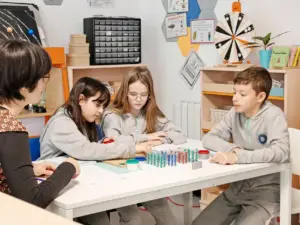
Maria Montessori’s contributions to education are the scientific observation of the child, self-learning materials, mixed-age grouping and freedom within clear limits. These four ideas remain in classrooms for ages 0 to 12 and are the core of what you will see on a visit to a Montessori school today.
Observe Before You Teach
Maria Montessori inverted the traditional order: first you observe the child, then you prepare the environment, and only at the end do you intervene. In a Children’s House classroom, the guide records for weeks which material attracts each three-year-old before suggesting the next step. This shift in mindset is what distinguishes a Montessori educator from a teacher who explains the syllabus.
Materials That Correct Themselves
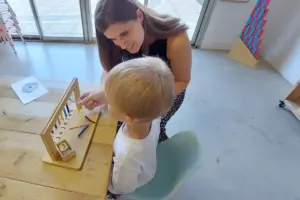
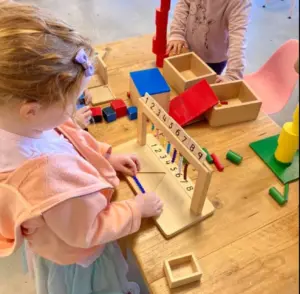
Every Montessori material contains a built-in control of error: the pink tower can only be built one way, and if something does not fit, the child sees it without anyone telling them. That way, error stops being a failure and becomes information. In the Elementary classroom (ages 6-12), that autonomy expands through long investigations the student plans themselves.
Mixed-Age Groups
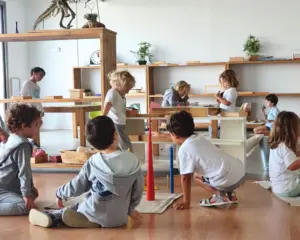
Three-, four- and five-year-olds share a classroom for a three-year cycle. Older children reinforce what they know by explaining, and younger ones learn by watching. It is a design that today’s educational neuroscience supports: peer learning consolidates memory better than repetition alone.
A Timeline to Place Mario Montessori’s Life
When you read his biography, it helps to have the dates in view. Here is a summary timeline that rarely appears in articles about this figure and helps you place each stage.
- 1898 : Mario is born in Chiaravalle, Italy.
- 1915 : Definitive reunion with his mother after years apart.
- 1920s to 1950s : Accompanies Maria as interpreter and editor at courses and conferences.
- 1952 : Maria Montessori passes away and Mario takes over the direction of AMI.
- 1996 : Mario Montessori passes away, after decades defending the rigor of training.
A Common Mistake When Studying His Life and How to Fix It
Common mistake: treating Mario as a mere administrative manager who inherited the name. Solution: read him as a conceptual bridge between two eras. Without his work in translation and training, much of Maria’s thinking would have been lost in partial translations.
If you are looking for reliable documentation, start with the Association Montessori Internationale, which preserves and publishes the original writings. To understand child development within a broad pedagogical framework, UNESCO sets out principles compatible with this respectful approach.
What It Means for Your Child Today
The fact that Maria Montessori’s son grew up far from his mother for years is not a sentimental anecdote. It is the origin of an educational conviction: the child needs stable bonds, time and a prepared environment in order to develop.
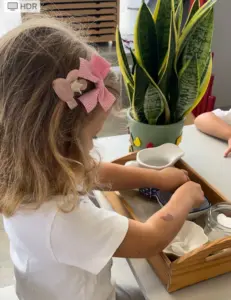
Imagine your child is three years old and, upon entering the classroom, chooses a practical life material, repeats it seven times and puts it back. Nobody asked them to do it. That free concentration is exactly what Maria Montessori described, and what Mario defended throughout his professional life.
At our Nido and Children’s House at IMS Sotogrande, we support this process with Spanish-English immersion bilingualism and French from the earliest years. You can see how the environment is organised by visiting us.
Frequently Asked Questions
Did Maria Montessori Have Children?
She had one son, Mario Montessori, born in 1898 and died in 1996. Due to social pressure, she could not acknowledge him or live with him day to day during his early years. They were fully reunited around 1915 and worked together until her death.
Who Carried On the Montessori Method After Maria’s Death?
Mario Montessori, her son and collaborator, took over the direction of the Association Montessori Internationale after Maria’s death in 1952. He preserved the rigor of guide training and coordinated the international distribution of his mother’s writings until his own death in 1996.
What Did Maria Montessori Contribute to Education?
She introduced the scientific observation of the child as the starting point, self-learning materials with a built-in control of error, classrooms grouped in three-year age cycles, and freedom within clear limits. These four ideas remain the foundation of Montessori schools today, including those accredited by AMI.
Why Is It Important to Know Mario Montessori?
Knowing Mario Montessori helps you understand that the method is not a collection of wooden materials, but a pedagogy with historical roots and scientific rigor. He translated, edited and defended Maria’s ideas so that they would still reach classrooms today with their original meaning intact.