
International School Sotogrande: A Magical Bedtime Routine for Children

When the day winds down and energy dips, many parents face a silent battle: convincing a child it’s time to sleep. Bedtime stories can be your best ally in transforming that tense moment into one of connection and calm, if used with intention. In this article we explore international school Sotogrande in depth with practical examples.
At IMS, we support families in Sotogrande, La Línea, Algeciras, and across the Costa del Sol in this process. The nighttime routine is a cornerstone of child well-being, and reading before sleep holds a special place in Montessori pedagogy. When it comes to international school Sotogrande, it pays to listen to what families and lead guides actually report.
- Key Points
- Why Bedtime Stories Work Better Than Any Other Technique
- How to Structure the Nighttime Routine Without It Becoming a Negotiation
- Choosing the Right Type of Story by Age
- Common Mistakes That Ruin Storytime
- How Bedtime Stories Strengthen Family Bonds
- Frequently Asked Questions
- Key Takeaways
Key Points
- Bedtime stories lower cortisol and prepare the brain for deep rest.
- The ideal nighttime routine begins 30-45 minutes before lights-out.
- Story choice matters: not every book suits every age.
- Consistency is more important than perfection.
- At IMS, we integrate evening reading as part of health education.

Why Bedtime Stories Work Better Than Any Other Technique
Nighttime reading activates brain circuits that ease the transition to sleep. According to the American Academy of Pediatrics, children with a bedtime reading routine sleep better and longer. The rhythm of your voice, familiar word repetition, and close physical contact create a sense of security that reduces anxiety. Daily practice with international school Sotogrande reveals nuances no handbook fully captures.
In the Montessori approach, we especially value this moment because it respects the child’s natural rhythm. It’s not about the adult imposing a story, but about offering a space where the child feels accompanied without pressure. Understanding international school Sotogrande from inside the classroom reshapes everyday decisions.

How to Structure the Nighttime Routine Without It Becoming a Negotiation
The key is a predictable sequence. Children need to know what comes next to relax. An effective routine includes: Concrete data on international school Sotogrande is worth reviewing before acting on assumptions.
- Light dinner at least one hour before bed.
- Bath or wash with warm water (the temperature change helps wind down).
- Pajamas and bed preparation with the child’s participation.
- Choose a story from two or three options (offer choice, not an endless catalog).
- Dim light and goodnight with short, repetitive phrases.
The entire process should take no more than 30-40 minutes. If it drags, dinner or bath time is likely starting too late.
Book a personalized school visit to see how we integrate healthy routines into our program.

Choosing the Right Type of Story by Age
Ages 0-3: Repetition and Voice
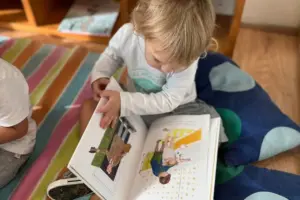
At this stage, content matters less than tone. Babies and toddlers are soothed by a familiar voice, repetitive cadence, and large illustrations with soft colors. Books with textures, flaps, and onomatopoeia work well. In our Montessori Nido, we see the youngest children request the same book for weeks, and that’s completely normal and beneficial.
Ages 3-6: Stories with Structure
Children in Children’s House (Casa de Niños) already follow a narrative. Look for stories with a clear beginning, middle, and end. Protagonists facing everyday situations (fear of the dark, first day of school, sibling jealousy) help process emotions. At IMS, we include this stage as part of the emotional intelligence work we develop in the classroom.
Ages 6-12: Adventure and Autonomy
In Taller (Elementary), children can start reading alone before bed. Support the transition: first read together for a few minutes, then let them read alone with the door open. Short-chapter series create anticipation and motivation. Independent reading before bed is one of the best ways to foster a reading habit without force.
Common Mistakes That Ruin Storytime
Using the story as punishment or reward. If you take away the story when a child misbehaves, it loses its value as a calming tool and becomes a bargaining chip.
Choosing overly long or stimulating stories. Adventures with lots of action, terrifying villains, or complex plots energize instead of relax. Save those books for daytime.
Reading with your phone nearby. Blue light interferes with the child’s (and adult’s) melatonin. Storytime is a moment of total presence: no screens, no interruptions.
Skipping the story when you’re in a hurry. A short 5-minute story is better than none. Consistency matters more than duration.
How Bedtime Stories Strengthen Family Bonds
The evening reading moment is one of the few times during the day when adult and child are in close physical contact, without an agenda, screens, or pending tasks. This kind of secure interaction strengthens attachment, according to multiple developmental psychology studies.
For international families living in the Sotogrande area, bedtime can also be a space to keep the mother tongue alive. Reading in Spanish one day and English the next, or alternating by parent, reinforces the natural bilingualism we cultivate at IMS.
Frequently Asked Questions
What time should the bedtime story routine start?
The ideal nighttime routine begins 30-45 minutes before you want the child to be asleep. For a 3-6 year-old who falls asleep at 8:30 PM, the routine should start around 7:45-8:00 PM. Consistency of schedule is more important than the exact time: keep the same framework every day, including weekends.
What if my child always asks for the same story?
Repeating the same story is completely normal and beneficial, especially between ages 2 and 5. Repetition builds security, improves vocabulary comprehension, and lets the child anticipate what’s coming, reducing anxiety. Don’t see it as a problem, it’s a learning tool. If monotony exhausts you, suggest a second book as an option, but never force it.
Do audiobooks count as bedtime stories?
Audiobooks can complement the routine, but they don’t replace physical contact and the adult’s presence. If you use them, choose stories with a calm voice and no jarring sound effects. Even better: record yourself telling a story. Your voice is the one your child needs to hear to relax. At IMS, we recommend audiobooks as a resource for travel or exceptional situations, not as a daily habit.
How many stories should I read each night?
One to three stories is the typical range by age. For children aged 0-3, a short story with repetition is enough. From 3 to 6, two stories work well if the first is more dynamic and the second calmer. For children over 6, a chapter a night creates healthy continuity and anticipation. The golden rule: before starting, agree on how many there will be, and stick to it.
Key Takeaways
Bedtime stories are much more than a tradition: they’re a powerful tool for regulating a child’s nervous system, strengthening family bonds, and creating reading habits that last a lifetime. The key lies in consistency, age-appropriate choices, and the adult’s full presence.
If you’d like to learn how we integrate healthy routines and health education into our Montessori program, book a personalized school visit. We’re in Sotogrande, just minutes from La Línea, Algeciras, and all of the Costa del Sol.