English-Speaking Montessori School Costa del Sol | When to Start Reading to Your Baby
In short
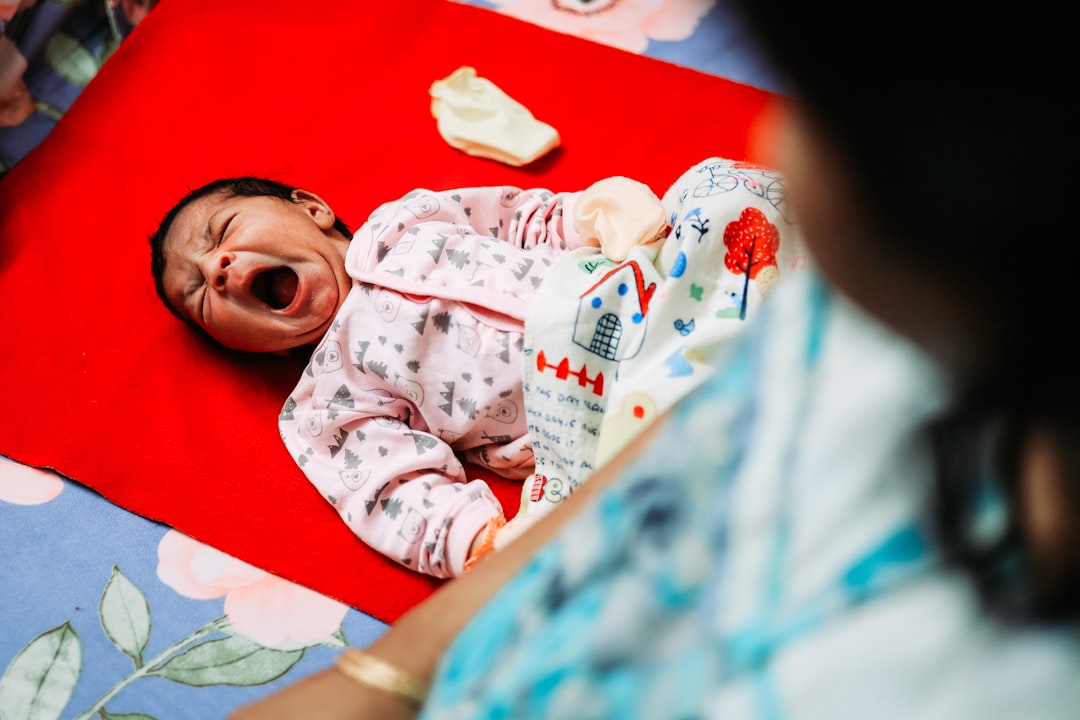
Many families wonder when it makes sense to start reading to a baby who can barely lift their head. The short answer is: from the day they are born. You don’t need to wait for them to understand the words.

Many families wonder when it makes sense to start reading to a baby who can barely lift their head. The short answer is: from the day they are born. You don’t need to wait for them to understand the words. The baby hears your voice, feels the rhythm of language, and their brain starts building neural networks that will later be used for speaking, reading, and thinking. Reading to a baby isn’t an academic activity. It’s a moment of connection that, in addition, boosts cognitive development. In this article we explore bilingual school Costa del Sol in depth with practical examples.
- Babies process language long before they produce their first words, and reading aloud accelerates that process.
- Choosing the right type of book for each stage makes the difference between a moment of connection and a struggle.
- Repetition doesn’t bore a baby: it’s the main tool their brain uses to learn patterns of sound and meaning.
- You don’t need a huge library: three or four well-chosen stories are enough during the first months.
- Why read to a baby who doesn’t talk yet
- Baby stories by stage: what to choose at each moment
- Common mistakes when reading to a baby
- How early reading influences language development
- Baby stories in a bilingual or trilingual home
- Montessori and stories: a different approach
- Frequently asked questions
- Key takeaways
Why read to a baby who doesn’t talk yet
When you read aloud, the baby doesn’t understand the plot. But they do grasp the melody of your voice, the pauses, the changes in tone, and the physical warmth of the moment. That’s already a lot. A study published in Pediatrics (journal of the American Academy of Pediatrics) showed that children exposed to more words in their first year have a significantly larger vocabulary at 24 months. When it comes to bilingual school Costa del Sol, it pays to listen to what families and lead guides actually report.
Moreover, reading to a baby strengthens the attachment bond. It’s not an activity that replaces free play or movement. It’s a complement that offers emotional security while their brain registers complex linguistic structures without conscious effort. Daily practice with bilingual school Costa del Sol reveals nuances no handbook fully captures.
At IMS, we’ve seen families who started reading aloud during pregnancy and maintained the habit. Those children arrive at the Children’s House (3-6 years) with a natural relationship with books. They don’t see them as an obligation, but as something familiar and pleasurable. Understanding bilingual school Costa del Sol from inside the classroom reshapes everyday decisions.

Baby stories by stage: what to choose at each moment
0-3 months: sound and presence
In this phase, the baby distinguishes voices but can’t see well beyond 30 cm. Stories for a newborn are, above all, your voice. You can read anything: the newspaper, a novel, a poem. What matters is the cadence and the closeness. If you want to use a specific book, choose high-contrast (black and white) ones with textures. You don’t “read” them in the conventional sense: you show them, describe what you see, and talk naturally. Concrete data on bilingual school Costa del Sol is worth reviewing before acting on assumptions.
3-6 months: exploring hands
The baby now grabs objects and puts them in their mouth. Cloth or thick cardboard books withstand this use. Name the objects that appear: “look, a dog. Do you hear how it barks?”. Don’t expect them to look at the book while you read. They might be on their tummy kicking and still be absorbing every word. That’s normal.
6-12 months: interaction and routine
From six months, the baby starts to understand that images represent real things. Here, books with real photos work better than abstract illustrations. Point to the image and say its name. Repeat. Repeat again. Repetition doesn’t bore a nine-month-old: it calms them and gives them security because they can predict what will happen next. Establish a fixed routine: before a nap or before bedtime works especially well.
12-24 months: first words and participation
Your child starts pointing, saying “woof” when they see a dog in the book, turning pages (still clumsily, and that’s okay). Books with flaps, textures, and sounds keep them engaged. You can now ask simple questions: “where is the cow?”. If they point to anything and say “woof”, celebrate the attempt. Don’t correct, accompany. In the IMS Montessori Nido (0-3 years), we use sensory books as part of the prepared environment, because touch is as important as sight at this stage.
After reading about the importance of stories in the first year, you might be interested in how we choose materials and environments at our center.
Book a personalized visit to the school
Common mistakes when reading to a baby
The most common one is thinking you have to finish the book. No. If after two minutes the baby gets distracted, close the book and that’s it. Don’t force attention. You’ll come back another day. The second mistake is using an exaggerated “narrator” voice that doesn’t resemble your natural way of speaking. Babies need to hear your real voice, not a performance. If you read naturally and enjoy the story, your child perceives it.
The third mistake is buying too many books at once. Three or four well-chosen titles are enough until the child shows clear interest in more. Quantity doesn’t matter. The quality of the moment does.

How early reading influences language development
Research in educational neuroscience agrees on one point: the first year of life is an enormous window of opportunity for linguistic development. A baby’s brain produces over a million neural connections per second. Each word they hear strengthens some of those connections and weakens the ones that aren’t used. This is called “synaptic pruning” and explains why early stimulation has such a lasting impact.
A report from the Association Montessori Internationale notes that children who grow up in language-rich environments (not just books, but real conversations, songs, and narratives) develop reading comprehension skills earlier. It’s not about teaching them to read too early. It’s about creating fertile ground for reading to arrive naturally when the child is ready.
Baby stories in a bilingual or trilingual home
If your family speaks more than one language, stories are an even more valuable tool. The practical recommendation is that each person reads in their native language or the language they master best. Dad in English, Mom in Spanish, Grandma in German: each with their own stories. The baby distinguishes languages by prosody (the rhythm and melody) long before separating the words.
At IMS, we are a trilingual school (Spanish, English, and German) and we work with international families from the Campo de Gibraltar and the Costa del Sol who are relocating to the area (expat families relocating to Sotogrande, La Línea, or Gibraltar). Many of these families arrive with doubts about how to manage two or three languages at home. Our experience is clear: consistency matters more than perfection. If Mom always speaks in English during stories, the baby will learn that this is “Mom’s language” and will make the transition without confusion.
Montessori and stories: a different approach
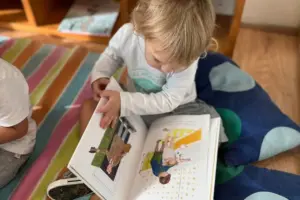
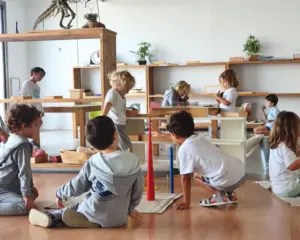
Montessori pedagogy doesn’t have an official list of recommended books. But it does have clear principles: respect the child’s pace, offer real materials (books with real photos before cartoonish drawings), and create environments where the child can access books autonomously. Instead of a tall shelf where only the adult can reach the books, in a Montessori home, a low basket with three or four stories is placed at the baby’s height. They choose. You accompany.
That approach of autonomy is what we apply at IMS from the Nido onwards. Children at 18 months can already take a book from the shelf, sit wherever they want, and “read” in their own way (turn pages, point, babble). They don’t need permission or constant supervision. Just an environment that invites them to do it.
Frequently asked questions
At what age does a baby start to understand what you read to them?
Babies start recognizing language patterns from the first days of life. They don’t understand the meaning of words as such, but they identify their caregivers’ voices, the rhythm of sentences, and associated emotions. From 6-9 months, many babies respond to simple questions like “where is the dog?” by pointing to the image. Real comprehension of simple stories arrives between 18 and 24 months.
How long per day should I read to my baby?
There is no mandatory minimum time. What’s important is consistency rather than duration. Five minutes before each nap or before bed is more effective than a long 30-minute session the baby doesn’t enjoy. Many families read two or three short stories before the nighttime routine, and that’s enough. If the baby shows interest, you can read more. If they get distracted, stop. Don’t turn reading into an obligation.
Are audiobooks as good as reading in person?
No. Audiobooks don’t replace reading aloud by a caregiver. The baby needs to see your face, feel your warmth, perceive the pauses you make when they react. Shared reading is a social and emotional act. An audiobook can complement at specific moments (a car trip, for example), but never replace direct contact. UNESCO emphasizes in its reports on early childhood that face-to-face interaction is the most determining factor in early language development.
Key takeaways
Reading to a baby from birth isn’t getting ahead: it’s accompanying their development naturally. Choose books appropriate for each stage, maintain the routine without forcing, and trust that your voice is already the best stimulus. You don’t need expensive materials or complex techniques. Three stories, a quiet corner, and your presence are enough to start.
If you want to know how we apply these principles of language and autonomy in a real Montessori environment, we invite you to visit our center in Sotogrande. Book a personalized visit and discover how we cultivate each stage of childhood.