Easy Sensory Play Ideas for Toddlers (Ages 1-3) at Home
In short
If you have a little one at home who explores everything with their hands, wants to touch every surface, and is fascinated by water or sand, you are witnessing a unique window of development. Sensory play for toddlers is the most natural and powerful tool to nurture that innate curiosity that defines early childhood.

If you have a little one at home who explores everything with their hands, wants to touch every surface, and is fascinated by water or sand, you are witnessing a unique window of development. Sensory play for toddlers is the most natural and powerful tool to nurture that innate curiosity that defines early childhood. In this article we explore sensory play ideas for toddlers in depth with practical examples.
In Montessori pedagogy, sensory learning is central. Young children don’t learn the way we do: they learn through their senses. Touch, smell, hearing, sight, and taste are their main pathways to understanding the world. When we offer varied materials and different textures, we’re not just entertaining them: we’re building the foundations for their intelligence, language, and independence. When it comes to sensory play ideas for toddlers, it pays to listen to what families and lead guides actually report.
- Sensory play stimulates key neural connections during the first three years of life.
- You don’t need expensive toys: most materials are already in your kitchen or cupboards.
- A child’s voluntary repetition indicates deep concentration, not boredom.
- These activities prepare children for writing, mathematics, and problem-solving.
Why sensory play makes a difference in the early years
Between 12 and 36 months, a child’s brain forms over a million neural connections per second. This fact, backed by developmental neuroscience, explains why sensory stimulation has such a profound impact at this stage. Every time your child plunges their fingers into flour, mixes water with paint, or listens to the sound of different materials, they are organizing their perception of the world. Daily practice with sensory play ideas for toddlers reveals nuances no handbook fully captures.
Maria Montessori observed this in her classrooms over a century ago. She developed specific materials like texture boards , sound cylinders, or smelling bottles precisely because she understood that children build their intelligence through direct sensory experience. This isn’t just play: it’s the foundation for all future learning. Understanding sensory play ideas for toddlers from inside the classroom reshapes everyday decisions.
Book a personalized school tour
Sensory play ideas sorted by material type
Water and liquid play activities
Water is the most versatile and economical sensory stimulus available. For toddlers aged 1-3, try these activities: fill a tray with warm water and add a few drops of food coloring. Give them small containers, spoons, and funnels. Watch how they concentrate on pouring, mixing, and observing how the color changes. Concrete data on sensory play ideas for toddlers is worth reviewing before acting on assumptions.
Another option: freeze small toys inside blocks of ice. Give them lukewarm water with a dropper or a small spoon to “release” the objects. This activity builds fine motor skills, patience, and the concept of cause and effect. If it’s warm outside, take it to the balcony or garden and turn it into an outdoor activity.
Flour, rice, and legume sensory bins
Dry materials offer tactile experiences completely different from liquids. Fill a deep tray with uncooked rice and hide small figures or large beads inside. The child can search with their hands, use spoons, or sift with colanders. This sensory “treasure hunt” develops tactile discrimination and concentration.
Cornflour mixed with a bit of water creates a fascinating texture: it behaves like a solid when squeezed and a liquid when released. Scientists call it a “non-Newtonian fluid,” but your child will simply experience it as something magical. Prepare the bathtub or an easy-to-clean area because the fun is worth it.
Sensory play with smells and sounds
Not all sensory play involves mess. Smells and sounds stimulate senses we sometimes overlook. Prepare spice jars (cinnamon, cloves, vanilla) with perforated lids and ask the child to smell them. You can create pairs: two jars with the same scent for them to match.
For sounds, fill small bottles with different materials: rice, chickpeas, stones, water. Sealed with strong tape, they become homemade shakers. The child can shake them, compare sounds, and even create rhythms. These activities develop auditory discrimination, which is fundamental for language development.

How to prepare a Montessori-inspired sensory environment at home
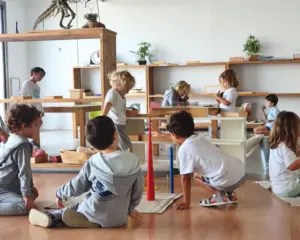
At IMS Sotogrande, our Nido (0-3 years) environments are designed so that every object invites sensory exploration. But you can replicate many of these principles at home without transforming your living room. The key lies in three ideas: accessibility , order , and choice .
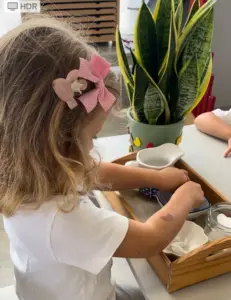
Place materials within the child’s reach on low shelves, not in closed boxes. Offer one activity at a time on a prepared tray: this reduces overstimulation and increases concentration. And allow the child to choose what to repeat and when to stop. If your child wants to spend 40 minutes with the rice, let them: they are in a state of deep concentration that Montessori called “normalization.”

Safety and age-appropriate adaptations
Safety comes first, especially with children under 2 who still put everything in their mouths. Use large materials that cannot be swallowed: wooden spoons, large sensory balls, thick fabric pieces. Always supervise activities with water and small objects.
For children aged 12-18 months, simplify: trays with a single material, large objects, and short activities of 5-10 minutes. Between 18-24 months, add complexity: two materials together, tools like spoons or tongs. From 24-36 months, introduce sorting, pouring, and multi-step activities. Always adapt the activity to your child’s current level, not their chronological age.
Sensory activities that prepare for future learning
You might be surprised to learn that today’s sensory play directly prepares for tomorrow’s reading and writing. When a 2-year-old pours water from one jug to another, they are training the hand-eye coordination they will later use to form letters. When they sort buttons by color or size, they develop logical-mathematical thinking.
The Montessori sensory materials within the prepared environment are designed with this progression in mind. In our Nido and Children’s House at IMS Sotogrande, we see every day how children who arrived exploring chaotically begin to show order, concentration, and precision. This transformation isn’t accidental: it’s the result of offering rich sensory experiences that respect their pace.
Frequently asked questions
When should I start sensory play with my baby?
You can start from 6 months with very simple experiences: fabrics with different textures, rattles with various sounds, or trays with warm water under supervision. From one year onwards, the possibilities multiply. The key is to observe the child: if they show interest in touching, manipulating, or exploring, they are ready for a sensory activity adapted to their developmental level.
What do I do if my child tries to eat the materials?
This is completely normal between 12 and 24 months. The mouth is a legitimate pathway for exploration at this age. Use edible and safe materials: cooked pasta, rice cakes, fruit puree for coloring, fruit cut into large pieces. You can also first offer the material to smell or touch and gently redirect their hand to the tray. Never punish oral exploration: simply choose materials that are safe for it.
How long should a sensory activity last?
It depends entirely on the child. A 15-month-old might concentrate for 5 minutes, which is great. A 2-year-old might stay engaged for 20 or 30 minutes if the activity captivates them. Don’t set timers: observe. If the child repeats an action over and over, they are concentrating. If they get up, look away, or start throwing materials, they are finished. Respect that moment and put the activity away without fuss.
Is sensory play beneficial for children with special needs?
Absolutely. In fact, sensory stimulation is one of the most widely used tools in occupational therapy and special education. At IMS, we have the Rainbow Classroom , specialized in diversity and special educational needs, where sensory activities are part of the daily routine. If your child has sensory sensitivities (hypersensitivity or hyposensitivity), consult a professional who can guide you on which types of stimuli will benefit them most.
Key takeaways
Sensory play for toddlers doesn’t require expensive materials or hours of preparation. It needs your presence, simple household materials, and the trust to let your child explore at their own pace. Every tray of rice, every scent jar, and every pouring activity are building blocks for their cognitive, emotional, and motor development.
Start today with just one activity: fill a tray with flour, hide three large objects, and place it on a low shelf. Observe what your child does without intervening. If you’d like to see how these experiences are integrated into a professional Montessori environment, book a tour of our Nido or Children’s House in Sotogrande. We’ll be delighted to show you how we cultivate childhood every day.