
Why Won’t My Child Listen? Positive Parenting Strategies from a Montessori School
In short
When your child won’t listen, it sets off alarm bells for any parent. You’ve spent ten minutes asking them to put on their shoes and they’re still engrossed with their blocks. It’s not that they’re ignoring your authority, at least not in most cases.

When your child won’t listen , it sets off alarm bells for any parent. You’ve spent ten minutes asking them to put on their shoes and they’re still engrossed with their blocks. It’s not that they’re ignoring your authority, at least not in most cases. Their brain is in a period of major reorganization, and automatic obedience isn’t what their body is asking for. In this article, you’ll understand what’s really behind this behavior and what you can do today to change the dynamic without yelling or punishments.
- Disobedience between ages 2 and 6 is largely a neurological impulse for autonomy, not a personal challenge.
- A prepared environment and visible routines drastically reduce conflicts.
- Offering real choices within clear limits is your most powerful tool.
- Connecting emotionally before requesting a behavior multiplies cooperation.
- Asking once, in a normal tone and making eye contact, changes the outcome.
- Why Your Child Won’t Listen: It’s More Than Just a Phase
- How a Prepared Environment Influences Cooperation
- The Two-Choice Technique: From “No” to “You Decide”
- Connect Before You Correct: The Secret Few Practice
- What to Do When Disobedience Is a Constant Pattern
- How We Do It at IMS Sotogrande
- Frequently Asked Questions
- Key Takeaways
Why Your Child Won’t Listen: It’s More Than Just a Phase
The first step to stop feeling like your child is defying you is to understand what’s happening in their head. Between 18 months and 6 years, the brain goes through a period of will explosion. The child discovers they are a separate being and wants to test it constantly. It’s not an educational failure: it’s a developmental milestone. When it comes to child won’t listen, it pays to listen to what families and lead guides actually report.
The Association Montessori Internationale (AMI) explains it this way: the child from 0 to 6 absorbs their environment with all their senses and builds their identity through action. When you say “don’t touch that” and they touch it, they are not being disobedient in the adult sense. They are responding to an internal need to explore that, in that moment, is stronger than any verbal instruction. Daily practice with child won’t listen reveals nuances no handbook fully captures.
If your child is also sleeping poorly, hungry, or has just arrived from school with a saturated nervous system, obedience becomes literally impossible. The prefrontal cortex, the brain area that regulates impulse control, doesn’t fully mature until age 25. In a 4-year-old, it works intermittently. Asking them to always obey is asking them something they biologically cannot fulfill.

How a Prepared Environment Influences Cooperation
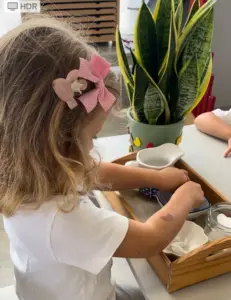
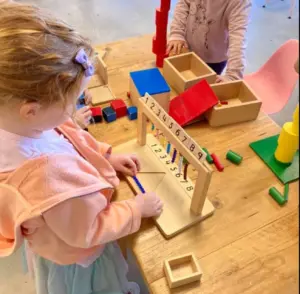
A child who refuses to pick up their toys often isn’t clear on where everything goes, or the volume of objects is simply overwhelming. In Montessori pedagogy, the classroom is designed so the child can act with autonomy: shelves at their height, limited materials, and an exact place for each piece. That same logic works at home.
Start by reducing the number of visible toys. Place only eight or ten pieces on an open shelf and store the rest in a cupboard. Label boxes with photos. You’ll see how your child starts picking up without you having to ask three times, because now they know exactly what is expected of them. The conflict wasn’t disobedience: it was confusion.
Book a personalized school visit and discover how a prepared environment makes a difference from the early years.

The Two-Choice Technique: From “No” to “You Decide”
Asking a child to do something in an imperative tone activates their resistance impulse. On the other hand, offering them two acceptable choices gives them a sense of control and multiplies cooperation. It’s not manipulation: it’s respect for their growing need for autonomy.
Examples That Work at Home
Instead of “put on your shoes,” try “do you prefer the blue sneakers or the red ones?” Instead of “pick up now,” say “do you want to start with the blocks or the cars?” Both options lead to the same result, but the child feels they participate in the decision. The difference is enormous: you go from a battle to a conversation.
This works especially well in the critical moments of the day: dressing time, the transition from one activity to another, and bedtime preparation. These are moments when the child is already managing a complicated internal transition. If you also take away control, an explosion is guaranteed.

Connect Before You Correct: The Secret Few Practice
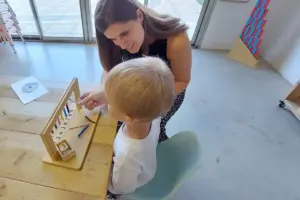
Before giving an instruction, make sure your child is really listening to you. Getting down to their level, gently touching their shoulder, and waiting for them to look at you completely changes the reception of the message. It seems obvious, but most “you’re not listening to me!” shouts come from another room.
Neuroscience confirms it: when a child is in full activity (playing, drawing, climbing), their brain is in focused beta waves. Your voice arrives as background noise. If before speaking you offer eye contact and a gentle physical touch, you help their brain switch channels and pay attention to you. That’s not giving in: it’s facilitating their ability to respond to you.
What to Do When Disobedience Is a Constant Pattern
If your child won’t listen habitually, it’s not just about age. There may be factors overloading their nervous system: too much screen time, lack of outdoor movement, chaotic routines, or too many extracurricular activities. Children need unstimulated time to process the day and self-regulate.
Another common cause is that the instructions you give are too vague or too long. “Behave” tells them nothing. “When you finish eating, put your plate in the sink” is a clear, concrete, and executable instruction. Also, avoid sermons: a 5-year-old cannot retain a three-minute speech about why they shouldn’t throw the ball inside the house. A brief and direct phrase is enough.
If, despite adjusting the environment, routines, and the way you ask, disobedience persists with great intensity, it’s worth consulting a professional. It’s not a failure: it’s parental intelligence. A pediatric neurologist or child psychologist can rule out situations that require specific support.
How We Do It at IMS Sotogrande
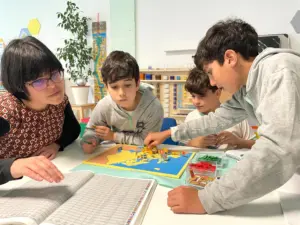
In the classrooms at IMS, we work every day with children who say “no” frequently, and we see it as a sign of health. The difference is that the Montessori environment is designed to channel that energy instead of fighting it. Each material has an order, each shelf is within the child’s reach, and each guide knows that asking for “blind obedience” does not educate: it only silences.
Our AMI guides apply exactly the strategies I’ve described: connection before instruction, choices within limits, and an environment that reduces confusion to a minimum. When parents visit us, the first thing they notice is the silence. It’s not silence of repression, but silence of children concentrated on what they have chosen to do. That is the magic of a prepared environment.
Frequently Asked Questions
Is it normal for my 3-year-old not to listen to me?
Yes, it’s completely normal. At age 3, the brain goes through a peak in autonomy development. The child isn’t ignoring you out of defiance: they’re testing their ability to make decisions. If you offer choices within clear limits and stay calm, cooperation comes without the need for punishments.
When should I be concerned about disobedience?
When the behavior persistently interferes with their daily life: they cannot follow any instruction, are consistently aggressive with other children or adults, or show disproportionate reactions to minimal changes. In those cases, consult with a pediatric neurologist or child psychologist to rule out specific needs for support.
Do punishments work to make my child obey?
Punishments may produce immediate obedience out of fear, but they don’t teach the child why a behavior is inappropriate. According to the American Academy of Pediatrics (AAP), natural consequences and firm but respectful limits generate real long-term learning. Punishment only postpones the problem without solving it.
Is it better to ignore tantrums or intervene?
Don’t ignore the child or the emotion. They are feeling something real and need to know you are there. Stay close, validate their feeling (“I see you’re very angry”), and wait for them to calm down before talking about the behavior. Connecting with the emotion isn’t giving in: it’s teaching them to manage what they feel.
Key Takeaways
Your child who won’t listen isn’t disrespecting you: they’re growing and need your guidance, not your anger. Preparing the environment, offering choices, connecting before asking, and maintaining clear limits calmly are the tools that truly transform family dynamics. It won’t change in a day, but every time you choose connection over punishment, you’ll be laying the foundation of a relationship based on trust.
If you want to see how we apply all of this in a real environment, we invite you to visit IMS Sotogrande. Book your appointment in the admissions section and discover first-hand how a Montessori school supports children on their path to autonomy without losing mutual respect.