
My Child Won’t Listen: Why It Happens and What to Do (Montessori Tips)

When your child won’t listen, it’s easy to feel frustrated, doubt your parenting, or even feel embarrassed in public. However, this resistance has real roots that are worth understanding before reacting. It’s not a personal attack or a sign that something is wrong: it’s part of development.
- Key Takeaways
- Why your child won’t listen: what no one explains
- The most common mistake when a child won’t listen
- Montessori strategies to stop repeating the same orders
- What if they still won’t listen? When resistance is intense
- The difference between obedience and cooperation
- What studies say about respectful discipline
- Frequently asked questions
- Key conclusions
Key Takeaways
- Childhood defiance is almost always a way of communicating an unmet need or an unclear boundary.
- Children aged 2 to 6 are in a critical period for autonomy: their “no” is a tool for growth.
- The Montessori approach focuses on guiding rather than demanding blind obedience, which reduces daily battles.
- Tantrums and resistance decrease when the environment is prepared and expectations are realistic.
- Asking for help isn’t failing: at IMS, we support families in the Campo de Gibraltar area with practical tools from Nido through Taller.

Why your child won’t listen: what no one explains
Before looking for techniques to make your child “listen,” it’s worth understanding what’s really happening. A child who doesn’t obey is rarely a rebellious or ill-mannered child. In most cases, they are going through one of these situations. When it comes to child won’t listen, it pays to listen to what families and lead guides actually report.
First, they may be exercising their autonomy. Between 18 months and 3 years, a child’s brain is programmed to say “no.” It’s their way of testing boundaries and discovering they are a separate person from you. Second, they might not understand the instruction: sometimes we ask for things that are too abstract for their age. Third, they may be tired, hungry, or overstimulated. The body is in charge, and when a child is hungry or sleepy, cooperation collapses.
At IMS, we work with this every day with families from Sotogrande, La Línea, Algeciras, and the surrounding area. The first thing we do is observe: what is the child feeling at that moment? Is the request appropriate for their age? Does the environment allow them to cooperate, or is it putting obstacles in their way?

The most common mistake when a child won’t listen
The mistake most parents make (and one I made myself before training as a Montessori guide) is repeating the order louder. Yelling “Come here now!” three times doesn’t educate. It only escalates the conflict. The child learns that the first time doesn’t matter and that you only react when you’re already out of control.
Another common mistake is offering long explanations at the wrong moment. A 3-year-old in the middle of a tantrum cannot process a speech about why they need to pick up their toys. Their limbic brain is fully activated and the prefrontal cortex (the part that reasons) is offline. Long words reach a brain that cannot listen.
The solution? First, reconnect. Then, direct.

Montessori strategies to stop repeating the same orders
The Montessori approach doesn’t seek blind obedience. It aims for the child to understand the “why” and choose to cooperate because they feel respected and capable. This doesn’t mean there are no boundaries. It means boundaries are set with clarity, warmth, and consistency.
Bring your body to their level
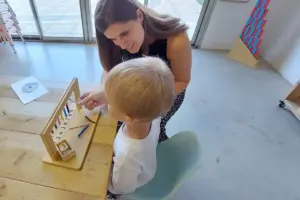
Instead of yelling from the kitchen “Let’s eat dinner!”, come close, crouch to their eye level, and say their name. Eye contact and physical proximity change communication. In the Children’s House classroom at IMS, guides do this constantly: they approach, wait for eye contact, and speak softly. It works because the child feels seen, not threatened.
Offer two real choices
Children need to feel they have some control. Instead of “Put on your shoes!”, try: “Would you like to put on your shoes or your coat first?” Both options lead to the same result, but the child feels they are participating in the decision. This works from about 2.5 years old.
Use affirmative phrases instead of negative ones
“Don’t run” tells the child’s brain exactly what they’re doing, but doesn’t offer an alternative. “We walk here” gives a clear, positive instruction. In the prepared Montessori environment, this is fundamental: instead of filling the space with “don’t touch,” “don’t do,” we create environments where the child can act freely within limits.
What if they still won’t listen? When resistance is intense
There are days when no strategy seems to work. Children aren’t robots, and there are moments when emotion overwhelms them. In those cases, the most important thing is for you to stay calm.
It’s not about being a perfect parent. It’s about being a regulated parent. If you lose your temper, the child loses their sense of security. Breathe deeply, remember it’s not personal, and accompany the emotion without trying to eliminate it. “I see you’re very angry. I’m here with you.” That’s enough.
If the resistance is constant and very intense, if the child hurts other children or themselves, or if you feel you’ve exhausted your resources, don’t hesitate to seek professional support. At IMS, we have the Rainbow classroom, specialized in diversity and special educational needs, where we work with families to find the right path for each child.
Book a personalized school visit
The difference between obedience and cooperation
Many adults confuse obedience with good behavior. A child who obeys out of fear isn’t learning to be responsible: they’re learning to avoid punishment. A child who cooperates because they understand the boundary and feel respected is developing skills that will serve them for life.
Maria Montessori said it clearly: “The obedient child is never free.” It’s not about raising children without rules, but about raising children who choose to do the right thing because they understand it, not because we yell at them. This approach requires more patience at first, but the results in the medium and long term are very different.
We see this in school every day: Taller children (ages 6-12) who came to Nido years ago are autonomous, respectful people capable of resolving conflicts without an adult telling them what to do. It’s not magic. It’s consistency from age 0.
What studies say about respectful discipline
Research in educational neuroscience supports what Montessori intuited over a century ago. A study published by the American Academy of Pediatrics shows that yelling and physical punishment generate the same stress patterns in a child’s brain as abuse. It’s not an opinion: it’s neuroscience.
On the other hand, the Association Montessori Internationale (AMI) has been documenting for decades how prepared environments and respectful guidance reduce challenging behaviors sustainably. It’s not about the child never facing a boundary, but about that boundary being presented without emotional violence.
Frequently asked questions
Is it normal that my 2-year-old won’t listen?
Yes, it’s completely normal and expected. At 2 years old, the brain is in full development of the sense of autonomy. The “no” is their way of saying “I exist as a separate person.” It’s not disobedience: it’s a developmental milestone. If you want to support this stage with tools, our Montessori Nido in Sotogrande works on exactly this.
What do I do if my child hits me when I ask for something?
Stop the action calmly, without yelling or giving long explanations. Gently hold their hands and say: “I won’t let you hit. I’m here with you.” Then, once they’ve calmed down, you can talk about what they’re feeling. At IMS, we teach children to identify and express emotions from Nido, because a child who can name their feelings hits less.
Can the Montessori method help with a very stubborn child?
Stubbornness is misdirected energy. A “stubborn” child is usually a very determined child who needs environments where they can make real decisions. Montessori offers exactly that: materials they can choose, tasks they can complete alone, and adults who trust in their capability. “Stubbornness” becomes initiative. If your child is between 3 and 6 years old, our Children’s House is a good place to see this in action.
When should I worry about my child’s disobedience?
You should consult a professional if the behavior is constant for months, if the child regularly hurts others or themselves, if there’s a sudden change in behavior without apparent cause, or if you feel the situation is overwhelming and affecting the whole family. At IMS, we have the Rainbow classroom, specialized in diversity, where we evaluate and support each case individually.
Key conclusions
Your child won’t listen because their brain is learning to be an autonomous person. It’s not a problem with your parenting or their character: it’s a process that needs guidance, not control. Montessori tools work because they respect the child’s rhythm without giving up clear boundaries.
If you want to see how this is applied in a real classroom, with AMI-certified guides and a trilingual environment, we invite you to visit IMS Sotogrande. You can book a personalized visit or write to us at [email protected]. We are 15 minutes from La Línea and 25 from Algeciras: families from across the area choose us because the difference is noticeable from day one.